
Most wedding hotels believe their problem is “not getting enough leads.”
In reality, that’s rarely the issue.
The real problem is that there is no structured funnel. Leads come in randomly, conversations are inconsistent, follow-ups are delayed, and conversions depend more on luck than system.
That’s why some properties get dozens of inquiries but still struggle to close bookings, while others with fewer inquiries consistently fill their wedding calendar.
The difference is not marketing spend.
The difference is funnel clarity.
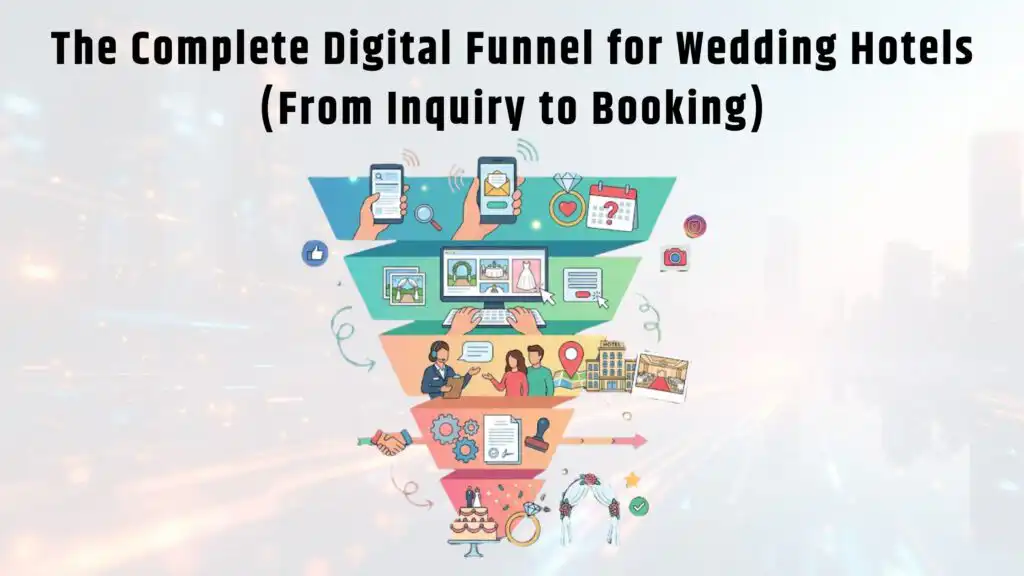
If you truly want predictable, high-value wedding bookings, you need to understand and optimize every stage of the journey:
Ad → Instagram → Landing Page → WhatsApp → Site Visit → Booking
Let’s break this down like a real system—not theory.
Stage 1: Ads – Where the First Impression Happens
This is where your funnel begins.
A couple scrolling Instagram or searching on Google sees your ad. In that moment, you have less than 3 seconds to make them stop.
What should happen here is simple:
The user should immediately understand that your property is a wedding venue, not just a hotel.
But most ads fail at this stage.
They show rooms, generic visuals, or “luxury stay” messaging. This attracts travelers, not wedding prospects. Even if you get clicks, they are low-intent.
Drop-off happens when:
The user does not relate to the ad
The messaging feels generic
The visuals do not reflect weddings
Optimization here is about clarity and relevance.
Your ads should show real wedding setups, decorated venues, couple moments, and scale. The messaging should speak directly to someone planning a wedding, not a vacation.
When your ad qualifies the audience before they click, everything downstream improves.
Stage 2: Instagram – Where Trust Begins
Once someone clicks your ad or searches your property, the next place they go is your Instagram.
This is your digital showroom.
In seconds, the user decides whether your property is worth considering.
What should happen here:
They should feel, “This place hosts beautiful weddings.”
But here’s where most hotels lose potential clients.
Their Instagram looks like a hotel page, not a wedding venue.
Random posts, food pictures, room shots, festival greetings—none of this helps a couple imagine their wedding.
Drop-off happens when:
The feed lacks wedding content
There is no consistency in positioning
The page does not build aspiration
Optimization here is about storytelling.
Your Instagram should feel like a curated wedding experience. Real events, transformations, emotions, and moments should dominate your feed.
When done right, Instagram doesn’t just build trust—it pushes the user to inquire.
Stage 3: Landing Page – Where Interest Becomes Action
Now the user is interested.
They click your website link, expecting clarity.
This is a critical stage. If your landing page is not designed for weddings, you lose the lead.
What should happen here:
The user should quickly understand your wedding offering and feel confident enough to take the next step.
But most hotels send traffic to their homepage.
And that’s where the problem starts.
A homepage talks about rooms, amenities, and general information. It does not answer wedding-specific questions.
Drop-off happens when:
The user cannot find wedding details
The page feels generic
The inquiry process is complicated
Optimization here is about focus.
A dedicated wedding landing page should showcase real weddings, highlight your venue capacity, and clearly guide the user toward inquiry.
Clarity reduces friction.
Less friction increases conversions.
Stage 4: WhatsApp / Inquiry – Where Speed Decides Everything
Once the user submits an inquiry or messages you, the game changes.
Now it’s not about marketing—it’s about response.
What should happen here:
The user should receive an immediate, structured response that builds confidence and moves them forward.
But in most cases, this stage is completely unstructured.
Replies are delayed. Messages are generic. Follow-ups are inconsistent.
Drop-off happens when:
Response time is slow
Communication lacks clarity
The conversation does not guide the user
Optimization here is about speed and structure.
Instant acknowledgment, quick sharing of relevant details, and a clear next step—usually a site visit—are critical.
In wedding sales, the first responder often wins.
Stage 5: Site Visit – The Real Conversion Point
This is the most important stage in the entire funnel.
No matter how strong your marketing is, most bookings happen after a site visit.
What should happen here:
The couple should experience your property in a way that reinforces everything they saw online.
But many hotels treat site visits casually.
There is no structured walkthrough, no storytelling, no effort to create a memorable experience.
Drop-off happens when:
The visit feels unplanned
The property is not presented well
The experience does not match expectations
Optimization here is about experience design.
From the moment the couple arrives, every interaction should be intentional. The way you show your spaces, explain setups, and answer questions should build excitement.
A strong site visit converts interest into emotional commitment.
Stage 6: Booking – Where Systems Beat Emotions
Even after a successful site visit, bookings are not guaranteed.
Multiple venues are being evaluated. Decisions involve families, budgets, and comparisons.
What should happen here:
The couple should feel confident, reassured, and ready to finalize.
But this is where many hotels lose deals.
Follow-ups are weak. Communication is inconsistent. There is no urgency.
Drop-off happens when:
There is no structured follow-up
The client loses momentum
Another venue engages better
Optimization here is about consistency.
Timely follow-ups, clear communication, and gentle urgency can significantly improve conversions.
Booking is not just about closing—it’s about maintaining momentum.
The Real Insight: Every Stage Multiplies the Next
Most hotels focus only on the top of the funnel.
They think more ads = more bookings.
But the truth is, every stage affects the next.
If your ads are generic, your leads are weak.
If your Instagram is poor, your trust drops.
If your landing page is unclear, your conversions fall.
If your response is slow, your leads go cold.
If your site visit is average, your bookings don’t happen.
This is not a marketing problem.
This is a system problem.
From “Running Ads” to “Building a Booking Engine”
This is where the real differentiation happens.
Any agency can run ads.
Very few can build a complete funnel.
When your entire journey is optimized—from first impression to final booking—you don’t depend on luck anymore.
You create a predictable system where:
Right audience sees your property
Right message builds interest
Right experience builds trust
Right process drives conversion
And that is how wedding hotels scale.
Final Thought: You Don’t Need More Leads—You Need a Better Funnel
If you are already getting inquiries but struggling to convert them, the answer is not increasing your ad budget.
It is fixing your funnel.
Because in wedding marketing, success is not about how many people see you.
It’s about how many people move from:
Seeing → Feeling → Visiting → Booking
And that journey is not accidental.
It is designed.
Ready to Build Your Wedding Booking Funnel?
If your property has the potential to host weddings but your inquiries are inconsistent or conversions are low, it’s time to look beyond campaigns.
Because the hotels that are winning in 2026 are not the ones running ads—
they are the ones running systems.
Build a powerful wedding booking funnel that converts inquiries into confirmed events — get started now.
Follow us on Instagram:- @brand_chanakya