 Special Offer - Flat 18% off on annual payments!


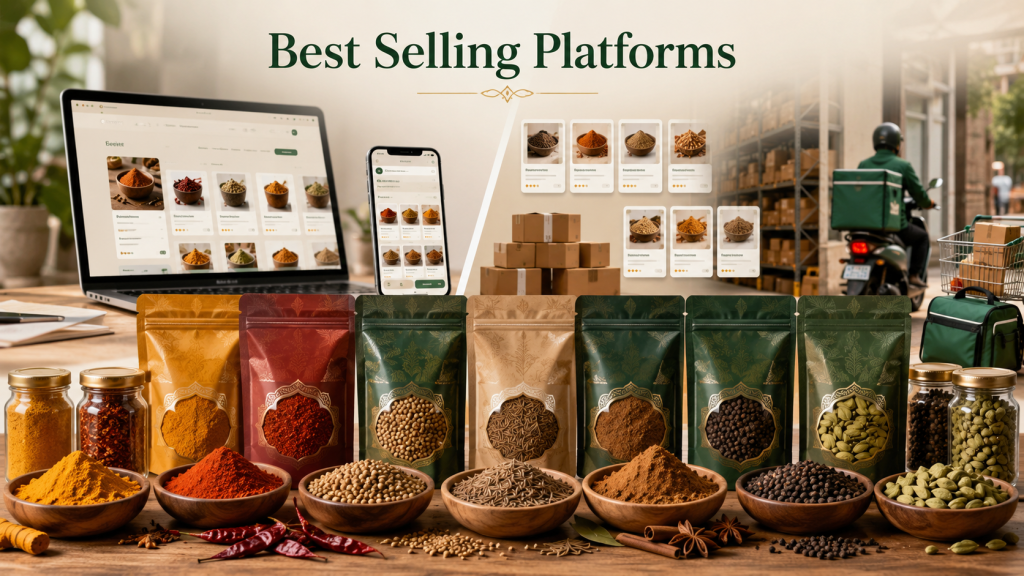
Best platform to sell spices online in India: Amazon is the top choice for most brands — largest customer base, built-in traffic, and FBA logistics. Combine with Flipkart for Tier 2/3 reach, Blinkit/Zepto for impulse buyers, and a D2C website (Shopify/WooCommerce) for maximum margins and customer data ownership.
Table of Contents
Choosing the best platforms to sell spices online in India is one of the most important decisions for any spice brand looking to grow digitally. Each platform serves a different audience, follows unique commission structures, and comes with its own operational requirements.
The wrong choice can waste both time and money, while the right platform can accelerate your brand’s growth and profitability. This guide compares India’s leading ecommerce channels for spice brands — Amazon, Flipkart, quick commerce (Blinkit, Zepto, Instamart), and D2C websites.
Platform Overview
300M+ customers. Best for scale & discovery.
Strong Tier 2/3 reach. Lower commissions.
10–15 min delivery. Impulse + repeat buyers.
Highest margins. Own customer data fully.
Master Comparison Table
| Factor | 🟠 Amazon | 🔵 Flipkart | ⚡ Quick Commerce | 🌐 D2C Website |
|---|---|---|---|---|
| Commission | 15–18% | 12–15% | 18–25% | 2–4% (gateway only) |
| Your Realization | 70–78% of MRP | 75–82% of MRP | 62–72% of MRP | 85–92% of MRP |
| Traffic | Built-in, high | Built-in, high | Built-in, moderate | You generate |
| Customer Data | No access | No access | No access | Full ownership |
| Competition | Very high | High | Moderate | None (your store) |
| Delivery Speed | 1–3 days (Prime) | 2–4 days | 10–15 minutes | 3–7 days (3PL) |
| Setup Time | 1–2 weeks | 1–2 weeks | 4–8 weeks | 2–4 weeks |
| Min Investment | ₹50K–1L | ₹30K–75K | ₹2L–5L | ₹50K–2L |
| Best For | Scale, discovery | Value segment | Impulse, repeat | Margins, brand |
Amazon India: Deep Dive
🟠 Amazon India
Amazon is where most spice brands should start. It has the largest customer base, sophisticated search and discovery, and Prime’s fast delivery builds trust. For spices, Amazon captures the “planned purchase” customer — someone specifically searching for turmeric powder or garam masala.
Commission Structure: 15–18% referral fee + ₹30–50 closing fee + FBA fees. After all fees, expect 70–78% of MRP.
What Works: Everyday spices (turmeric, red chili, coriander), bulk/value packs, combo sets, organic/premium positioning, brands with strong packaging and A+ content.
✓ Advantages
- Massive built-in traffic (300M+ customers)
- Trust factor — customers buy confidently
- FBA handles logistics and returns
- A+ Content, Brand Store for storytelling
- Powerful advertising platform (PPC)
- Prime badge increases conversions
✗ Challenges
- Intense competition, price wars
- No customer data ownership
- Advertising costs keep rising
- Complex fee structure
- Risk of account suspension
- Reviews can make or break you
Flipkart: Deep Dive
🔵 Flipkart
Flipkart is India’s homegrown marketplace with particularly strong reach in Tier 2/3 cities. The audience is slightly more value-conscious than Amazon’s. For spice brands targeting middle India, Flipkart can be more profitable due to lower commissions and less competition.
Commission Structure: 12–15% commission + fixed fees. After all fees, expect 75–82% of MRP — typically better than Amazon.
What Works: Value packs, regional spices, everyday essentials. Less crowded premium segment than Amazon.
✓ Advantages
- Lower commissions than Amazon
- Strong Tier 2/3 city reach
- Less competition in many categories
- Big Billion Days = massive sales spike
- Flipkart Assured builds trust
✗ Challenges
- Smaller traffic than Amazon
- Price-sensitive audience
- Weaker advertising tools
- No customer data ownership
- Slower seller support
Quick Commerce: Deep Dive
⚡ Blinkit, Zepto, Instamart
Quick commerce is the fastest-growing channel for spices. These platforms deliver in 10–15 minutes, capturing the “I need it now” moment. When someone runs out of jeera while cooking, they order from Blinkit — not Amazon. This impulse nature is powerful for spice brands.
Commission Structure: 18–25% commission + logistics (if applicable). After all fees, expect 62–72% of MRP. Lowest margins but unique value.
What Works: Small packs (50–100g), essential spices, specialty blends, regional masalas. Impulse-friendly items.
✓ Advantages
- Captures impulse purchases
- High repeat purchase rate
- Premium pricing accepted
- Growing 80% YoY
- Less price comparison
- Brand discovery opportunity
✗ Challenges
- Highest commissions (18–25%)
- Complex onboarding (4–8 weeks)
- Large inventory requirements
- Limited to metro cities
- Strict packaging compliance
- No customer data
D2C Website: Deep Dive
🌐 Your Own Shopify / WooCommerce Store
A D2C website is your own storefront. No marketplace commissions, full customer data ownership, and complete brand control. The catch: you need to drive all traffic yourself through SEO, ads, and marketing.
Cost Structure: 2–4% payment gateway fee + Shopify subscription (₹2,000–5,000/month) + marketing costs. After all costs, you retain 85–92% of revenue.
What Works: Subscription boxes, premium/organic spices, gift sets, brand storytelling, customer loyalty programs.
✓ Advantages
- Highest margins (85–92%)
- Full customer data ownership
- Build direct relationships
- Subscription model possible
- No competition on your site
- Complete brand control
✗ Challenges
- No built-in traffic
- Marketing costs add up
- Trust barrier for new customers
- Logistics management
- Website maintenance
- Takes time to scale
Which Platform for Your Situation?
🚀 “I’m just starting out with a limited budget”
Start with Amazon. It has built-in traffic, FBA handles logistics, and you can start with 5–10 SKUs. Invest in good listings and basic PPC. Once you hit ₹2–3L/month, add Flipkart.
💎 “I have a premium / organic spice brand”
Start with Amazon + D2C. Amazon for discovery and credibility, D2C for margins and brand building. Premium customers research before buying — a strong website helps. Consider Zepto for premium-focused quick commerce later.
🏭 “I’m an established brand with production capacity”
Go multi-channel: Amazon + Flipkart + Quick Commerce (Blinkit first) + D2C. Maximize reach across all touchpoints, as each channel serves different customer needs.
🏠 “I want to sell regional / specialty spices”
Start with Amazon + D2C. Regional spices have dedicated audiences who actively search. SEO-driven D2C works well. Quick commerce may not carry niche demand.
📦 “I want maximum volume / scale”
Focus on Amazon + Flipkart + Blinkit. These three platforms together cover most of India’s online grocery shoppers. Optimize for volume, not margins.
The Multi-Channel Strategy
Most successful spice brands don’t choose one platform — they use multiple channels strategically:
Recommended Multi-Channel Mix
🟠 Amazon
Primary volume driver, brand credibility
⚡ Quick Commerce
Impulse purchases, urban penetration
🌐 D2C
Margins, relationships, subscriptions
🔵 Flipkart
Tier 2/3 reach, value segment
Key Multi-Channel Tips
- Maintain consistent pricing across platforms to avoid channel conflict
- Create platform-specific SKUs if needed (smaller packs for quick commerce)
- Centralize inventory management to avoid stockouts
- Use D2C for exclusives — subscription boxes, limited editions
- Allocate ad budgets by ROI, not equally across platforms
✅ Key Takeaways
- Start with Amazon — largest traffic, easiest to launch, FBA simplifies logistics
- Add Flipkart once you reach ₹2–3L/month for Tier 2/3 city reach at lower commissions
- Quick commerce (Blinkit/Zepto) is high-growth but needs ₹2–5L investment and metro inventory
- D2C website gives 85–92% margin retention and full customer data — essential for long-term brand
- The ideal mix: Amazon (40–50%) + Quick Commerce (20–30%) + D2C (15–25%) + Flipkart (10–15%)
Need Help Choosing the Right Platforms?
Brand Chanakya helps spice brands build multi-channel strategies. From platform selection to execution — we handle it all.
Frequently Asked Questions
Which platform is best for selling spices online in India?
+
Amazon is the best platform to sell spices online in India for most brands because it offers the largest customer base, high search visibility, and nationwide delivery. New spice brands can quickly reach millions of shoppers through Amazon, while established businesses often combine Amazon with Flipkart, Blinkit, Zepto, and a D2C website to maximize sales, customer reach, and long-term profitability.
Is Amazon better than Flipkart for spice brands?
+
Yes, Amazon is generally better than Flipkart for spice brands that want wider reach, stronger brand visibility, and higher sales potential across India. Flipkart, however, performs well for value-conscious customers and Tier 2 and Tier 3 cities with slightly lower marketplace commissions. Many successful spice businesses sell on both platforms to reach different customer segments.
Can I sell spices on Blinkit, Zepto, and Instamart?
+
Yes, you can sell spices on Blinkit, Zepto, and Instamart if your products meet their onboarding, packaging, inventory, and quality requirements. These quick commerce platforms are ideal for everyday spices, impulse purchases, and repeat orders in major Indian cities. They help spice brands increase visibility among customers looking for fast grocery delivery.
Should I build a D2C website for my spice brand?
+
Yes, every growing spice brand should build a D2C website to improve profit margins, own customer data, and strengthen brand identity. While marketplaces generate immediate sales, a Shopify or WooCommerce store gives you complete control over pricing, marketing, subscriptions, repeat customers, and long-term business growth through SEO and digital marketing.
Which platform offers the highest profit margins?
+
A D2C website offers the highest profit margins because you avoid marketplace commissions and own the complete customer relationship. Most spice brands retain significantly more revenue on their own website compared to Amazon, Flipkart, or quick commerce platforms. Combining D2C with marketplaces creates a balanced strategy for both profitability and customer acquisition.
What licenses are required to sell spices online in India?
+
To sell spices online in India, businesses typically need an FSSAI license, GST registration (where applicable), and marketplace-specific seller documentation. Additional compliance may be required for exports, private-label brands, or packaged food products. Keeping all regulatory documents updated helps ensure smooth onboarding on Amazon, Flipkart, Blinkit, Zepto, and other ecommerce platforms.
Brand Chanakya
Digital growth agency specializing in ecommerce for food & FMCG brands. ₹1 Cr+ ad spend managed. Based in Udaipur, serving clients across India.