
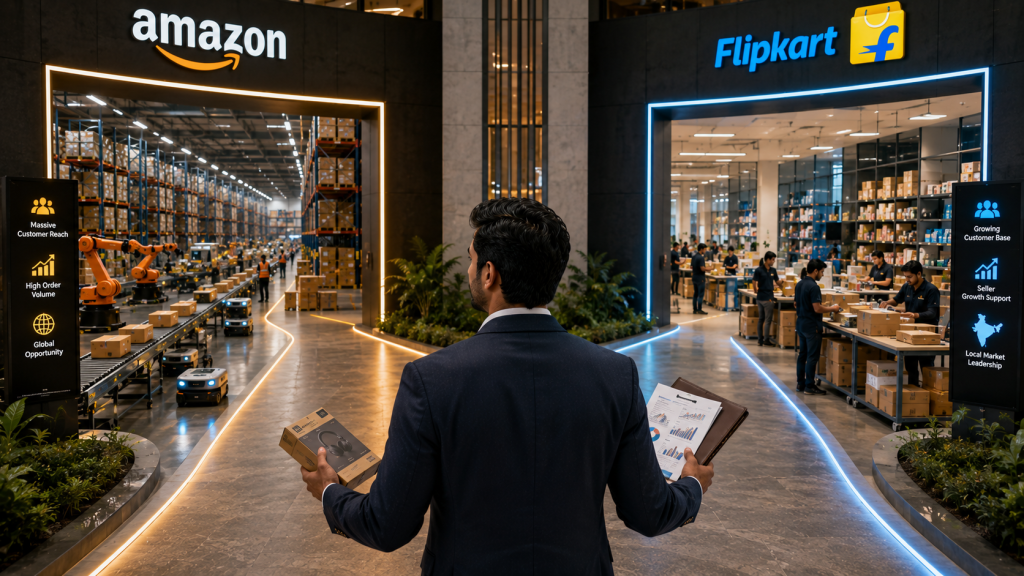
“Should I start on Flipkart or Amazon?” is the first real strategic decision most new online sellers in India face — and most answer it by guessing, or by copying whichever platform a competitor happens to be on. It deserves a proper comparison, because the two platforms reward genuinely different kinds of sellers.
Here’s the honest breakdown across audience, fees, onboarding, category strength and advertising — and a simple framework to decide where your product belongs first.
Flipkart vs Amazon for sellers in India: Flipkart is generally better for first-time sellers, fashion, home and value products under ₹1,000, and tier-2/tier-3 reach via Shopsy. Amazon is generally better for premium, spec-driven and branded products where buyers compare specifications, and where Brand Registry and mature advertising tools matter. Neither platform is cheaper in the abstract — your net margin depends on category, price point and fulfilment choice.
- Audience: Amazon India skews metro and tier-1 comparison shoppers; Flipkart runs deeper into tier-2 and tier-3 India.
- Fees: Both charge commission + fixed fee + collection fee + weight-based shipping, plus 18% GST. Commission bands are broadly comparable.
- Onboarding: Flipkart Seller Hub is easier to start on; Amazon Seller Central is more powerful once you are established.
- Advertising: Amazon’s ad stack is more mature but more competitive; Flipkart PPC often delivers lower cost-per-click in less crowded categories.
Brand Chanakya has managed Flipkart and Amazon seller accounts for Indian brands since 2016.
Who Actually Shops Where
Both platforms reach a massive, overlapping audience, but the centre of gravity differs. Amazon India draws heavy traffic from metro and tier-1 buyers searching with intent — they arrive already comparing brands and specifications. Flipkart’s strength runs deeper into tier-2 and tier-3 India, helped by Hindi-first UX, EMI options tuned for first-time online shoppers, and its zero-commission Shopsy layer aimed squarely at value-conscious buyers in smaller towns.
If your product is a considered, spec-driven purchase — electronics, premium appliances, branded gadgets — Amazon’s audience is primed for that comparison-shopping behaviour. If your product is price-led, fashion, home, or an everyday essential aimed at a broader Indian household, Flipkart (and Shopsy underneath it) tends to convert that audience more naturally.
Commission & Fee Comparison
Both marketplaces charge a similar bundle of fees — commission (referral fee), a fixed/closing fee per order, a collection fee, and weight-based shipping, all with 18% GST stacked on top. The category-by-category commission bands are broadly comparable between the two, and both now run zero-commission bands on low-priced products to protect value sellers. The real differences show up in the fixed fee tiers, the cost of using each platform’s own fulfilment programme (FBF vs FBA), and how aggressively each platform pushes sellers toward paid visibility to compensate for a crowded organic search.
Ease of Onboarding & Account Management
Flipkart’s registration flow is generally considered friendlier for first-time sellers — fewer category-gating restrictions at the entry level, a simpler document set, and a Seller Hub UI built with smaller businesses in mind. Amazon’s Seller Central is more powerful once you’re established, with deeper analytics and Brand Registry tools, but it also has a steeper learning curve and stricter account health thresholds that catch new sellers off guard.
For a founder managing their own account with no prior marketplace experience, Flipkart is usually the lower-friction starting point. For a brand that already has its trademark registered and wants to build a defensible, ad-supported presence from day one, Amazon’s tooling pays off faster.
Don’t want to choose blind?
We audit your product, category and margins against both platforms’ current fee structures and tell you which one to launch on first — and whether you should be on both within six months.
Where Each Platform Wins By Category
| Category | Flipkart Tends To Win | Amazon Tends To Win |
|---|---|---|
| Fashion & apparel | Strong | Moderate |
| Mobiles & electronics | Moderate | Strong |
| Home & kitchen (value) | Strong | Moderate |
| Premium appliances | Moderate | Strong |
| Books & media | Moderate | Strong |
| Beauty & personal care | Strong | Strong |
| Tier 2/3-focused value goods | Strong (via Shopsy) | Moderate |
Directional only — based on typical category demand patterns, not a guarantee for any specific SKU. Always validate with each platform’s own category insights before committing inventory.
Advertising Ecosystem Comparison
Amazon’s ad stack (Sponsored Products, Sponsored Brands, Sponsored Display) is more mature and more heavily used by larger brands, which means more competition for premium keywords but also more precise targeting tools once you’re running campaigns. Flipkart’s advertising suite — PPC, banner placements, and time-bound tools like Lightning Deals — has caught up significantly and often delivers lower cost-per-click in categories where fewer big brands are bidding, which can make early customer acquisition cheaper for a new seller.
A Simple Decision Framework
- Price point under ₹1,000, fashion or home category? Start on Flipkart (and enable Shopsy from day one).
- Considered purchase, premium positioning, need Brand Registry-level tools? Start on Amazon.
- Already selling offline with steady demand and margin to spare? List on both simultaneously and let the data over 60–90 days tell you where to double down.
- Limited team bandwidth to manage two dashboards? Pick one, get it profitable, then expand — running two accounts badly is worse than running one well.
Most of our clients end up on both platforms eventually — but almost none of them should have launched on both on day one. Getting the sequencing right saves months of split attention and ad spend.
Frequently Asked Questions
Should I start selling on Flipkart or Amazon in India?
Start on Flipkart if you sell fashion, home or value products under ₹1,000; start on Amazon if you sell premium, spec-driven or branded products. Flipkart’s shoppers skew price-led and reach deeper into tier-2 and tier-3 India, while Amazon’s audience arrives already comparing brands and specifications.
Brand Chanakya matches the platform to the shopper, not to the competitor — because a product listed where nobody is searching for it will underperform on either marketplace.
Is Flipkart cheaper than Amazon for sellers?
Neither platform is cheaper in the abstract — commission bands on Flipkart and Amazon are broadly comparable. Both charge a commission, a fixed fee per order, a collection fee and weight-based shipping, with 18% GST stacked on top, and both run zero-commission bands on low-priced products.
Your real net margin is decided by category, price point and whether you use FBF or FBA — which is why Brand Chanakya runs both fee calculators side by side before recommending a launch platform.
Which platform is easier for a first-time seller?
Flipkart is easier for first-time sellers. Its registration flow needs a simpler document set, applies fewer category gates at entry level, and the Seller Hub UI is built with small businesses in mind. Amazon Seller Central is more powerful but has a steeper learning curve and stricter account health thresholds.
If you already hold a registered trademark, Amazon’s Brand Registry and A+ content tools start paying off faster than they do for an unbranded seller.
Which marketplace is better for tier-2 and tier-3 city customers?
Flipkart is generally better for tier-2 and tier-3 India. Hindi-first UX, EMI options tuned for first-time online shoppers, and the zero-commission Shopsy layer give it deeper reach into smaller towns and value-conscious households.
If you are launching a value-priced product for a broad Indian household audience, enable Shopsy from day one rather than treating it as a later add-on.
Can I sell on both Flipkart and Amazon at the same time?
Yes, but most new sellers should not launch on both on day one. Running two accounts badly is worse than running one well — pick one platform, get it profitable, then expand within 60 to 90 days once you have margin and bandwidth to spare.
Sellers already doing steady offline volume are the exception: they can list on both simultaneously and let 60–90 days of data decide where to double down.
Key Takeaways
- There is no universally cheaper platform. Commission bands on Flipkart and Amazon are broadly comparable — your real margin is decided by category, price point and whether you use FBF or FBA.
- Match the platform to the shopper, not to your competitor. Comparison-driven, spec-heavy products belong on Amazon first; price-led fashion, home and everyday goods convert better on Flipkart.
- Flipkart is the lower-friction start for new sellers. Simpler documentation, fewer category gates and a Seller Hub built for small businesses — Shopsy adds tier-2 and tier-3 reach at zero commission.
- Amazon rewards brands that are already set up. Trademark, Brand Registry and A+ content make Seller Central pay off faster than it does for an unbranded seller.
- Early ad costs are usually lower on Flipkart. Fewer large brands bidding in many categories means cheaper customer acquisition while you build review volume.
- Sequence, don’t split. Most sellers end up on both platforms — but running one account well beats running two badly. Get the first profitable, then expand in 60–90 days.
Ready To Stop Guessing And Start Growing On Flipkart?
Get a free, no-obligation audit of your Flipkart store. We’ll tell you exactly what’s costing you sales — and what to fix first.