
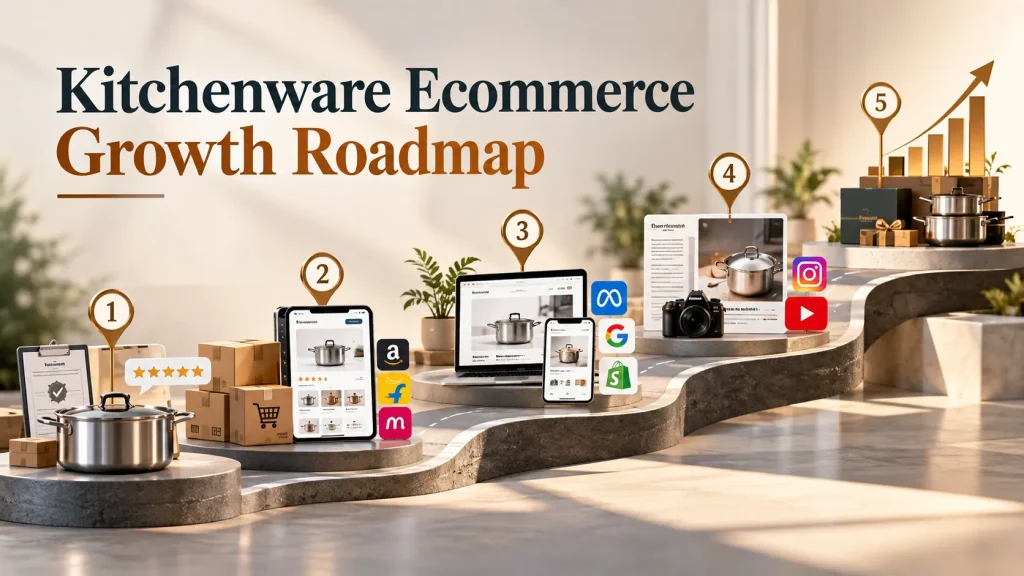
Kitchenware Ecommerce Growth Roadmap: A Step-by-Step Path to Online Growth
Stage 1: Launch Foundations (Months 1-3)
Every successful kitchenware brand’s growth curve starts with unglamorous groundwork: certifications, one strong marketplace listing, and initial reviews. Trying to skip ahead to advertising or influencer marketing before this stage is solid almost always wastes budget.
- Complete BIS and other applicable certifications
- Launch on one marketplace (typically Amazon) with strong lifestyle photography
- Run a modest launch offer to generate your first 20-30 reviews
Warning
Don’t scale ad spend before your listing has enough reviews to convert that traffic. Paying for clicks that land on an unproven listing is one of the most common ways early budget gets wasted.
Stage 2: Marketplace Traction (Months 4-8)
With reviews building, this stage is about expanding marketplace presence and starting to layer in paid advertising deliberately.
| Activity | Focus |
|---|---|
| Add a second marketplace (Flipkart or Meesho) | Broaden reach without overextending resources |
| Amazon Sponsored Products | Steady, measured ad spend on top-performing SKUs |
| First bundle or gift set | Increase average order value |
Stage 3: D2C and Paid Growth (Months 9-14)
Once marketplace sales are consistent, a D2C website becomes worth the investment — primarily for gift sets, bundles, and better margins than marketplaces allow.
- Launch a Shopify store with lifestyle content and a clear brand story
- Introduce Meta Ads targeting past marketplace buyers and lookalike audiences
- Set up Google Shopping ads once the D2C catalog is stable
Expert Tip
Use marketplace reviews as social proof on your new D2C site before it has reviews of its own. Screenshotting verified Amazon reviews (with permission) borrows trust from a platform buyers already believe in.
Stage 4: Content, SEO, and Influencer Layer (Months 15-20)
By this stage, paid advertising alone starts showing diminishing returns as costs rise. This is the point to invest in channels that compound rather than needing continuous spend.
- Build SEO content around common buyer questions — material comparisons, care guides, recipe content
- Partner with regional home-cooking influencers for authentic product demonstrations
- Set up email and WhatsApp retention flows for existing customers
Did You Know?
SEO content published in month 15 often doesn’t show meaningful traffic until months 18-20. Brands that start this layer too late in their roadmap miss a full growth cycle waiting for it to mature.
Stage 5: Scale and Diversify (Months 21+)
With marketplace, D2C, content, and influencer channels all contributing, this stage is about diversifying further — quick commerce for smaller SKUs, expanding into adjacent categories, and deepening seasonal campaign sophistication.
Case Study Example
A stainless steel utensil brand we’ve observed followed a similar staged path — Amazon-only for the first four months, adding Flipkart and their own D2C site by month ten, and only investing seriously in influencer partnerships around month sixteen once their review base and D2C content were established. Their most significant single revenue jump came not from any one channel, but from a well-planned Diwali gift-set campaign executed in their second festive season, once the earlier stages were already in place.
Realistic Revenue Milestones
| Timeline | Realistic Revenue Range |
|---|---|
| Months 1-3 | Early traction, primarily reviews and initial sales |
| Months 4-8 | Steady monthly growth, first seasonal spike captured |
| Months 9-14 | D2C contributing meaningfully, second seasonal cycle |
| Months 15-24 | Multiple channels compounding toward ₹1 crore annualized |
Common Roadmap Mistakes
Common Mistake
Trying to run every channel — marketplaces, D2C, influencers, SEO, and quick commerce — simultaneously from month one. This spreads limited budget and attention so thin that no single channel gets enough investment to actually work.
- •Skipping the review-building stage before scaling ad spend
- •Launching D2C before marketplace demand is validated
- •Starting SEO content too late to matter within the growth window
- •Underinvesting in seasonal campaign planning during the first year
Tracking Progress Along the Way
A roadmap is only useful if you’re checking your actual numbers against it regularly. Rather than waiting until year-end to assess progress, review these markers monthly so you can adjust course while there’s still time to act on what you learn.
| Stage | Signal You’re On Track |
|---|---|
| Months 1-3 | Review count climbing past 20-30 on your primary listing |
| Months 4-8 | Repeat purchase rate starting to appear in your data |
| Months 9-14 | D2C site generating a meaningful, growing share of total revenue |
| Months 15+ | Organic (non-paid) traffic growing month over month |
Adjusting the Roadmap to Your Reality
This roadmap assumes steady, consistent execution — real businesses rarely move in a perfectly straight line. A slower-than-expected review count might mean spending an extra month on Stage 1 rather than rushing into Stage 2. A stronger-than-expected D2C launch might mean pulling forward your influencer partnerships. Use the stages as a sequence to follow, not a rigid calendar to force your business into.
Key Takeaways
- Growth follows stages — foundations, marketplace traction, D2C, content/SEO, then scale
- Reaching ₹1 crore realistically takes 18-30 months of consistent execution
- SEO and content need to start well before you expect returns from them
- Seasonal campaigns, once other foundations are in place, often drive the biggest single jumps
- Running every channel at once from day one usually underfunds all of them
What Changes If Your Category Is More or Less Competitive
This roadmap assumes a moderately competitive kitchenware sub-category. Highly competitive segments like generic pressure cookers or basic steel utensils may need a longer Stage 1 and 2 to build enough reviews to compete with entrenched players. Less competitive niches — specialty cast iron, artisanal copperware, or a distinctive design angle — can often compress the early stages and reach D2C investment sooner, since less review volume is needed to stand out.
Conclusion
There’s no shortcut to ₹1 crore in kitchenware ecommerce sales, but there is a reliable sequence. Brands that follow it — foundations first, then marketplace traction, then D2C and paid growth, then content and diversification — build durable momentum instead of a series of disconnected campaigns.
Want This Roadmap Mapped to Your Brand’s Stage?
Get a free growth audit with a realistic, staged plan for your kitchenware business.
Frequently Asked Questions
How long does it realistically take a kitchenware brand to reach ₹1 crore in online sales?
Most brands following a structured plan reach this milestone in 18-30 months, depending on category competitiveness and consistency of execution.
Should I launch on Amazon and D2C at the same time?
Most brands should start with one marketplace to validate demand, then add a D2C website once initial traction and cash flow support it.
When should a kitchenware brand start using influencer marketing?
Once the product has at least basic review proof on marketplaces, typically after the first 2-3 months.
Is Google Shopping worth it for kitchenware brands?
Yes, particularly once your D2C website is live, since it captures buyers actively comparing products by price and specification.
How much of the budget should go toward SEO versus paid ads?
Early on, paid ads should dominate since SEO takes months to show results. As the brand matures, shift more toward SEO and content.
What role does quick commerce play in this roadmap?
Quick commerce is usually a later-stage addition, suited to smaller kitchen essential SKUs rather than a starting channel.