
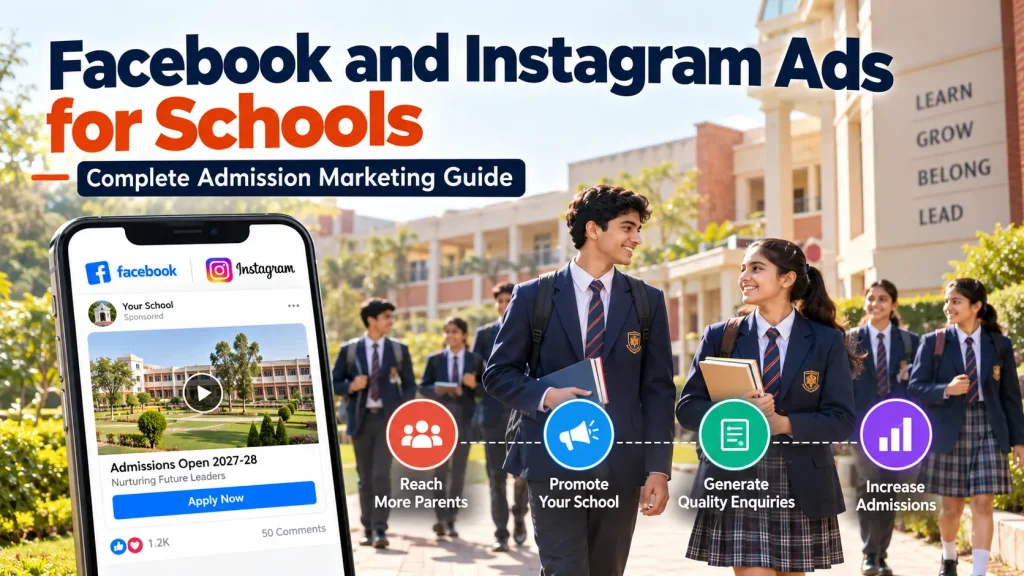
Facebook and Instagram Ads for Schools: A 2027–28 Admission Strategy
Facebook and Instagram Ads for Schools can help educational institutions reach parents earlier in the admission journey, showcase their campus and faculty, promote open houses, and generate qualified enquiries. With the right audience targeting, creative strategy, lead forms, WhatsApp campaigns and conversion tracking, schools can build awareness and turn social media interest into campus visits and admissions.
Google Search ads work when a parent is actively looking. Facebook and Instagram ads work earlier, when a parent is scrolling at night, not yet searching, but already thinking about next year. That’s exactly when an early-moving school wants to be seen.
This playbook walks through the full 2027-28 season on Meta: how to structure campaigns by phase, who to target, which ad formats to use, what creatives work, how much to spend and how to track admissions rather than clicks. It fits into the broader strategy in our 2027-28 school admissions guide.
01Why Meta ads matter for 2027-28
Parents of school-going children are heavy users of Instagram and Facebook. More importantly, Meta lets you do three things that are hard to do elsewhere:
- Reach parents before they search, so your school becomes one of the first names on their shortlist.
- Show, not tell, with video of your campus, teachers and children that builds trust faster than text.
- Build warm audiences of video viewers and page engagers that you can remarket to all season.
Schools that launch in October 2026 spend the quiet months building these audiences cheaply. By December, when every school starts advertising, they already have thousands of parents who know their name.
02Campaign structure by phase
| Phase | Months | Objective | Audience | Main creative |
|---|---|---|---|---|
| 1. Awareness | Oct–Nov 2026 | Video views / reach / engagement | Broad parents in catchment | Campus tour, principal message, day-in-the-life reels |
| 2. Shortlist | Nov 2026–Jan 2027 | Leads (instant forms) and event registrations | Broad + warm audiences | Open house invite, admissions 2027-28 announcement, testimonials |
| 3. Conversion | Jan–Mar 2027 | Leads, WhatsApp messages | Warm and remarketing audiences | Registration deadlines, campus visit booking, results, FAQs |
| 4. Last seats | Apr–Jun 2027 | Leads, messages | Tight catchment, specific classes | “Limited seats in Class X”, quick admission process |
For the month-by-month view across all channels, see our school admission marketing calendar 2027-28.
03Targeting that works in 2027-28
Location first
For day schools, target a radius around your campus that matches how far families realistically travel, often 5–15 km in cities and wider in smaller towns. Exclude areas you can’t serve with transport. For boarding schools, target the states and cities your students actually come from, and consider NRI audiences if you admit international students. Our guide to SEO for boarding schools covers how that wider catchment changes strategy.
Let the creative do the targeting
Meta’s delivery system now does much of the audience-finding itself, and broad targeting within your location often performs as well as or better than narrow interest targeting. The creative becomes your targeting: an ad that clearly speaks to “parents of children entering Class 1” will find those parents. Test broad targeting against a few interest-based ad sets, and keep what performs.
Warm and custom audiences
- People who watched 50% or more of your campus videos
- Instagram and Facebook page engagers
- Website visitors, especially to the admissions page
- People who opened your lead form but didn’t submit
- Lookalikes of past inquiries or enrolled families, using data you have permission to use
04Choosing the right objective
Awareness / Engagement
For Phase 1. Cheap video views build the warm audiences you’ll convert later.
Leads (instant forms)
Parents submit without leaving Instagram. High volume, but needs qualifying questions.
Leads (website)
Sends parents to your admission page. Fewer but often more serious inquiries.
Messages (WhatsApp)
Starts a WhatsApp chat directly. Works very well for Indian parents who prefer to ask questions first.
Run instant forms and WhatsApp side by side in Phase 2, and let your cost per campus visit, not cost per lead, decide which gets more budget.
05Lead forms that bring serious parents
Instant forms can bring a flood of low-quality leads if they’re too easy. A few changes make a big difference:
- Use the “higher intent” form type, which adds a review step before submission.
- Ask 2–3 qualifying questions: class applying for, area of residence, preferred time for a call.
- Write a clear intro: what happens after they submit (“Our admissions team will call you within 2 hours”).
- Show a fee range or “fees from” if your school is comfortable with it. It filters out mismatched inquiries.
- Connect the form to your CRM or at least to instant WhatsApp and email alerts, so no lead waits.
0612 creative ideas that fill seats
- Principal’s 45-second welcome for the 2027-28 session, filmed on campus.
- “A day in Class 1” reel from morning assembly to home time.
- Parent testimonial, unscripted, in the language your parents speak.
- Safety walkthrough: gate, CCTV, transport tracking, medical room.
- Teacher introductions for the entry classes.
- Open house invitation with date, time and a clear “register” button.
- Results and achievements carousel, specific and verifiable.
- Facility tour: labs, library, sports, activity rooms.
- “Admissions 2027-28 open” announcement with key dates.
- FAQ reels: “What is the admission age for Nursery?”, “Is transport available in [area]?”
- Student voice: older students describing what they love about the school.
- Deadline reminder for registration or fee submission, for remarketing only.
Refresh creatives every 2–3 weeks during peak months. The same video shown to the same parents ten times starts to work against you.
07Budgets and benchmarks
Plan your Meta budget backwards from the seats you need. If you need 100 new admissions, convert about 10% of inquiries, and pay about ₹250 per inquiry, you need around 1,000 inquiries and roughly ₹2,50,000 in ad spend across the season.
| Phase | Share of Meta budget | What to watch |
|---|---|---|
| Awareness (Oct–Nov) | 20–25% | Cost per video view, audience size |
| Shortlist (Nov–Jan) | 40–45% | Cost per lead, lead-to-visit rate |
| Conversion (Jan–Mar) | 20–25% | Cost per visit, cost per admission |
| Last seats (Apr–Jun) | 10% | Seats filled in target classes |
These are planning ranges, not guarantees. Cost per inquiry varies with city, competition, fees and creative quality.
08Policy and compliance pitfalls
- Don’t call out personal attributes. Meta’s policies restrict ad copy that implies you know something personal about the viewer. “Worried your child is falling behind?” can be rejected; “Helping every child learn at their own pace” is fine.
- Get consent for children’s images. Use photos and videos only with written parental consent, and avoid showing children’s full names.
- Be truthful about results and facilities. Exaggerated claims damage trust and can attract complaints.
- Check landing pages. Broken links, slow pages or pages that don’t match the ad lead to poor performance and possible rejection.
09Tracking admissions, not clicks
The metric that matters at the end of the season is cost per admission. To see it:
- Install the Meta Pixel and set up the Conversions API for more reliable tracking.
- Tag every lead with its campaign and ad in your CRM.
- Mark each lead’s stage: contacted, visit booked, visited, registered, admitted.
- Where possible, send offline conversion events (visits, admissions) back to Meta so it learns which leads matter.
- Review weekly and move budget toward the campaigns that produce visits and admissions.
If you’d rather have this built and run for you, our performance marketing team manages admission campaigns for schools across India.
10Frequently asked questions
Are Facebook and Instagram ads effective for school admissions?
Yes, especially for reaching parents before they start searching. Video ads build awareness and trust, and lead forms or WhatsApp ads generate inquiries. They work best when combined with Google Search ads, a good admission landing page and fast follow-up.
When should schools start Meta ads for the 2027-28 session?
October 2026 is ideal for an April 2027 session. Early months are used to build awareness and warm audiences at low cost, so that by December and January you can convert parents who already know your school.
How much should a school spend on Facebook and Instagram ads?
Work backwards from the seats you need. With a typical cost per inquiry of ₹150–400 and an inquiry-to-admission rate around 10%, a school needing 100 admissions might plan for ₹1.5–4 lakh in Meta ad spend across the season, depending on location and competition.
Should schools use lead forms or send parents to the website?
Test both. Instant lead forms usually bring more inquiries at a lower cost, while website leads are often more serious. Use higher-intent forms with qualifying questions, and compare channels by cost per campus visit and admission, not cost per lead.
Can schools use children’s photos in ads?
Only with written parental consent. Avoid showing full names, and follow your school’s child protection policy. Many schools use group shots, activities and older students’ voices to keep ads authentic and safe.
Launch your 2027-28 admission campaigns early
We plan, build and manage Meta and Google admission campaigns for schools, tracked all the way to admissions.
📚 You Might Also Like
SEO for Schools and Colleges
Digital Marketing for Schools: Cost in India
How to Choose a Digital Marketing Agency for Schools
School Admission Problems in India