
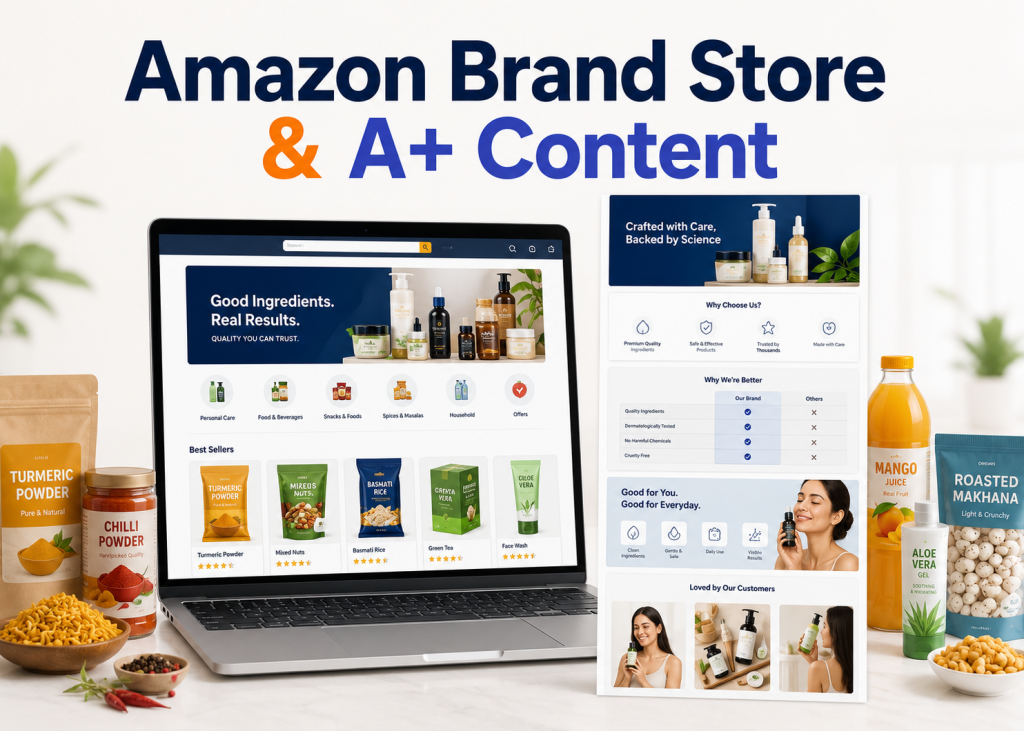
The Real Problem: Why FMCG Brands Lose on Amazon Without A+ Content
Imagine a consumer searching “protein bar” on Amazon. They see 50 results. Your brand is in position 7. They click your listing. They land on — a white page, 5 bullet points, and a single product image on a grey background.
Your competitor in position 9 has a Brand Store, six lifestyle images, a comparison table showing all variants, a video demonstrating the product, and an A+ module explaining exactly why their protein bar is better for post-workout recovery.
Who gets the sale?
This scenario plays out millions of times daily on Amazon India — and FMCG is the category where it matters most. Unlike electronics (where specs sell) or fashion (where images sell themselves), FMCG products compete on trust, ingredient story, and brand perception — exactly what A+ Content and Brand Stores are designed to communicate.
- 📝 Plain text title and 5 generic bullet points
- 🖼️ 1–3 white background product images
- ❓ No ingredient story, no use-case visuals
- 📊 No comparison with other variants or SKUs
- 📉 Higher return rate — unmet expectations
- ⭐ Lower conversion — browser bounces
- 🔗 No cross-sell — single SKU exit
- 🎨 Rich lifestyle images — product in real context
- 📖 Ingredient story, sourcing, benefits — visually told
- 📊 Variant comparison table — upsell built in
- 🎥 Product demo video — 40% better conversion
- 📉 Fewer returns — expectations set correctly
- 🏪 Brand Store link — complete portfolio experience
- 🔄 Higher repeat — brand loyalty built on-platform
What is Amazon A+ Content? (Beyond the Definition)
Amazon A+ Content (formerly Enhanced Brand Content) is a feature available to Brand Registry sellers that allows you to replace the plain product description section with rich, visual content — images, comparison tables, feature callouts, ingredient highlights, and video.
There are two tiers:
Available free to all Brand Registry sellers. Up to 5 content modules. Can include images, text overlays, comparison charts, and feature highlights. Replaces the standard product description.
Free for Brand Registry
Available to brands meeting Amazon’s criteria (typically 5+ A+ listings live). Adds interactive hotspots, larger image modules, video carousels, Q&A modules, and enhanced comparison tables. Amazon reports 84% higher sales vs basic listings.
+84% Sales Lift (Amazon Data)
A+ Content replaces the “Product Description” section on your listing page. The bullet points (above the fold) remain — A+ enhances everything below them, where considered purchase decisions are made.
Below-the-fold conversion tool
📦 Amazon’s Official Data on A+ Content Impact
Amazon’s own internal data shows that Basic A+ Content can drive a 3–10% increase in sales, while Premium A+ Content drives an average 20% increase vs Basic A+ — and up to 84% higher sales compared to listings with no A+ content at all. For FMCG, where purchase decisions are more impulse-driven, the impact is consistently at the higher end of this range.
What is an Amazon Brand Store? The Full Picture
An Amazon Brand Store is a multi-page, dedicated microsite for your brand — inside Amazon. Think of it as your brand’s own section within Amazon where shoppers can explore your entire product range, read your brand story, watch videos, and shop by collection or occasion — without ever leaving Amazon.
It’s free to set up for Brand Registry sellers. But most FMCG brands either skip it or build a bare-minimum one-page version and wonder why it’s not moving the needle.
Your brand’s hero page — brand story, best-sellers, hero imagery, brand promise. The first impression for any shopper who clicks “Visit the Brand Store” on any of your listings.
Sub-pages for each product range or occasion. A health food brand might have: Protein Range / Breakfast Range / Kids Range / Gifting. Increases average order value by making cross-sell contextual.
Dedicated pages for brand video, founder story, manufacturing process, ingredient sourcing. Critical for organic, Ayurvedic, and premium FMCG brands where “why we’re different” needs more than a bullet point.
A dynamic page that automatically pulls your current Amazon deals. Drives shoppers during sale events (Prime Day, Great Indian Festival) directly to your brand — not a competitor’s brand.
Brand Stores come with a dedicated analytics dashboard — traffic sources, page views, visitor sessions, sales attributed. The only place on Amazon where you get brand-level (not just ASIN-level) data.
Sponsored Brand campaigns (the headline ads at the top of search) must link somewhere. A well-built Brand Store page as the landing page consistently outperforms individual listing pages by 12–20% in conversion.
Amazon Brand Stores are the only place on Amazon where your competitors’ products are NOT shown alongside yours. Every other page on Amazon — including your own product listings — shows competitor ads. Your Brand Store is your ad-free zone. That alone makes it worth building properly.
The Data: How Much Do They Actually Improve Sales?
Average sales lift from Basic A+ vs no A+
Sales lift from Premium A+ vs no content
Repeat purchase rate with active Brand Store
Return rate reduction with proper A+ content
Conversion Rate by Listing Type
Average conversion rate for FMCG products on Amazon India
Sales Impact of A+ Tiers
Indexed sales performance (Base = Plain listing at 100)
A+ Content Sales Impact by FMCG Category
| FMCG Category | Basic A+ Uplift | Premium A+ Uplift | Key Reason |
|---|---|---|---|
| 🥤 Beverages | +18–22% | +55–70% | Taste/experience visuals drive trial |
| 💪 Health & Nutrition | +22–30% | +60–84% | Ingredient credibility is purchase trigger |
| 🌿 Organic / Ayurvedic | +28–35% | +70–84% | Sourcing story is the product’s USP |
| 🍪 Packaged Snacks | +15–20% | +40–55% | Occasion/mood visuals boost impulse |
| 👶 Baby Care | +25–32% | +65–80% | Safety story and certifications critical |
| 🧹 Household Cleaning | +12–18% | +35–50% | Before/after and efficacy visuals work |
| 💊 Nutraceuticals | +30–40% | +75–84% | Clinical credibility through visuals = trust |
| 🐕 Pet Food | +20–28% | +55–70% | Ingredient quality and breed targeting matter |
A+ Content Modules — Which Ones Actually Work for FMCG
Amazon gives you a library of A+ modules to choose from. Not all modules perform equally for FMCG. Here’s our ranked breakdown based on what we’ve seen convert best across FMCG categories:
🏆 Hero Image + Brand Story
- ✓ Full-width lifestyle image with brand tagline
- ✓ Founder story / brand origin in 40–60 words
- ✓ Works for all FMCG categories without exception
📊 Comparison Table Module
- ✓ Compare your own variants — size, flavour, use-case
- ✓ Prevents “which one should I buy” decision fatigue
- ✓ Increases average order value via upsell
🧪 Ingredient / Feature Callout
- ✓ 4-icon grid showing key ingredients or benefits
- ✓ “What’s Inside” visual — addresses ingredient anxiety
- ✓ Certifications visible here (FSSAI, USDA Organic)
🎥 Video Module (Premium A+)
- ✓ 30–60 sec product demo or brand story video
- ✓ Autoplay in Premium A+ increases watch rate 3x
- ✓ Best for: beverages, food prep, baby care, pet food
📸 Lifestyle Usage Images
- ✓ Product in context — kitchen, gym, outdoor
- ✓ Emotion-led imagery — family, celebration, wellness
- ✓ Tells consumer “this is for someone like me”
❓ Q&A / How to Use Module
- ✓ Answers top 3–4 purchase objections visually
- ✓ “How much to use” / “When to use” FAQs reduce returns
- ✓ Available as interactive hotspot in Premium A+
Brand Store Pages That Drive Revenue for FMCG
A Brand Store without a clear page strategy is just a digital brochure. Here’s how high-performing FMCG Brand Stores are structured:
| Page | Purpose | Revenue Impact |
|---|---|---|
| 🏠 Homepage | Brand story, hero product, bestsellers, brand promise banner | High — first impression |
| 📦 Product Range Pages | One page per product family / flavour range. Shows all variants, sizes, packs | Very High — reduces bounce |
| 🎁 Gifting / Bundle Page | Gift packs, combo offers, occasion bundles. Drives AOV especially during festive season | High AOV — seasonal spike |
| 🌿 Ingredient / Story Page | For organic, Ayurvedic, premium FMCG — farm to shelf story, certifications | Medium — trust builder |
| 🔥 Deals Page | Dynamic — auto-pulls Amazon deals. Crucial for Prime Day & Great Indian Festival | Very High during events |
| 🆕 New Launches Page | Dedicated page for new SKUs. Creates urgency and newness signal on the platform | Medium — velocity builder |
Why FMCG Brands Need A+ More Than Any Other Category
Electronics sell on specs. Apparel sells on images. But FMCG is the one category where the consumer genuinely cannot evaluate the product before buying online. They can’t taste it, smell it, or feel the texture. The listing is the product experience — and A+ Content is the tool that replaces physical trial.
There are three specific FMCG challenges that A+ Content directly solves:
- Ingredient anxiety: Consumers want to know what’s in their food, supplement, or cleaning product. A+ gives you space to present this visually and credibly — something 5 bullet points cannot do.
- Price justification: Premium FMCG (organic ghee at ₹800 vs regular at ₹300) needs to explain its premium. A+ provides the real estate to tell that story — sourcing, process, certifications — that converts skeptics.
- Occasion and usage context: FMCG products sell better when the consumer can visualize using them. A protein shake converts better when you show it being consumed post-workout. A premium snack sells better in a family movie-night context. A+ makes this visual storytelling possible.
7 Mistakes FMCG Brands Make with A+ Content
Using product-on-white images in A+ modules — the same images already in the gallery. A+ modules need lifestyle and context images. White background is for the main image gallery, not A+.
Repeating the same bullet point text as image overlays. A+ Content is a different reading mode — it should tell a story sequentially, not repeat what’s already above the fold.
Over 70% of Amazon India traffic is mobile. A+ modules that look great on desktop become unreadable text-over-image on mobile. Always preview and optimize for mobile viewport.
FMCG brands with 3+ SKUs who don’t use the comparison module are losing cross-sell revenue. A consumer looking at your 200g pack should see your 500g and 1kg options — contextually.
A Brand Store built once and never touched is dead. Amazon’s algorithm rewards active stores. Update for every new launch, every sale event, every seasonal campaign. Static stores decay in ranking.
Video is the single highest-converting A+ element available. FMCG brands that skip video in A+ (and in the main image gallery) are surrendering 20–40% conversion potential. Even a 30-second product demo changes numbers dramatically.
“We are passionate about quality” is not a brand story. Consumers can smell generic copy from a mile away. Your A+ brand story needs a specific founding moment, a specific problem solved, a specific reason why you exist — not corporate filler.
How to Build A+ Content That Actually Converts: The Process
Audit Your Top 5 ASINs First
Don’t build A+ for your entire catalog at once. Identify your 5 best-selling or most strategic ASINs. These get A+ built first. Every rupee of conversion improvement here has the highest return because these already get the most traffic.
Map Your Customer’s Purchase Anxiety
Read your 1-star and 2-star reviews on Amazon and on competitor listings. Every complaint is a conversion barrier — and A+ Content is your chance to address it proactively. If people complain about “too sweet,” add a flavour profile module. If they question ingredients, build an ingredient transparency module.
Brief Lifestyle Photography Specifically for A+
This is where most brands underinvest. A+ photography is different from e-commerce photography. You need context shots: product in the hands of a real person, in the environment where it’s used, with an emotional moment captured. Brief your photographer specifically for A+ — not for the main listing gallery.
Write Modules as a Narrative Arc
A+ Content scrolls top to bottom. Treat it like a story: Hook (brand/problem) → Solution (product) → Proof (ingredients, certifications) → Context (how to use, occasions) → Cross-sell (other variants) → Trust (brand story). Each module should flow logically into the next.
Publish, Measure, Iterate
After publishing A+ Content, wait 30 days and compare conversion rate and session data from before vs after. Amazon’s Brand Analytics dashboard shows unit session percentage — this is your North Star metric. Brands that A/B test their A+ content (possible via Manage Your Experiments) consistently find 8–15% additional improvement over their first version.
Getting Started: Your A+ Content & Brand Store Checklist
✅ Before You Can Build A+ Content
Brand registered on Amazon Brand Registry (requires active trademark)
Seller Central account in good standing (no IP or policy violations)
At least one ASIN in your catalog as the brand owner
Lifestyle photography ready (minimum 1500×1500px, no watermarks)
✅ A+ Content Must-Have Checklist
Hero lifestyle image as Module 1 — brand visual + tagline
Ingredient/feature callout module — 4 key benefits with icons
Comparison table module — all your variants in one view
Usage/occasion image module — product in real-life context
Brand story module — specific, human, 50–80 words max
Mobile preview checked before publishing
No competitor brand names or pricing claims in modules
✅ Brand Store Must-Have Checklist
Homepage built with hero image, brand statement, and 6–8 bestseller tiles
At least 2–3 sub-pages (by product range or occasion)
Deals page added (dynamic — auto-updates with current offers)
Sponsored Brand Ads linked to Brand Store page, not generic homepage
Store Insights reviewed monthly — track traffic source and sessions
Updated for every new launch, Prime Day, and festive season
⏱️ How Long Does It Take to See Results?
Once A+ Content is published, it typically takes 2–4 weeks for Amazon’s algorithm to update the listing display. Most brands see measurable conversion rate improvement within the first 30–45 days. For Brand Stores, traffic builds over 60–90 days as Sponsored Brand campaigns and organic store links generate consistent visitors. Don’t measure results in week 1 — the data becomes meaningful by week 4.
Brand Chanakya — FMCG Ecommerce Team
We’ve built A+ Content and Brand Stores for 200+ FMCG brands on Amazon India since 2016. Our team manages end-to-end Amazon account management for FMCG brands — from listing creation to Brand Registry to A+ Content to advertising. ₹1 Cr+ in ad spend managed. 1500+ clients served.
Want Expert A+ Content & Brand Store for Your FMCG Brand?
Our Amazon FMCG team handles end-to-end — Brand Registry, A+ Content, Brand Store, and Sponsored Ads — so you can focus on the product while we build the storefront.
Frequently Asked Questions
Does Amazon A+ Content actually increase sales for FMCG brands in India?
Yes — for FMCG brands selling on Amazon India, A+ Content drives a 3–10% sales lift with Basic A+ and up to 84% higher sales with Premium A+ compared to listings with no A+ content. The impact is highest for categories like nutraceuticals, organic products, and baby care, where ingredient trust and sourcing story directly influence the purchase decision.
How much does it cost to set up an Amazon Brand Store for an FMCG business in India?
Setting up an Amazon Brand Store in India is completely free for sellers enrolled in Amazon Brand Registry — there’s no platform fee. The real investment goes into lifestyle photography, copywriting, and design, which typically costs ₹15,000–₹40,000 per product range when done properly, as outlined in our content production process above.
What is the eligibility criteria for Amazon Brand Registry for Indian sellers?
To register on Amazon Brand Registry in India, a seller needs an active registered trademark for their brand, a Seller Central account in good standing with no IP or policy violations, and at least one ASIN listed under that brand. Once approved, the seller automatically unlocks access to A+ Content and Brand Store tools.
How long does it take to see results after publishing A+ Content on Amazon India?
On Amazon India, A+ Content typically takes 2–4 weeks for the algorithm to fully update the listing display, with most FMCG brands seeing a measurable conversion rate improvement within 30–45 days. Brand Store traffic builds more gradually, usually over 60–90 days, as Sponsored Brand campaigns and organic store links accumulate visitors.
Continue Reading
Related Guides for FMCG Brands on Amazon India
🛒
Amazon Marketing Services India
Full-stack Amazon management — listings, A+ Content setup, FBA strategy, Sponsored Ads, and account health for Indian brands.
📦
FMCG Brands Ecommerce Service
End-to-end marketplace growth for FMCG brands — high-velocity SKU management, promotions, and multi-platform distribution across Amazon, Flipkart, and quick commerce.
🏆
Best Ecommerce Marketing Company in India
Full-stack ecommerce growth — D2C brand scaling, marketplace management, and performance marketing across Amazon, Flipkart, and quick commerce platforms.
💊
Health Supplements Brands Ecommerce Services
Marketplace strategy for nutraceutical and health supplement brands — A+ Content, listing optimization, and Amazon Ads for high-trust FMCG categories.