
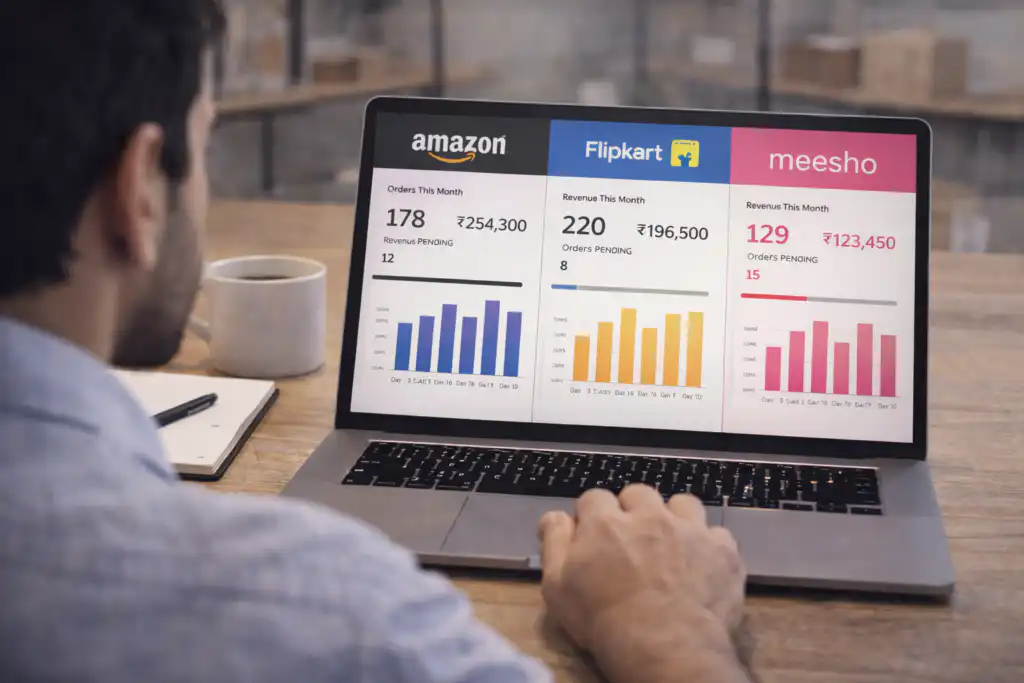
Amazon vs Flipkart vs Meesho: Which Platform Is Best for Sellers in India?
Platform Overview: Who’s Who in Indian Ecommerce
India’s ecommerce landscape is dominated by three platforms that couldn’t be more different from each other. Amazon India is the trusted, premium marketplace — known for reliability and global reach. Flipkart, now owned by Walmart, is the homegrown giant with a deep understanding of Indian consumer behaviour. And Meesho is the disruptor — a social commerce and ultra-value platform that has quietly become the largest app by order volume in India.
Understanding who uses each platform — and why — is the first step to choosing where to sell.
The Premium Marketplace
Global brand trust, FBA logistics, and a premium buyer base that’s willing to pay for quality.
500K+ active sellers
Est. GMV: ₹4.5L Cr
The Indian Giant
India’s homegrown marketplace leader in fashion, electronics, and Tier 2–3 penetration.
600K+ sellers
Est. GMV: ₹4.8L Cr
The Value Disruptor
Zero commission model, massive Tier 3–5 reach, and the fastest-growing order volumes in India.
1.2M+ suppliers
~1.8M orders/day
The numbers above tell an important story: Meesho now handles the highest daily order volumes in India, yet its GMV is far lower than Amazon or Flipkart. This perfectly illustrates the core difference — Meesho is a volume play, while Amazon is a margin play. Flipkart sits somewhere in the middle, with strong volume and aspirational buying.
Fee Structures & Commission Tables (2026)
This is where sellers most often get surprised. The platform with the lowest headline commission isn’t always the cheapest to sell on. You need to account for referral fees, shipping fees, pick & pack, GST, return handling, and any advertising spend. Let’s break it down platform by platform.
🛒 Amazon India — Fee Structure 2026
| Fee Type | Category | Rate / Amount | Notes |
|---|---|---|---|
| Referral Fee | Electronics | 5%–8% | Varies by subcategory |
| Referral Fee | Fashion & Apparel | 10%–18% | Higher for branded |
| Referral Fee | FMCG / Grocery | 6%–8% | Subject to minimum |
| Referral Fee | Home & Furniture | 9%–12% | Depends on order value |
| FBA — Pick & Pack | Small items (<500g) | ₹28–₹55 | Per unit |
| FBA — Pick & Pack | Medium items (500g–2kg) | ₹60–₹90 | Per unit |
| FBA — Shipping | Local / Zonal / National | ₹30–₹100+ | Based on zone |
| Closing Fee | All categories | ₹2–₹30 | Flat per order |
| GST on fees | All fees | 18% | Applied on platform fees |
| Selling on Amazon (SoA) | Self-ship | ₹25–₹50/order | Monthly plan available |
🛒 Flipkart — Fee Structure 2026
| Fee Type | Category | Rate / Amount | Notes |
|---|---|---|---|
| Commission Fee | Electronics | 5%–9% | Slightly higher than Amazon |
| Commission Fee | Fashion & Apparel | 12%–20% | Among the highest |
| Commission Fee | Books & Media | 8%–10% | Flat structure |
| Commission Fee | Home & Living | 8%–14% | Varies by price range |
| Shipping Fee (Ekart) | Local (<500g) | ₹32–₹45 | Flipkart’s own logistics |
| Shipping Fee (Ekart) | National (500g–1kg) | ₹55–₹80 | Per shipment |
| Collection Fee | All prepaid orders | 1.8% | Payment gateway fee |
| Fixed Fee | Low-value orders | ₹10–₹25 | Per order |
| Return Shipping | All returns | ₹45–₹120 | Seller bears cost |
| GST on fees | All fees | 18% | Applied on platform fees |
🛒 Meesho — Fee Structure 2026
| Fee Type | Category | Rate / Amount | Notes |
|---|---|---|---|
| Commission Fee | All Categories | 0% | Zero commission model |
| Shipping Fee | Forward (<500g) | ₹23–₹35 | Per shipment — lowest in industry |
| Shipping Fee | Forward (500g–2kg) | ₹38–₹58 | Weight-based slabs |
| Return Shipping | All categories | ₹20–₹40 | Seller bears partial cost |
| Payment Gateway | Prepaid orders | ~1.5% | Applicable on order value |
| GST on shipping fees | Logistics | 18% | Applied on shipping fees only |
| Ads (optional) | Promoted listings | Bidding-based | CPC model, entry from ₹1/click |
Don’t compare platforms by commission alone. A seller on Meesho may pay 0% commission but price their product at ₹299. The same seller on Amazon might charge ₹599, pay 18% in fees, and still net more per unit — because of the buyer’s willingness to pay. Platform choice must factor in average order value, not just fee rates.
Amazon India — Deep Dive
Amazon entered India in 2013 and has since invested over $6.5 billion in the country. It has built a reputation as the go-to destination for branded products, quality assurance, and reliable delivery — largely powered by its Fulfillment by Amazon (FBA) network.
Who buys on Amazon India?
Amazon’s buyer base skews towards Tier 1 and Tier 2 cities, with relatively higher disposable incomes. Buyers on Amazon typically trust the platform more for expensive purchases — electronics, branded fashion, health products, and premium home goods. The platform has a strong Prime membership base of 10M+ users who prioritise fast delivery over price.
Key strengths for sellers
- FBA infrastructure: Amazon’s fulfillment centres handle storage, packing, shipping, and returns. This dramatically reduces operational burden — especially for sellers scaling beyond 500 orders/month.
- Global selling: Amazon allows Indian sellers to list on Amazon.com, Amazon.co.uk, and other international marketplaces — a major advantage for brands thinking beyond India.
- Amazon Advertising: The most mature and data-rich advertising platform among the three, offering Sponsored Products, Sponsored Brands, and Display Ads with robust reporting.
- Brand Registry: Sellers who register their trademark get access to A+ content, brand stores, and counterfeit protection — crucial for building brand equity on the platform.
- Buy Box mechanics: While competitive, the Buy Box system rewards sellers with good metrics — creating a virtuous cycle for quality operators.
✓ Pros
- Highest buyer trust in India
- Best FBA logistics network
- Access to global markets
- Most powerful advertising tools
- Strong brand-building ecosystem
- Premium buyer demographics
- Best-in-class seller support
✗ Cons
- High total fee burden (12%–26%)
- Intense competition from large brands
- Complex account health metrics
- FBA requires upfront inventory commitment
- Returns policy is very buyer-friendly
- Higher competition in popular categories
- Takes time to build organic ranking
Best categories on Amazon India (2026)
Electronics accessories, kitchen appliances, health & wellness, books, premium fashion, beauty & personal care, and branded FMCG consistently perform well. The platform rewards sellers who can maintain 4+ star ratings with reasonable pricing in these categories.
Flipkart — Deep Dive
Flipkart is the original Indian ecommerce success story — founded in Bengaluru in 2007, acquired by Walmart in 2018, and still the market leader in several categories. With Ekart as its logistics backbone and a massive presence in Tier 2–4 cities, Flipkart has carved a unique position in India’s digital commerce ecosystem.
Who buys on Flipkart?
Flipkart’s user base is significantly broader than Amazon’s in terms of geography. While it serves metro buyers, it has exceptional penetration in smaller cities — and its Big Billion Days sale is India’s single largest shopping event. Fashion, mobiles, and electronics are Flipkart’s biggest categories. The platform caters to aspirational middle-India buyers looking for value with some brand assurance.
Key strengths for sellers
- Ekart logistics: Flipkart’s own logistics arm covers 95%+ of India’s pin codes — invaluable for sellers targeting Bharat, not just metros.
- Flipkart Quick (2-hour delivery): Available in select cities, this is a powerful conversion driver for categories like electronics and essentials.
- Myntra integration: Fashion sellers get access to Myntra’s premium fashion buyer base through Flipkart’s group ecosystem.
- Flipkart Ads: A growing advertising platform with Product Ads, Display, and Video ad formats — particularly strong during sale events.
- Seller support: Flipkart has been investing in seller education through Flipkart Samarth and regional seller programs.
✓ Pros
- Broadest reach in Tier 2–4 cities
- Strong electronics & fashion categories
- Big Billion Days = massive volume spike
- Ekart covers 99%+ pin codes
- Myntra access for fashion sellers
- Strong in mobiles & large appliances
- Seller Samarth program for MSMEs
✗ Cons
- Highest fashion commissions (up to 20%)
- High return rates in fashion (40%–60%)
- Customer service often favours buyers
- Complex promotional pricing requirements
- Less sophisticated ad tools vs Amazon
- Inconsistent seller support quality
- Slower payment cycles than Meesho
Best categories on Flipkart (2026)
Mobile phones and accessories, electronics, large appliances, value fashion, footwear, and sports equipment. Flipkart’s dominance in mobiles is unmatched — it controls an estimated 60%+ of online smartphone sales in India. Home furniture and kitchen appliances are also rapidly growing categories.
Meesho — Deep Dive
Meesho is the most disruptive force in Indian ecommerce since Flipkart itself. What started as a social commerce platform allowing homemakers to resell products has evolved into a full-fledged marketplace — with zero seller commissions, ultra-low logistics costs, and access to price-sensitive buyers in India’s smallest towns and villages.
Who buys on Meesho?
Meesho’s buyer base is predominantly from Tier 3, 4, and 5 cities — first-time internet buyers who may not have Amazon or Flipkart accounts. These are price-sensitive consumers looking for deals on apparel, home goods, jewellery, kitchenware, and lifestyle products. Average order values are significantly lower (₹200–₹500 range) but volumes are enormous.
Key strengths for sellers
- Zero commission: Meesho charges 0% commission on all categories — a structural advantage that lets sellers compete purely on price and product quality.
- Lowest shipping rates: Meesho has negotiated industry-lowest rates with logistics partners, passing savings directly to sellers.
- Uncontested reach: In Tier 4–6 towns, Meesho is the only marketplace with meaningful order volumes. If you want to serve Bharat, Meesho is often your only real option.
- Simple onboarding: The seller onboarding process is significantly simpler than Amazon or Flipkart — most sellers go live within 48 hours.
- COD friendly: Cash on Delivery accounts for a large share of orders, reducing payment barriers for buyers — but also increasing return rates.
✓ Pros
- Zero commission — highest margin retention
- Lowest shipping costs in the industry
- Access to 1B+ unserved consumers in Bharat
- Fastest onboarding process
- Best for unbranded / value products
- Huge uncontested demand in Tier 3–6
- Growing seller tools and catalogue support
✗ Cons
- Very low average selling prices
- High return rates (COD-driven)
- Weak brand building environment
- No premium buyer segment
- Less mature advertising platform
- Product authenticity/quality issues widespread
- Low buyer loyalty — pure price shopping
Best categories on Meesho (2026)
Women’s ethnic wear, fashion jewellery, home decor, kitchenware, bed & bath, mobile accessories, kids’ clothing, and seasonal gifting. Unbranded and generic products thrive here — sellers who manufacture or source directly at low cost have a massive competitive advantage on Meesho.
The Brand Chanakya team has worked with multiple clients who generate over ₹10 lakh/month on Meesho selling unbranded fashion — with near-zero marketing spend. Volume is the game here, not margin per unit. If you can fulfil 500+ orders/day consistently, Meesho becomes extraordinarily profitable.
Master Comparison: All Factors Side by Side
Here’s the comprehensive head-to-head comparison that sellers actually need. We’ve evaluated 20+ factors that matter to your business — not just commission rates.
| Factor | 🛒 Amazon | 🛒 Flipkart | 🛒 Meesho |
|---|---|---|---|
| Commission Rate | 5%–18% | 5%–20% | 0% |
| Effective Cost (all-in) | 12%–26% | 14%–28% | 7%–15% |
| Avg. Selling Price | ₹800–₹2,500 | ₹500–₹2,000 | ₹150–₹500 |
| Buyer Trust Score | ⭐⭐⭐⭐⭐ | ⭐⭐⭐⭐ | ⭐⭐⭐ |
| Logistics Network | FBA + SoA | Ekart + 3PL | Valmo (self) |
| Pin Code Coverage | 96%+ | 99%+ | 99%+ |
| Return Rate (Fashion) | 25%–35% | 40%–60% | 30%–50% |
| Payment Cycle | 7–14 days | 7–15 days | 7–10 days |
| Onboarding Time | 2–5 days | 3–7 days | 24–48 hours |
| Brand Building | ✔ Strong | ● Moderate | ✘ Weak |
| Advertising Platform | Advanced | Intermediate | Basic |
| Global Selling | ✔ Yes | ✘ No | ✘ No |
| Tier 1/2 City Reach | ✔ Excellent | ✔ Excellent | ● Growing |
| Tier 3–6 City Reach | ● Limited | ✔ Strong | ✔ Dominant |
| Seller Support Quality | ✔ Good | ● Average | ● Average |
| COD Availability | ✔ Yes | ✔ Yes | ✔ Heavy |
| Subscription / Plan Fee | ₹999/month (pro) | No monthly fee | No monthly fee |
| Best for Branded Sellers | ✔ Yes | ● Partial | ✘ No |
| Best for Unbranded Sellers | ✘ Difficult | ● Possible | ✔ Yes |
| Overall Competition Level | High | High | Moderate |
Scoring Matrix: Which Platform Wins What
We scored each platform across eight critical seller priorities on a scale of 1–5. Use this matrix to weight the factors that matter most to your business.
| Priority | Amazon | Flipkart | Meesho |
|---|---|---|---|
| Fee Competitiveness | ⭐⭐ (2/5) | ⭐⭐ (2/5) | ⭐⭐⭐⭐⭐ (5/5) |
| Logistics Reliability | ⭐⭐⭐⭐⭐ (5/5) | ⭐⭐⭐⭐ (4/5) | ⭐⭐⭐ (3/5) |
| Brand Building | ⭐⭐⭐⭐⭐ (5/5) | ⭐⭐⭐ (3/5) | ⭐ (1/5) |
| Volume Potential | ⭐⭐⭐ (3/5) | ⭐⭐⭐⭐ (4/5) | ⭐⭐⭐⭐⭐ (5/5) |
| Buyer Quality | ⭐⭐⭐⭐⭐ (5/5) | ⭐⭐⭐⭐ (4/5) | ⭐⭐ (2/5) |
| Advertising Capability | ⭐⭐⭐⭐⭐ (5/5) | ⭐⭐⭐ (3/5) | ⭐⭐ (2/5) |
| Ease of Onboarding | ⭐⭐⭐ (3/5) | ⭐⭐⭐ (3/5) | ⭐⭐⭐⭐⭐ (5/5) |
| Geographic Reach | ⭐⭐⭐ (3/5) | ⭐⭐⭐⭐ (4/5) | ⭐⭐⭐⭐⭐ (5/5) |
| Total Score | 31 / 40 | 27 / 40 | 28 / 40 |
Don’t look at the total score alone. Weight the rows by what matters most to you. If you’re a brand selling ₹1,500+ products — prioritise rows 3, 5, and 6 (Brand Building, Buyer Quality, Advertising). If you’re a volume-first unbranded supplier — rows 1, 4, and 8 are your north star.
Which Platform Suits Which Seller?
After reviewing hundreds of seller accounts at Brand Chanakya, we’ve identified clear patterns in which platform works best for different seller profiles. Here’s a practical guide:
Choose Amazon if you are:
- A brand with a registered trademark and products priced above ₹800
- Selling in electronics, health, beauty, or premium home categories
- Planning to scale internationally or into Amazon Global Selling
- A seller who wants to build long-term brand equity and customer loyalty
- Comfortable investing in Amazon Ads to drive discovery and ranking
- Willing to manage FBA inventory discipline for the logistical benefits
Choose Flipkart if you are:
- Selling mobile phones, tablets, or large appliances — Flipkart’s stronghold
- A fashion seller targeting value-conscious buyers in Tier 2–3 cities
- A seller who wants to participate in India’s biggest sale events (Big Billion Days)
- Looking for the broadest possible geographic reach through Ekart
- A MSME seller qualifying for Flipkart Samarth program benefits
- Selling sports equipment, outdoor goods, or lifestyle products
Choose Meesho if you are:
- A manufacturer or direct importer of unbranded goods seeking volume
- Selling women’s ethnic fashion, jewellery, home decor, or kitchenware below ₹500
- A new seller who wants to start selling with minimal setup complexity
- Operating on thin margins and needing the lowest possible fee structure
- Targeting first-time internet buyers in Tier 3–6 cities and semi-urban areas
- Looking to test product demand quickly with no upfront investment
The Brand Chanakya recommendation for most growing sellers is a multi-platform strategy. Start on Meesho to validate product-market fit at volume, then build your Amazon presence for brand and margin, and use Flipkart selectively for category-specific scale. Running all three intelligently — with different SKUs, pricing, and positioning on each — is where the real advantage lies in 2026.
Brand Chanakya’s Final Verdict
There is no single best platform for Indian sellers. The question is: best for what? Here’s our final, unambiguous take based on seller type and objective:
Amazon India
If your goal is to build a lasting brand that commands premium pricing and customer loyalty — Amazon is the platform. The tools, the buyer quality, and the advertising ecosystem are unmatched.
Premium Pricing
Global Ambitions
Flipkart
If you want the widest geographic reach, the biggest single-day sale opportunities, and dominance in mobile/electronics — Flipkart is your primary channel. Ekart’s pin code coverage is simply unbeatable.
Value Fashion
Tier 2–4 Cities
Meesho
If you’re a manufacturer or direct importer who wants to sell enormous volumes with near-zero platform cost — Meesho is without doubt the most economically efficient marketplace in India today.
High Volume
Bharat Market
The 2026 Multi-Platform Truth
The sellers who are truly winning in Indian ecommerce in 2026 aren’t choosing one platform — they’re orchestrating all three. They use Meesho to clear stock and test new SKUs. They use Flipkart for category leadership and sale event volume. And they use Amazon to build the brand narrative that eventually lets them raise prices and command loyalty. This is exactly the framework the Brand Chanakya team helps clients design and execute.
The platforms themselves are also converging — Amazon is pushing into value categories, Flipkart is building brand stores, and Meesho is adding advertising tools. The strategic window to exploit each platform’s distinct strength is now, before the differentiation narrows.
Stop thinking about which platform to sell on. Start thinking about which products to position on which platform at which price point. The same product might belong on all three — priced at ₹199 on Meesho, ₹349 on Flipkart, and ₹549 on Amazon. This three-tier pricing strategy, executed correctly, is how you maximise both volume and profitability in the Indian market of 2026.
Not sure which platform suits your products?
Get a free marketplace strategy consultation with the Brand Chanakya team. We’ll analyse your product category, margins, and goals — and give you a clear roadmap.
No commitment. Just clarity. 🔗 brandchanakya.in