
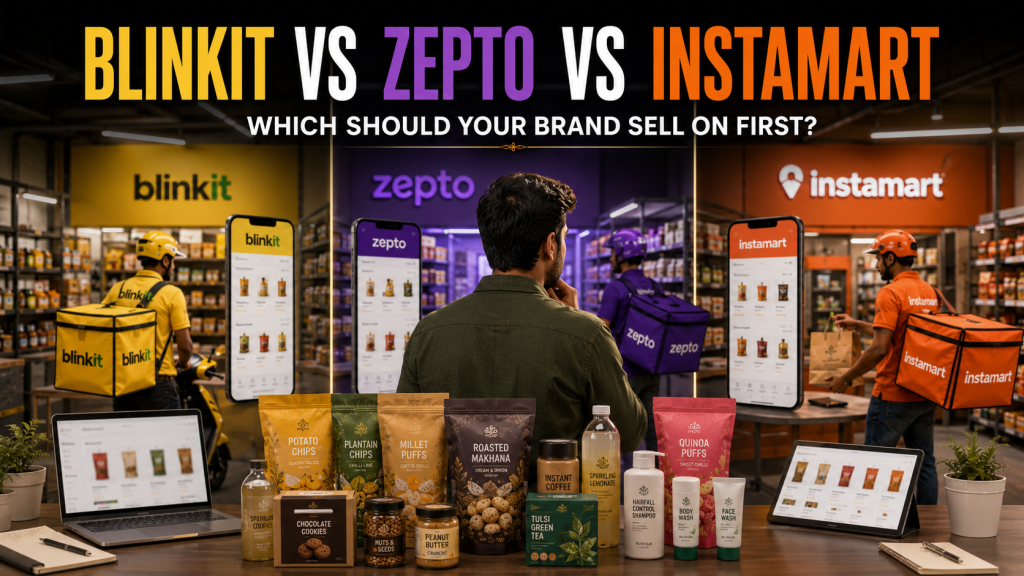
Almost every FMCG or D2C founder we talk to wants to be on all three platforms eventually. That’s a reasonable long-term goal — but launching on Blinkit, Zepto, and Instamart simultaneously is how brands end up with mediocre execution across all three instead of real traction on one. This Blinkit vs Zepto vs Instamart guide isn’t another feature-by-feature comparison. It’s a decision framework: which platform should you actually launch on first, based on your category, budget, and where your brand is right now.
All three platforms compete on the same core promise — groceries and everyday essentials delivered in 10 to 20 minutes from a hyperlocal dark store network. But the similarity mostly ends there. Each one has grown up with a different parent company, a different core user base, and a genuinely different shopper mindset behind every order. Treating them as interchangeable is the single most common mistake we see brands make when they’re deciding where to start.
📊 Quick Comparison Snapshot
| Factor | Blinkit | Zepto | Instamart |
|---|---|---|---|
| Parent company | Eternal (Zomato) | Zepto (independent) | Swiggy |
| Market position | Category leader by reach | Fast-growing challenger | Strong in food-adjacent grocery |
| Audience skew | Broad, mainstream metro household | Younger, 18–34, trend-forward | Existing Swiggy food-delivery base |
| Onboarding rigor | Highly structured, category-managed | Structured, similar CM model | Structured, integrated with Swiggy seller stack |
| Best category fit | Grocery, FMCG staples, wide assortment | Premium, organic, specialty, new-to-market brands | Recipe ingredients, snacking, impulse food |
| Ad inventory | Largest — sponsored search, banners, deal spotlights | Growing rapidly, competitive CPCs | Cross-sell potential from food-delivery intent |
None of these factors work in isolation — a platform with the widest reach isn’t automatically the right first move if your category doesn’t fit its dominant shopper behaviour, and a platform with a smaller footprint can still outperform for the right brand if the audience match is strong. That’s the lens the rest of this guide uses.
🟡 Blinkit — The Market Leader
🟡 Blinkit Widest reach
Blinkit typically has the largest dark store network and the highest order volumes of the three, which makes it the default first choice for most FMCG and grocery brands. Its scale means more category depth and, generally, the most mature ads and reporting tooling of the three platforms. The trade-off is competition — more sellers means your listing and pricing discipline has to be sharper to stand out.
Because Blinkit shoppers skew toward routine, need-based restocking rather than discovery browsing, brands with established recognition or a genuinely competitive price point tend to convert faster here than brands still trying to explain why they’re different.
🟡 Ready to launch on Blinkit?
We handle onboarding, catalog setup, ads, and ranking for FMCG & D2C brands going live on Blinkit.
⚡ Zepto — The Challenger
⚡ Zepto Younger, trend-forward audience
Zepto has grown fast on the back of a younger, more affluent, urban shopper base that’s genuinely open to trying new and premium brands — not just repurchasing familiar staples. If your brand sits in the premium, organic, or specialty bracket, Zepto shoppers tend to be a more receptive first audience than Blinkit’s broader mainstream base, even if total order volume is currently lower.
The app’s merchandising also tends to give newer brands more visual real estate to make a first impression — useful if your product needs a moment of explanation that a routine grocery restock doesn’t usually allow for.
⚡ Ready to launch on Zepto?
We handle onboarding, catalog setup, ads, and ranking for premium & new-to-market brands going live on Zepto.
🍽️ Instamart — The Food-Adjacent Player
🍽️ Swiggy Instamart Recipe & impulse-food fit
Instamart benefits from Swiggy’s existing food-delivery user base — people already in a “food decision” mindset who add groceries and ingredients to a food order. This makes it a strong fit for spice blends, snacking, beverages, and anything tied to a specific dish or occasion, where the purchase trigger is more immediate and craving-driven than a routine restock.
Brands positioned around a specific recipe, cuisine, or “cooking tonight” moment tend to see disproportionately strong performance here compared to their share of orders on Blinkit or Zepto.
🍽️ Ready to launch on Instamart?
We handle onboarding, catalog setup, ads, and ranking for recipe, snacking & impulse-food brands going live on Instamart.
We’ve gone deeper on platform-specific onboarding mechanics, commission structures, and account setup in our dedicated Zepto vs Blinkit vs Instamart comparison for FMCG brands — this guide focuses specifically on the sequencing decision: which one to launch on first.
🧭 Decision Framework: Which Fits Your Brand
Rather than a single “best” answer, think of it as a scorecard based on what stage and category you’re in. Here’s how three common brand profiles typically score against each platform, based on the pattern of results we see across our own managed accounts:
Blinkit
Moderate fit
Zepto
Strong fit
Instamart
Weak fit
Blinkit
Strong fit
Zepto
Good fit
Instamart
Good fit
Blinkit
Good fit
Zepto
Moderate fit
Instamart
Strong fit
💡
If none of the three profiles above match your brand cleanly, default to Blinkit first. Its scale gives you the most data, the most category benchmarks to learn from, and the most mature ad tooling to build a playbook you can then port to Zepto or Instamart.
🔀 Can You Sell on All Three at Once?
Technically, yes. Practically, we’d caution against it for most first-time quick commerce sellers. Each platform has its own Category Manager relationship, its own catalog formatting rules, its own pricing and promotion calendar, and its own ads dashboard. Running all three from day one usually means:
📉
Thin execution everywhere
Limited internal bandwidth gets split three ways instead of building real depth on one platform first.
💸
Diluted ad budgets
Small budgets spread across three platforms rarely reach the spend threshold needed to learn what’s working.
📦
Inventory strain
Committing stock to three separate dark-store networks simultaneously stresses supply chains that haven’t been tested yet.
🧩
Inconsistent pricing
Keeping MRP and promotions aligned across three platforms manually is where margin leaks quietly start.
The sequencing we usually recommend: launch on your best-fit platform first, get 60–90 days of real sales and ranking data, build a repeatable operating rhythm — then expand to the second and third platforms once that rhythm exists rather than being built from scratch three times over.
That 60–90 day window matters for a second reason beyond bandwidth: it’s roughly how long it takes to see a reliable read on fill-rate discipline, ad ROAS, and repeat-purchase behaviour for a given SKU. Expanding to a second platform before you have that read means you’re guessing at pricing and ad budgets instead of applying a playbook that’s already been tested against real orders.
❓ Frequently Asked Questions
Which platform has the lowest onboarding barrier?
All three run a category-managed, curated onboarding process rather than self-serve listing, so the barrier is broadly similar. The bigger variable is how prepared your documentation and catalog are, not which platform you choose.
Is Zepto worth it for a small brand with limited ad budget?
Often yes, specifically because Zepto’s audience skews toward trying new and premium brands. A smaller ad budget can go further reaching a more receptive audience than competing for visibility in a more saturated Blinkit category.
Do commission structures differ significantly between the three?
Commission slabs vary by category, negotiated terms, and city on all three platforms rather than following one fixed public rate — each platform shares exact figures directly during onboarding.
Should I wait until I’m profitable on one platform before adding another?
Profitability isn’t the only gate — but having a stable operating rhythm (inventory replenishment, ad management, ranking monitoring) on one platform makes expansion to a second platform far smoother than launching all at once.
Can an agency manage more than one quick commerce platform for my brand?
Yes — this is typically offered as a multi-platform account management package covering Blinkit, Zepto, and Instamart together under one team, one reporting cadence, and one strategy call.
What if my product genuinely fits all three platforms equally well?
In that case, default to the platform with the most reach and the most mature ad tooling — usually Blinkit — so you’re building your operating playbook against the largest possible sample of orders before porting it to the others.
Not sure which platform fits your brand?
We’ll review your category, budget, and current sales data and tell you honestly which quick commerce platform to launch on first.