
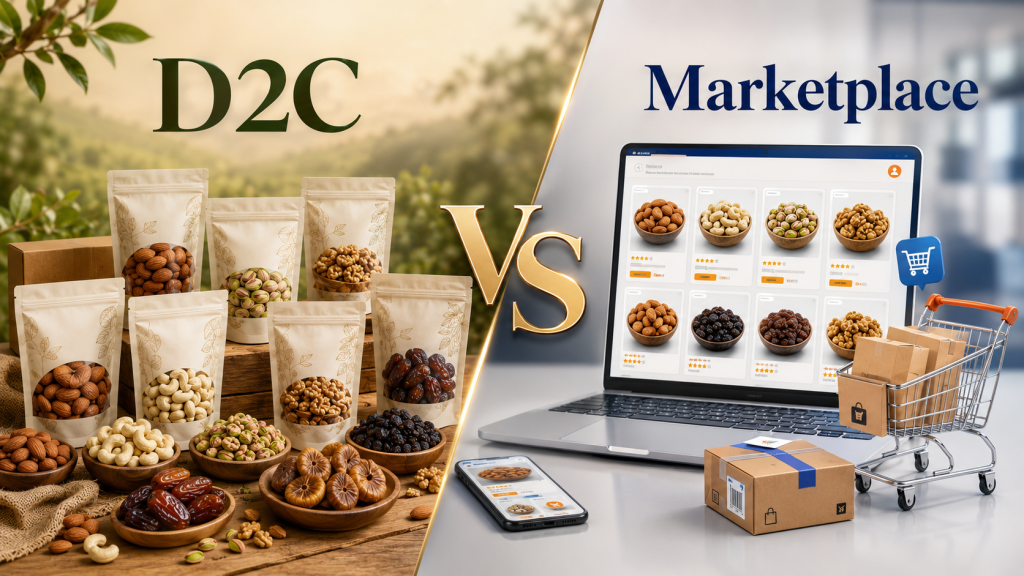
Every dry fruit brand faces this question: Should I sell on Amazon/Flipkart or build my own D2C website? The answer isn’t either/or — it’s understanding when each channel makes sense and how to use both strategically.
D2C vs Marketplace: The Core Difference
D2C WEBSITE
Own Your Brand
- ✅ Full control over brand experience
- ✅ Own customer data & emails
- ✅ Higher margins (no platform fees)
- ✅ Build direct relationships
- ⚠️ You drive all traffic
- ⚠️ Handle fulfillment yourself
MARKETPLACE
Leverage Platform
- ✅ Built-in traffic & trust
- ✅ Prime/fast delivery ready
- ✅ Easy discovery by new customers
- ✅ FBA handles logistics
- ⚠️ 15-25% platform fees
- ⚠️ No customer data ownership
It’s not D2C or Marketplace — it’s how to use both channels strategically. Most successful dry fruit brands run 60-70% marketplace revenue (volume) and 30-40% D2C revenue (margins + brand building).
Margin Comparison: The Numbers
💰 Unit Economics: ₹500 MRP Dry Fruit Pack
Fee Breakdown
| Cost Component | Amazon/Flipkart | D2C Website | Winner |
|---|---|---|---|
| Platform/Referral Fee | 6-8% | 0% | D2C |
| Payment Processing | Included | 2% | Marketplace |
| Fulfillment/Shipping | 8-12% (FBA) | 5-8% | D2C |
| Advertising (typical) | 8-15% ACoS | 10-20% CAC | Varies |
| Customer Acquisition | Built-in traffic | You pay for traffic | Marketplace |
| Total Typical Cost | 20-30% | 15-25% | D2C (at scale) |
Detailed Pros & Cons
D2C Website Advantages
- Customer data ownership: Email, phone, purchase history — build remarketing audiences
- Brand storytelling: Full control over design, messaging, and experience
- Subscription potential: Easy to set up weekly/monthly dry fruit subscriptions
- Bundling freedom: Create unique gift boxes, combos without platform restrictions
- No price comparison: Customers aren’t one click away from competitors
- Higher repeat rates: Direct relationship = stronger loyalty
Marketplace Advantages
- Instant credibility: “Available on Amazon” builds trust for new brands
- Discovery: Millions searching for “almonds” or “dry fruits gift box” daily
- Prime badge: 1-2 day delivery without building logistics infrastructure
- Festive traffic: Massive spike during Diwali, Rakhi without marketing spend
- Easy operations: FBA handles storage, packing, shipping, returns
- Reviews & ratings: Social proof that builds category authority
When to Prioritize D2C
When to Prioritize Marketplace
The Hybrid Strategy (Recommended)
Most successful dry fruit brands use both channels strategically:
🎯 Hybrid Channel Strategy
Marketplace: Standard SKUs, volume, discovery, festive sales
D2C: Premium combos, subscriptions, corporate gifting
Same MRP: Maintain consistent pricing across channels
Exclusive bundles: D2C-only gift boxes and combos
Packaging inserts: Drive marketplace buyers to D2C for reorders
Unified inventory: Single inventory system for both channels
Include a small card in every Amazon order: “Order direct next time at yourwebsite.com — Get 10% off + free shipping.” This legally drives repeat customers to your D2C channel where margins are higher.
Cost to Build D2C vs Marketplace Presence
| Investment Area | D2C Website | Amazon/Flipkart |
|---|---|---|
| Setup Cost | ₹50,000 – ₹2,00,000 | ₹0 (free to list) |
| Monthly Platform | ₹2,000 – ₹8,000 (Shopify) | ₹0 (pay per sale) |
| Photography/Content | ₹15,000 – ₹50,000 | ₹15,000 – ₹50,000 |
| Initial Inventory | ₹1,00,000+ | ₹1,00,000+ (FBA) |
| Marketing (Month 1) | ₹30,000 – ₹1,00,000 | ₹20,000 – ₹50,000 (PPC) |
| Total to Launch | ₹2,00,000 – ₹5,00,000 | ₹1,50,000 – ₹3,00,000 |
Need Help with Your Ecommerce Strategy?
Brand Chanakya helps dry fruit brands build profitable presence on both D2C and marketplaces. From Shopify setup to Amazon optimization — we handle it all.
Frequently Asked Questions
Both channels serve different purposes. Start with marketplaces (Amazon, Flipkart) for discovery and volume, then build D2C for margins and customer relationships. Most successful dry fruit brands run both channels with 60-70% marketplace and 30-40% D2C revenue split.
D2C margins are typically 25-40% higher than marketplace. On Amazon, you pay 15-22% in fees (referral + FBA + ads). On D2C, payment gateway (2%) + shipping (5-8%) = 7-10% total, giving you significantly better unit economics.
Shopify-based D2C store costs ₹50,000-2,00,000 for setup including design, development, payment integration. Monthly costs include Shopify subscription (₹2,000-6,000), apps (₹3,000-8,000), and marketing (variable). Total monthly fixed cost: ₹8,000-20,000.
Yes, and most successful brands do. Use marketplaces for volume and discovery, D2C for margins and brand building. Key is consistent pricing (MRP should be same), differentiated bundling (exclusive combos on D2C), and unified inventory management.
Brand Chanakya Team
Brand Chanakya helps food and FMCG brands build omnichannel ecommerce presence. From D2C websites to Amazon optimization, we’ve managed ₹1 Cr+ ad spend for clients across India.