
AI Quick Answer
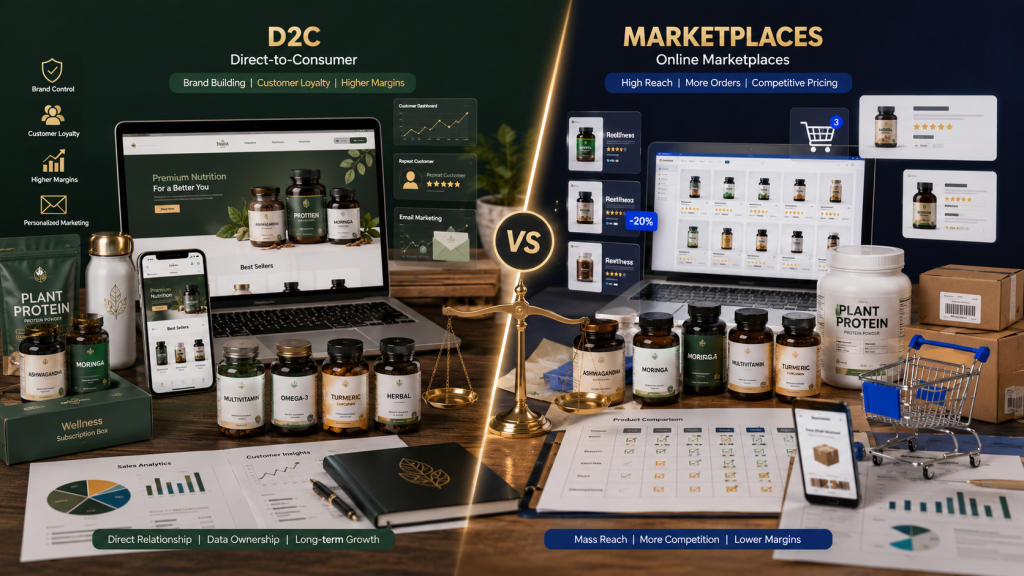
D2C vs Marketplace for Supplements depends on your brand’s growth stage, marketing budget, and business goals. Marketplaces like Amazon, Flipkart, and 1mg help new supplement brands acquire customers quickly with built-in traffic, while a D2C website offers higher profit margins, customer ownership, and long-term brand growth. Most successful supplement brands in India use a hybrid strategy, combining marketplaces for customer acquisition and D2C websites for repeat purchases and subscriptions.
Every supplement brand faces this question: Should I sell on my own D2C website or on marketplaces like Amazon and Flipkart? The answer isn’t binary — but understanding the tradeoffs helps you build the right channel strategy.
This guide breaks down the complete D2C vs Marketplace debate for Indian supplement brands, with real margin calculations and a practical roadmap.
D2C vs Marketplace: The Quick Overview
D2C Website
- ✓ Own customer data & relationships
- ✓ Higher margins (no commissions)
- ✓ Full brand control
- ✓ Build brand equity long-term
- ✗ Must drive your own traffic
- ✗ Higher customer acquisition cost
- ✗ Need to build trust from scratch
Marketplace
- ✓ Built-in traffic & trust
- ✓ Lower customer acquisition cost
- ✓ Easy logistics (FBA/Flipkart Assured)
- ✓ Quick to start selling
- ✗ 15-25% platform commissions
- ✗ Limited customer data access
- ✗ Competing with your own category
It’s not “D2C or Marketplace” — it’s “What percentage of revenue should come from each channel?” Most successful supplement brands use both, optimizing each for different stages of the customer journey.
Deep Dive: Pros & Cons
D2C Website Advantages
- Customer Ownership: Email, phone, purchase history — you own it all. Critical for supplements where repeat purchases drive profitability.
- Higher Margins: No 15-25% marketplace commission. On a ₹1,000 product, that’s ₹150-250 extra per order.
- Brand Experience: Control the entire journey — from landing page to unboxing. Tell your story, your way.
- Subscription Flexibility: Build custom subscription models, bundles, and loyalty programs.
- Retargeting: Pixel data lets you retarget visitors across Meta, Google, and other platforms.
A successful D2C website is only effective when it consistently attracts qualified traffic through SEO, paid advertising, and conversion optimization. Learn how our E-commerce Marketing Services help brands grow profitable online sales.
Marketplace Advantages
- Built-in Demand: 300M+ Amazon India users actively searching for supplements. No need to generate demand from scratch.
- Trust Transfer: “Fulfilled by Amazon” badge = instant credibility for new brands.
- Lower CAC: Customer acquisition cost is often 30-50% lower than D2C advertising.
- Logistics Solved: FBA handles storage, packing, shipping, returns. One less thing to manage.
- Search Intent: Customers come with buying intent. “Ashwagandha capsules” searcher is ready to purchase.
Detailed Factor Comparison
| Factor | D2C Website | Marketplace (Amazon) |
|---|---|---|
| Platform Fees | 2-3% (payment gateway only) | 15-25% (referral + closing + FBA) |
| Customer Data | 100% ownership | Limited (no email/phone) |
| Traffic | Must generate yourself | Built-in (millions of users) |
| Trust Factor | Must build from scratch | Instant (platform trust) |
| Customer Acquisition Cost | ₹200-800 per customer | ₹100-400 per customer |
| Repeat Purchase Rate | 35-50% (with retention marketing) | 15-25% (platform controls) |
| Brand Control | 100% | Limited (template pages) |
| Competition | Zero on your site | High (shown alongside competitors) |
| Logistics Complexity | Must manage or outsource | FBA handles everything |
| Time to First Sale | 2-4 weeks (need traffic) | 1-2 weeks (existing demand) |
Margin Analysis: The Real Numbers
Let’s calculate actual margins for a ₹1,000 MRP protein supplement:
💰 Margin Comparison: ₹1,000 MRP Supplement
🏪 D2C Website
🛒 Amazon (FBA)
D2C offers ₹110 more profit per ₹1,000 order (12% higher margin). Over 1,000 orders/month, that’s ₹1.1 Lakh additional profit. But this doesn’t account for customer acquisition cost — D2C requires more marketing spend to drive traffic.
When to Choose Which Channel
Decision Framework
Choose Marketplace-first if:
- You’re a new brand with no existing audience
- Limited marketing budget (under ₹2 Lakh/month)
- Need to test product-market fit quickly
- Don’t have logistics infrastructure
- Selling commoditized products (protein, multivitamins)
Choose D2C-first if:
- You have a strong brand story to tell
- Marketing budget of ₹3-5+ Lakh/month
- Premium or differentiated positioning
- Subscription model is core to business
- Already have social following or influencer partnerships
The Hybrid Strategy: Best of Both
The smartest supplement brands don’t choose — they orchestrate both channels:
Marketplace (40-50% of revenue): Discovery channel for new customers. Use Amazon for brand awareness and first-time purchases. Lower CAC, built-in trust.
D2C (50-60% of revenue): Retention channel for repeat customers. Higher margins, customer ownership, subscription revenue. Convert marketplace customers to D2C over time.
How to Convert Marketplace Customers to D2C
- Insert cards: Include D2C website URL in packaging (Amazon allows this)
- QR codes: Link to D2C exclusive offers, loyalty programs
- WhatsApp: Encourage customers to message for support (capture phone)
- Subscribe & Save alternative: Offer better subscription deal on D2C
- Exclusive products: Launch new SKUs on D2C first
Implementation Roadmap
Month 1-3: Marketplace Foundation
Launch on Amazon with 3-5 SKUs. Focus on listing optimization, get initial reviews, understand demand. Target: ₹1-3 Lakh monthly revenue.
Month 4-6: D2C Setup
Build Shopify store, set up payment gateway, integrate shipping partners. Soft launch with insert cards driving traffic from Amazon orders.
Month 7-12: D2C Scale
Launch Meta Ads, influencer campaigns. Build email/WhatsApp lists. Target: D2C = 30% of revenue by month 12.
Year 2+: Optimize & Expand
Add Flipkart, 1mg for marketplace reach. Push subscriptions on D2C. Target: D2C = 50-60% of revenue with higher margins.
Need Help Building Your Channel Strategy?
Brand Chanakya helps supplement brands build and optimize both D2C and marketplace presence. From Shopify setup to Amazon management — we handle it all.
Frequently Asked Questions
Which is more profitable for supplements — D2C or marketplace?
A hybrid D2C and marketplace strategy is the most profitable approach for most supplement brands in India because it combines higher D2C margins with the customer reach of marketplaces like Amazon and Flipkart.
How much does it cost to build a D2C website for supplements?
Building a D2C website for a supplement brand in India typically costs between ₹50,000 and ₹3 lakh, depending on your platform, design, integrations, and custom features.
Do I need both D2C website and Amazon for my supplement brand?
Yes. Most successful supplement brands in India use both a D2C website and Amazon to maximize customer reach, improve profitability, and build long-term brand value.
What platforms are best for D2C supplement websites in India?
Shopify and WooCommerce are the most popular platforms for building D2C supplement websites in India because they offer flexibility, scalability, and powerful e-commerce features.
How do I drive traffic to my D2C supplement website?
The best way to drive traffic to a D2C supplement website is through SEO, Google Ads, Meta Ads, influencer marketing, content marketing, email campaigns, and social media marketing.
Key Takeaways
- ✓Marketplace-first is ideal for new supplement brands looking for faster sales and lower customer acquisition costs.
- ✓D2C websites provide higher profit margins, complete customer ownership, and stronger long-term brand value.
- ✓A hybrid strategy combining marketplaces and D2C delivers the best balance of growth, profitability, and customer retention.
- ✓Amazon, Flipkart, and 1mg help brands gain visibility, while D2C websites build loyal repeat customers.
- ✓Subscription models, email marketing, and loyalty programs perform better on D2C platforms.
- ✓The most successful supplement brands in India generate revenue from both channels instead of relying on only one.
Conclusion
For Indian supplement brands, the D2C vs Marketplace debate doesn’t have a single winner — it has a winning strategy. Start where it makes sense for your budget and stage, then build toward a hybrid model that captures the best of both worlds: marketplace reach for discovery and D2C control for profitability.
The brands that scale fastest in India are those that use marketplaces to find their customer and D2C to keep them. Build for both, optimize each, and you’ll have a channel mix that compounds over time — not one that creates dependency on a single platform.
Brand Chanakya Team
Brand Chanakya helps health and wellness brands scale on both D2C and marketplace channels. With ₹1 Cr+ Ad Spend Managed, we understand what works for supplement brands in India.