
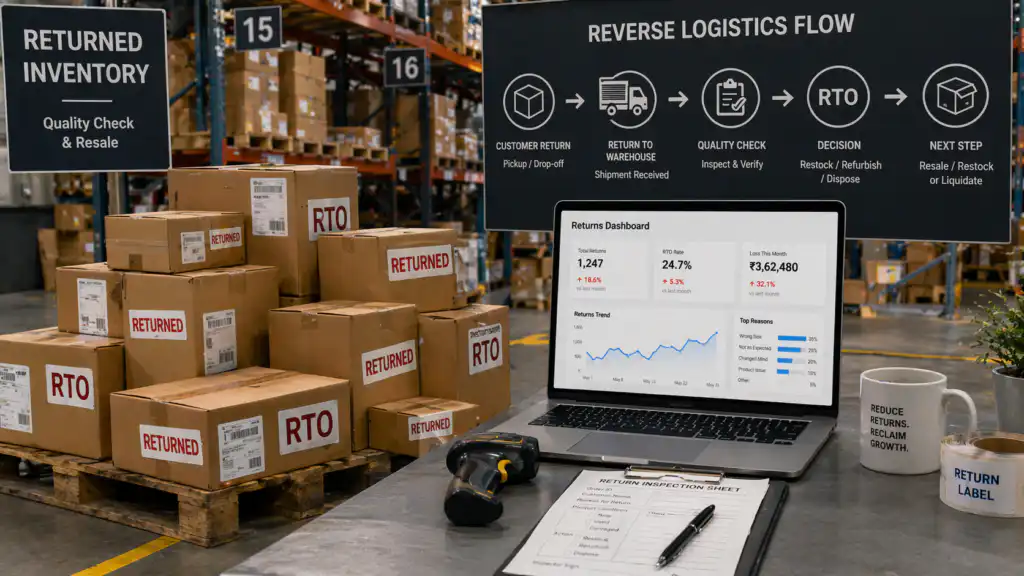
Ecommerce Returns and RTO Management: Reduce Returns and Protect Profits
Every returned order is money walking out of your business. You pay for forward shipping, reverse logistics, quality inspection, repackaging—and often end up selling the item at a discount or writing it off entirely.
In India’s e-commerce ecosystem, return rates are a silent profit killer. COD orders see RTO rates of 26-40%. Fashion brands face returns of 30-40%. And each return costs ₹180-240 in direct expenses before counting inventory holding costs and missed sales.
But here’s what most sellers miss: the majority of returns are preventable. By addressing root causes—COD fraud, sizing confusion, delivery failures, expectation mismatches—brands implementing balanced strategies report 42-48% decrease in return rates while retaining 89% of COD conversion volumes.
This guide breaks down the returns problem, identifies why it happens, and provides actionable strategies to protect your margins.
The True Cost of E-Commerce Returns
Let’s quantify what returns really cost your business:
💸 Return Cost Calculator: 10,000 Monthly COD Orders
This is just the direct cost. The hidden costs include:
- Blocked inventory: Products stuck in reverse transit can’t be sold
- Cash flow impact: COD returns mean zero revenue but full expense
- Warehouse costs: Processing, sorting, quality checks, restocking
- Value depreciation: Less than 50% of returned items resell at full price
- Opportunity cost: Time spent on returns is time not spent on growth
📉 The Profit Impact
Research suggests returns can eat 30% or more of your profit. For low-margin categories or promotional items, a 30% return rate can make the entire product line unviable.
Understanding RTO vs Customer Returns
Not all returns are the same. Understanding the difference helps you target solutions:
RTO (Return to Origin)
RTO occurs when the order is shipped but never reaches the customer. The package returns to you without delivery. Causes include:
- Customer refused delivery
- Incorrect or incomplete address
- Customer unavailable after multiple attempts
- Fake/fraudulent orders (especially COD)
- Customer changed mind before delivery
Customer-Initiated Returns
These are orders that were delivered successfully but the customer initiates a return. Causes include:
- Product didn’t fit (sizing issues)
- Product doesn’t match images/description
- Quality not as expected
- Damaged in transit
- Changed mind after trying
Why Returns Happen: Root Cause Analysis
Analysis of 34,000+ RTO cases reveals the primary drivers. Understanding these helps you prioritize solutions:
| Return Cause | % of Returns | Preventable? |
|---|---|---|
| Sizing/Fit Issues | 53-70% | Yes – Size guides, virtual try-on |
| Product Didn’t Match Expectations | 15-25% | Yes – Better images, descriptions |
| Customer Unavailable/Refused | 15-20% | Yes – Confirmation, scheduling |
| Damaged in Transit | 5-10% | Yes – Better packaging |
| Incorrect Address | 5-8% | Yes – Address verification |
| Fraudulent Orders | 3-5% | Yes – Risk scoring, OTP |
COD Management: Reducing RTO Without Killing Sales
COD represents 58-64% of orders in Tier-2/3 markets but contributes to 76-83% of total RTO volume. The instinct is to disable COD—but that sacrifices entire market segments.
⚠️ The COD Trap
Completely disabling COD typically causes 30-50% revenue drop. The goal isn’t elimination—it’s intelligent COD management that preserves sales while reducing risk.
Smart COD Strategies
Solving Sizing & Fit Issues (Fashion Returns)
Fashion sees the highest return rates—30-40%—with 70% due to sizing issues. The practice of “bracketing” (ordering multiple sizes to return non-fits) is now common, accounting for 30-40% of all fashion returns.
Operational Improvements to Reduce RTO
Delivery Speed Matters
Data shows clear correlation between delivery time and RTO rates:
Faster delivery means less time for buyer’s remorse and higher chance of customer being available.
Pre-Delivery Communication
- Dispatch notification: Immediate SMS/WhatsApp when order ships
- Real-time tracking: Share tracking link proactively
- Delivery day reminder: “Your order arrives today” message
- Delivery slot booking: Let customers choose convenient delivery time
- Alternate contact: Collect secondary phone number during checkout
Failed Delivery Recovery (NDR Management)
When delivery fails, quick action prevents RTO:
- Immediate customer contact: Within 2 hours of failed attempt
- WhatsApp-based rescheduling: Let customers reschedule via chat
- Address correction option: Allow address updates for “wrong address” failures
- Multiple reattempt options: Don’t give up after one failure
- COD to prepaid conversion: Offer to convert COD to prepaid with discount
✅ NDR Response Time Impact
Brands that contact customers within 2 hours of failed delivery see 40% higher successful reattempt rates compared to next-day contact.
Returns vs Exchanges
Converting returns into exchanges retains revenue while solving customer problems:
- Prominently offer “Exchange for different size” option
- Make exchange process easier than return
- Offer free exchange shipping (even if returns aren’t free)
- Enable direct size/color swaps without full return processing
Category-Specific Return Rates & Tips
| Category | Avg Return Rate | Main Causes | Key Solutions |
|---|---|---|---|
| Fashion/Apparel | 30-40% | Sizing, fit, color mismatch | Size guides, virtual try-on, customer photos |
| Footwear | 27-35% | Fit issues, comfort | Detailed size charts with foot length/width |
| Electronics | 5-8% | Defects, expectation mismatch | Accurate specs, demo videos |
| Beauty/Cosmetics | 10-15% | Shade mismatch, skin reaction | Shade finder tools, ingredient lists |
| Home & Kitchen | 12-18% | Size expectations, quality | Dimension callouts, material close-ups |
| Furniture | 15-20% | Size fit, color difference | AR visualization, assembly videos |
✅ RTO Reduction Checklist
Frequently Asked Questions
Summary: Turn Returns from Cost Center to Competitive Advantage
Returns management can’t remain a back-office function. It needs to sit alongside CAC, contribution margin, and repeat purchase rate as a first-order metric in your P&L.
Key takeaways:
- COD isn’t the enemy: Smart COD management reduces RTO by 40-48% while retaining 89% of COD conversion volumes
- Sizing is solvable: Detailed size guides, virtual try-on, and customer reviews dramatically cut fashion returns
- Speed matters: Orders delivered in 1-2 days see 22% RTO vs 35% for 5+ day delivery
- Prevention beats cure: Address verification, order confirmation, and pre-delivery communication prevent most failed deliveries
- Exchanges retain revenue: Make exchanges easier than returns to keep the sale
- Data drives decisions: Track RTO by pin code, product, customer segment to target interventions
Brands that treat returns management as a strategic growth lever—not just an operational burden—build sustainable competitive advantage. Lower return rates mean higher margins, better cash flow, and more resources to invest in growth.