
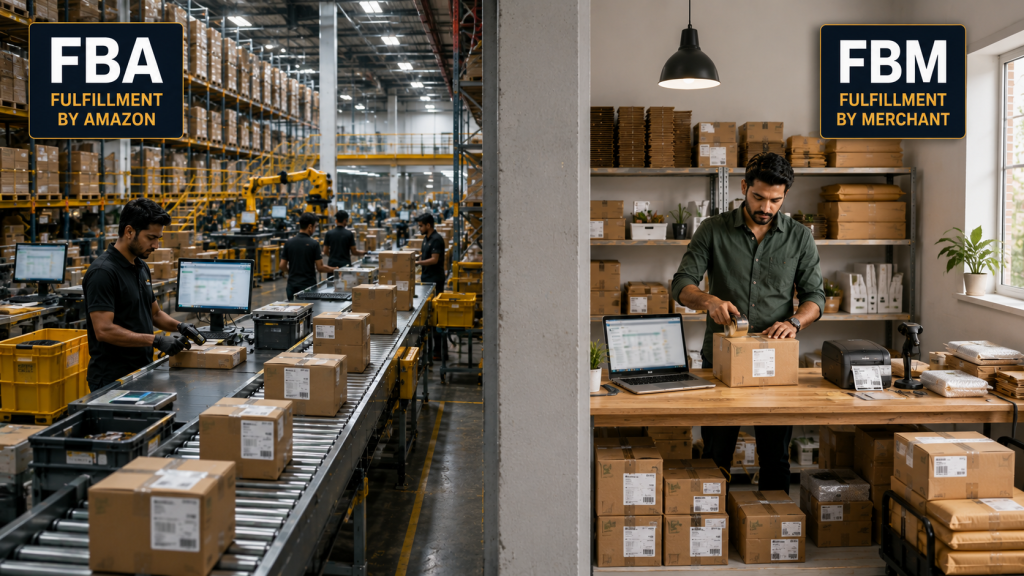
Should Amazon India sellers choose FBA or FBM?
For Amazon India sellers, FBA works best for compact, validated, steady-selling products where the Prime badge drives conversion. FBM (Self Ship) suits oversized, fragile, or low-volume products where storage fees would eat into margins. Easy Ship — Amazon India’s middle option not available in the US market — is the smartest starting point for new or unvalidated SKUs: no warehouse transfer, no storage fees, Amazon-grade delivery reliability.
A manufacturer client came to us convinced he needed FBA because “that’s what every successful seller uses.” His product: 18kg water purifiers with a 2% return rate. We ran the storage-fee math — FBA would have quietly eaten 12% of his margin on slow-moving stock. He launched on Self Ship instead and saved lakhs in his first year. The opposite happens just as often: sellers stick with FBM out of fear of Amazon’s cut, and lose the Prime badge that would have tripled their conversion rate.
The FBA vs FBM decision isn’t about which model is “better” — Amazon itself offers no universally right answer, which is exactly why so many new sellers get it wrong. It’s about matching the model to your product’s size, margin, return rate, and how hands-on you want to be. After setting up fulfilment strategy for 200+ Amazon sellers across categories, here’s the honest, India-specific breakdown — including the option most guides skip entirely.
Prime badge, hands-off
Best for steady-demand, small-to-medium, low-return products
Middle ground
You store, Amazon delivers — no warehouse transfer needed
Full control
Best for oversized, fragile, or low-volume/unvalidated products
FBA vs FBM: The Basics
FBA (Fulfilled by Amazon): You ship your inventory in bulk to Amazon’s fulfilment centres. Amazon stores it, picks, packs, ships, and handles customer service and returns for that order. Your listing gets the Prime badge.
FBM (Fulfilled by Merchant), aka Self Ship: You store the inventory yourself and handle packing and shipping through your own courier network — or a third-party logistics partner. No Prime badge, full control.
FBA: What It Costs and When It Wins
The Real Cost Structure
| Cost Component | What Determines It |
|---|---|
| Fulfilment fee | Product weight and dimensions — charged per unit shipped |
| Monthly storage fee | Per-cubic-foot, varies seasonally (higher Oct–Dec) |
| Long-term storage fee | Additional charge on inventory sitting 181+ days unsold |
| Removal/disposal fee | If you need unsold stock returned or destroyed |
Where FBA Wins
- Prime badge conversion lift. Prime-eligible listings typically convert meaningfully better — Prime members filter by badge and skip non-Prime results entirely in many searches.
- You’re not built for logistics. No warehouse, no packing team, no courier negotiations — Amazon’s infrastructure replaces all of it.
- Validated, steady-selling products. Once you know a SKU sells consistently, FBA’s speed and reliability compound your ranking through faster delivery promises.
- Scaling fast. Sale events (Prime Day, Diwali) get priority placement and handling capacity that’s hard to match with your own logistics.
Where FBA Hurts
- Unvalidated demand. Send 500 units of an unproven product and storage fees quietly compound every month it doesn’t sell.
- Large or heavy items. Furniture, appliances — fulfilment fees scale with size and can wipe out margin on bulky low-price items.
- High-return categories. Apparel with frequent size returns adds return-processing costs on top of storage.
- Seasonal or gifting products. Rakhi, Diwali decor — inventory left over after the season triggers long-term storage penalties.
FBM: What It Costs and When It Wins
The Real Cost Structure
No Amazon storage or fulfilment fees — but you carry warehousing, packing material, staff/labour, and courier costs directly. Your total cost depends entirely on how efficient your own logistics setup is.
Where FBM Wins
- Oversized or fragile products. Furniture, glass, large appliances — where Amazon’s fulfilment fees would be disproportionate to the product’s price.
- Low or unpredictable volume. New, unvalidated SKUs where you don’t want inventory sitting in a warehouse racking up fees.
- You already have strong logistics. Manufacturers or D2C brands with an efficient in-house dispatch system often ship cheaper themselves than through Amazon’s fee structure.
- Perishables or made-to-order items. Products that can’t sit in a warehouse for weeks.
Where FBM Hurts
- No Prime badge. You lose the segment of buyers who filter exclusively for Prime-eligible listings — a real, measurable chunk of search traffic.
- Delivery promise competition. Slower or less consistent delivery windows than FBA competitors hurts both conversion and, over time, your account’s performance metrics.
- You own every operational failure. Late dispatch, lost packages, and courier delays directly hit your seller rating — there’s no Amazon buffer.
The Option Most Guides Skip: Easy Ship
Easy Ship is Amazon India’s middle path, and in our experience it’s underused because most FBA-vs-FBM content is written for the US market, where it doesn’t exist. You keep inventory at your own premises — no bulk warehouse transfer, no storage fees — but Amazon’s delivery partners handle pickup and delivery instead of your own courier.
1
No storage fee exposure. You only ship what actually sells, so there’s no risk of unsold inventory racking up monthly charges.
2
Better delivery reliability than pure self-ship. Amazon’s logistics network is generally more consistent than juggling multiple courier partners yourself.
3
Still no Prime badge in most cases — so it doesn’t fully replace FBA’s conversion advantage, but it’s a strong bridge while you validate demand.
Our recommendation for most new sellers: Launch new, unvalidated SKUs on Easy Ship. Once a SKU proves 60-90 days of consistent sell-through, move it to FBA to capture the Prime badge and free up your own storage space.
Side-by-Side Cost Comparison
| Factor | FBA | Easy Ship | FBM (Self Ship) |
|---|---|---|---|
| Prime badge | Yes | Rarely | No |
| Storage fees | Yes, monthly | None (self-stored) | None (self-stored) |
| Who ships | Amazon, from their warehouse | Amazon pickup, from your location | Your own courier partners |
| Best for | Validated, steady sellers | New/unvalidated SKUs | Oversized, fragile, low-volume items |
| Operational load on you | Lowest | Medium | Highest |
| Inventory risk | Storage fees on unsold stock | None | None |
The Decision Framework
Choose FBA if
Validated & Prime-worthy
- Product sells consistently at a known rate
- Compact, standard size and weight
- Low return rate (under 5-8%)
- You want minimal day-to-day involvement
Choose Easy Ship if
Testing & Validating
- New SKU, demand still unproven
- Want Amazon-grade delivery without warehouse transfer
- Seasonal or limited-run product
- Building toward FBA once proven
Choose FBM if
Oversized or Specialised
- Large, heavy, or fragile items
- You already run efficient logistics
- Made-to-order or perishable goods
- Very low, unpredictable order volume
Can You Use Both Together?
Yes — and most established sellers eventually do. A common structure: keep your fast-moving, compact, high-margin SKUs on FBA for the Prime badge and hands-off scaling, while running oversized or slow-moving SKUs on FBM or Easy Ship to avoid storage-fee drag. You can mix fulfilment methods SKU-by-SKU within the same seller account — there’s no rule forcing an all-or-nothing choice.
Frequently Asked Questions
Does FBM hurt my Amazon ranking in India?+
In India, FBM does not directly hurt your Amazon ranking — the A9 algorithm does not penalise the Self Ship model by itself. However, FBA listings on Amazon India consistently win more Buy Box share and appear in Prime-filtered search results, which drives higher sales velocity. Over time, lower velocity indirectly weakens your organic ranking. For Indian sellers competing in high-volume categories, the Prime badge gap between FBA and FBM is a real, measurable disadvantage.
Can I switch a product from FBM to FBA on Amazon India later?+
Yes, Amazon India allows you to switch from FBM to FBA anytime without losing your listing history or reviews. Many Indian sellers deliberately launch new SKUs on Easy Ship or Self Ship to validate demand, then convert proven sellers to FBA once sell-through is consistent for 60–90 days. This approach avoids paying FBA storage fees on unproven inventory — a common and costly mistake among new sellers in India.
Is FBA worth it for low-priced products in India?+
For Indian sellers, FBA viability on low-priced products depends on weight, not price alone. FBA fees in India are charged primarily based on product size and weight — so a small, light product priced under Rs. 300 can still absorb FBA costs profitably, while a bulky Rs. 300 product cannot. Run the FBA fee calculator on Amazon Seller Central India before committing inventory. Products under 500g with margins above 40% are typically FBA-safe even at lower price points.
What happens to unsold FBA inventory on Amazon India?+
On Amazon India, unsold FBA inventory continues accumulating monthly storage fees from the day it arrives at a fulfilment centre. After 181 days, additional long-term storage charges apply on top of regular fees. Indian sellers can request removal (stock returned to your address) or disposal through Seller Central — both carry a per-unit fee. Factor this risk carefully before sending large, unvalidated batches to FBA warehouses in India.
Do returns work differently between FBA and FBM on Amazon India?+
Yes, return handling is significantly different between FBA and FBM for Amazon India sellers. FBA returns are received, inspected, and processed by Amazon’s fulfilment team under Amazon India’s buyer-friendly return policies — giving you less control but removing operational burden. FBM returns route directly back to your address, giving you full control over inspection and restocking, but adding to your operational load. High-return categories like apparel and electronics in India carry especially high FBA return-processing costs.
Is Easy Ship available for all sellers on Amazon India?+
Easy Ship is available to all registered sellers on Amazon India and is completely free to enrol in — you only pay the per-shipment delivery fee when an order is placed. Unlike FBA, Easy Ship requires no advance inventory transfer or minimum stock commitment. It is exclusive to Amazon India and does not exist on Amazon US or other international marketplaces, which is why most FBA vs FBM guides written for global audiences skip it entirely. It is the recommended starting model for Indian sellers testing new product categories.
FBA vs FBM on Amazon India — What You Need to Remember
📦
FBA = Prime badge + hands-off scaling — Best for products with proven, consistent demand and standard size/weight. Storage fees compound fast on slow-moving stock.
🚚
FBM = Full control, zero storage risk — Right for large, heavy, fragile, or low-volume products. You own logistics efficiency — and every failure.
⭐
Easy Ship = India’s best-kept fulfilment secret — Only available on Amazon India. Launch unvalidated SKUs here first. Once 60-90 days of sell-through is proven, migrate to FBA for the Prime badge.
🔀
Mix models SKU-by-SKU — Established Indian sellers run FBA for fast-moving SKUs and FBM/Easy Ship for oversized or slow-moving ones. No all-or-nothing rule exists.
📊
Run the numbers before deciding — FBA fulfilment fee + monthly storage + long-term storage risk must be calculated against your specific product’s margin, weight, and return rate using Amazon Seller Central India’s fee calculator.
The Bottom Line
There’s no universally correct answer between FBA and FBM — only a correct answer for your specific product’s size, margin, return rate, and how proven its demand already is. Most sellers get this decision wrong not because they picked the “worse” model, but because they picked one model for their entire catalog instead of matching it SKU by SKU.
Not sure which model fits your catalog?
Get a free fulfilment audit from Brand Chanakya — we’ll review your product mix, margins, and return rates, and map out the FBA/Easy Ship/FBM split that actually protects your profit.
VS
Varun Surana
Founder of Brand Chanakya, a digital growth agency based in Udaipur, Rajasthan, serving SMEs, MSMEs, and D2C brands across India since 2016. His team manages Amazon, Flipkart, and quick-commerce marketplace growth for 200+ brands, alongside SEO and performance marketing.
Continue Reading
Related Guides for Amazon India Sellers
🛒
Best Ecommerce Marketing Company in India
Full-stack ecommerce growth — marketplace management, ads, and D2C brand scaling across Amazon, Flipkart, and quick commerce platforms.
🏪
Flipkart Account Management Services
End-to-end Flipkart seller management — listings, ads, F-Assured setup, and account health monitoring for Indian brands.
⚡
Blinkit Account Management Services
Get your brand live on Blinkit — dark store onboarding, inventory planning, and 10-minute delivery category growth strategy.
📦
FMCG Brands Ecommerce Service
Marketplace growth strategy for FMCG brands — high-velocity SKU management, promotions, and multi-platform distribution.