
India’s FMCG Ecommerce Landscape in 2026
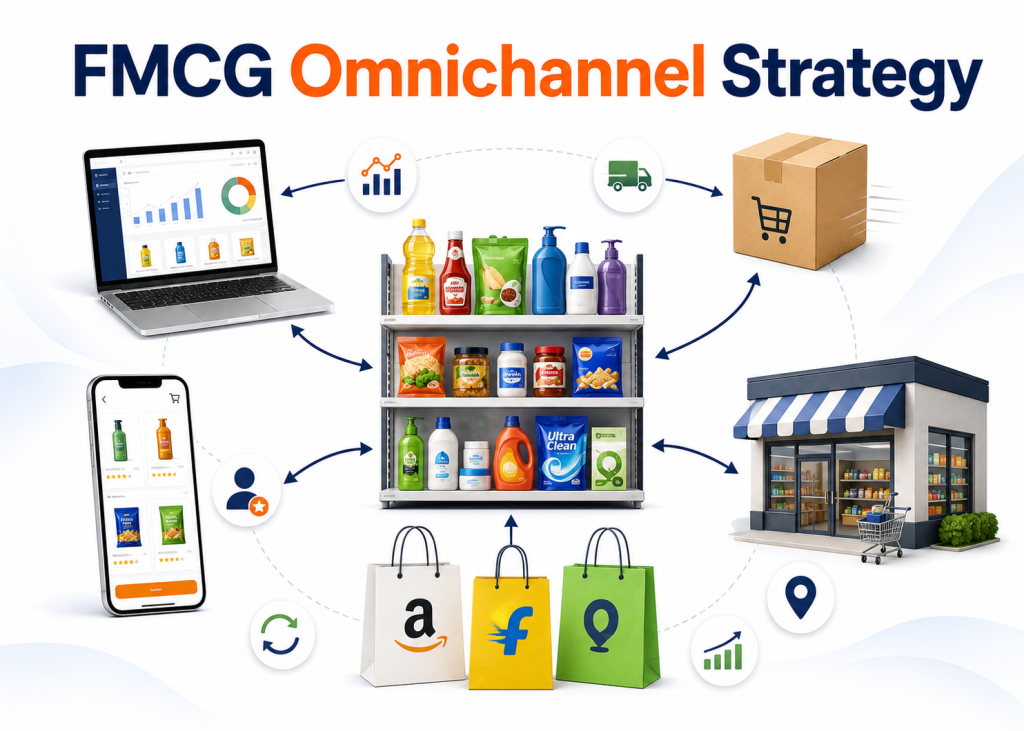
Three years ago, “FMCG ecommerce” in India meant having a listing on Amazon and hoping for the best. In 2026, it means managing a five-channel operation — online marketplaces, quick commerce, D2C, traditional distribution, and GEO/AI search — simultaneously, with each channel talking to the others.
The numbers have shifted dramatically. Online now contributes 12–18% of total FMCG sales for brands with urban consumer bases — up from 4–5% in 2021. In the top 8 metro cities, that number is already 25–30% for premium FMCG categories like nutrition, organic food, and personal care.
What’s fundamentally different in 2026 is the consumer journey. A customer might discover your protein bar on Blinkit at 10pm, research it on Google, check your D2C website for ingredient details, read reviews on Amazon, and finally buy it from their local kirana because they walk past it daily. Every touchpoint matters. Every channel has a role. A brand present on only one of these touchpoints loses the customer to one that shows up everywhere.
“FMCG in India has crossed the tipping point. Omnichannel is no longer a strategy for scale — it’s the baseline for survival in urban markets.”
Why Single-Channel FMCG Brands Are Losing
The most common mistake we see from mid-size FMCG brands in India is channel concentration risk — putting 80–90% of their digital sales effort into one platform and then experiencing a catastrophic revenue drop when that platform changes its algorithm, raises commissions, or a competitor out-bids them on ads.
We’ve seen this happen repeatedly:
- Amazon-only brands that saw 40% revenue drops when Blinkit and Zepto captured their best SKU categories
- Traditional distribution-only brands that lost urban market share because they had zero quick commerce presence
- D2C-only brands that built an expensive acquisition machine with no marketplace base to fall back on when Meta ad costs spiked
- Blinkit-first brands that achieved great QC numbers but built zero brand equity outside the app — invisible on Google, Amazon, and in kiranas
⚠️ The Platform Dependency Trap
Any FMCG brand generating more than 60% of its online revenue from a single platform is in a fragile position. Commission increases, algorithm changes, new competitor listings, or a platform-level policy shift can wipe out months of growth overnight. Omnichannel is fundamentally a risk management strategy as much as a growth strategy.
The Four Channels of India’s FMCG Omnichannel Stack
India’s FMCG omnichannel stack in 2026 has four distinct layers. Each has a different consumer role, different margin profile, and different strategic purpose.
Online Marketplaces
- ✓ Highest discovery surface — 350M+ active shoppers
- ✓ Built-in trust and logistics infrastructure
- ✓ Best for considered, planned purchases
- ✓ Multi-pack, bulk, and subscription orders
- ✓ Meesho unlocks Tier 2/3 value-segment consumers
Margin: 35–50% after fees
Quick Commerce
- ✓ Impulse + immediate need — highest intent channel
- ✓ Urban consumer trial and habit formation
- ✓ Best for snacks, beverages, FMCG daily use
- ✓ 10-minute delivery changes purchase behavior
- ✓ Real-time consumer data at pin-code level
Margin: 25–35% after platform cost
D2C Website
- ✓ Highest margin channel — no commissions
- ✓ First-party data ownership — your most valuable asset
- ✓ Subscription and auto-replenishment models
- ✓ Brand storytelling beyond marketplace limits
- ✓ Retention marketing — email, WhatsApp, push
Margin: 55–70% gross (before CAC)
Traditional Distribution
- ✓ Widest reach — 12 million+ retail outlets in India
- ✓ Essential for Bharat (Tier 3/4/rural) penetration
- ✓ Drives volume at scale no digital channel can match
- ✓ Physical shelf presence = passive discovery daily
- ✓ Modern trade (DMart, Reliance) growing fastest
Margin: 38–52% depending on trade structure
The FMCG Omnichannel Architecture — 2026
The FMCG Omnichannel Flywheel
The most powerful insight in omnichannel strategy is that the channels don’t just exist in parallel — they reinforce each other. When done right, your omnichannel operation builds a compounding flywheel where each channel feeds growth into the next.
The Brand Chanakya FMCG Growth Flywheel
🏆 Result: Brand equity + repeat purchase + data moat + distribution width = Unbeatable market position
Here’s how the flywheel works in practice: A consumer tries your ghee on Blinkit. They like it. They Google the brand — and find your D2C website with a rich ingredients story, third-party certifications, and a subscription offer. They subscribe. Now they’re a recurring revenue customer. Your D2C data shows this customer cohort buys every 28 days. You use this data to push your distributor to stock in the neighbourhoods where D2C demand is highest. The kirana now stocks your brand — and the customer’s neighbor discovers it without even opening an app.
That neighbour searches your brand on Amazon after seeing it on the kirana shelf. They find 4-star reviews and an A+ listing. They buy. The flywheel adds another rotation.
The 5-Phase Omnichannel Rollout Plan
Building an omnichannel FMCG operation doesn’t mean doing everything simultaneously from Day 1. The most successful FMCG brands we’ve worked with follow a phased approach — each phase unlocking the next.
Month 1–3
Before touching quick commerce or D2C, build an unshakeable marketplace foundation. This means: Brand Registry on Amazon, A+ Content on your top 5 ASINs, Brand Store built properly, Sponsored Products running at target ACOS, and consistent 4+ star ratings. Why first? Because marketplace data is your best signal for which SKUs have product-market fit before you invest in other channels.
On Flipkart, claim your brand store and ensure your listings are category-compliant and conversion-ready. On Meesho, focus on value-positioned pack sizes that reach Tier 2/3 consumers your premium pricing can’t.
Month 2–4
Once your top 5 SKUs have proven conversion on marketplaces, take your 3 best performers to quick commerce. Start with one platform — Blinkit for premium/health, Zepto for snacks/beverages/new brands. Focus on 3 cities first: Mumbai, Delhi NCR, Bengaluru. These three cities generate 60–65% of India’s quick commerce FMCG revenue.
Pricing strategy is critical here: QC MRP should be 5–8% above marketplace pricing to protect channel margins and prevent conflict with your distributor’s pricing. Create QC-specific smaller pack sizes if your current lineup is above ₹300 — the QC impulse sweet spot is ₹79–₹199.
Month 3–6
With marketplace and QC data in hand, you now know which products your consumers love and why. Use this to build a D2C website that converts — not a brochure site, but a proper Shopify or WooCommerce store with subscription flows, retention email sequences, and WhatsApp re-engagement.
The D2C channel’s job is not to compete with Amazon on price — it’s to own the customer relationship. Offer exclusive bundles, early access to new launches, and loyalty rewards that are only available direct. Your best customers — the ones who buy monthly — should be migrated here over 6–12 months. A loyal D2C subscriber is worth 4.2x a one-time marketplace buyer in lifetime value.
Month 5–9
By Month 5, you have something no traditional FMCG brand has: pin-code-level demand data from quick commerce and D2C orders. Use this data to make your traditional distribution smarter. Where your Blinkit orders are highest, your distributor should be pushing hardest into kiranas. Where your D2C has the most subscribers, launch modern trade in those neighbourhoods.
This digital-to-physical data loop is the single biggest competitive advantage of an omnichannel FMCG brand in 2026. Traditional FMCG companies spend crores on Nielsen surveys to understand demand geography — you have real purchase data from your own consumers. Use it.
Month 6+ ongoing
In 2026, a growing slice of FMCG discovery is happening on AI search engines — ChatGPT, Perplexity, Google AI Overviews, and voice assistants. When someone asks “best organic ghee brand in India” on ChatGPT, is your brand in the answer? This is Generative Engine Optimization (GEO) — and it’s the newest, least-crowded channel in FMCG marketing.
GEO optimization for FMCG means building a digital content footprint — category pages, comparison blogs, ingredient explainers, and expert-cited content — that AI models pull from when answering consumer questions. Brands that build this now own a channel their competitors aren’t even aware of yet.
Channel-Category Fit Matrix
Not every FMCG category performs equally well on every channel. This matrix shows where to prioritize based on your product type.
| Category | Amazon | Flipkart | Blinkit | Zepto | D2C | Instamart | Meesho |
|---|---|---|---|---|---|---|---|
| 🍪 Packaged Snacks | ● | ● | ● | ● | ● | ● | ● |
| 🥤 Beverages | ● | ● | ● | ● | ● | ● | ● |
| 💪 Health & Nutrition | ● | ● | ● | ● | ● | ● | ● |
| 🌿 Organic / Ayurvedic | ● | ● | ● | ● | ● | ● | ● |
| 🧹 Household Cleaning | ● | ● | ● | ● | ● | ● | ● |
| 👶 Baby Care | ● | ● | ● | ● | ● | ● | ● |
| 🍳 Kitchen Essentials | ● | ● | ● | ● | ● | ● | ● |
| 💊 Nutraceuticals | ● | ● | ● | ● | ● | ● | ● |
| 🐕 Pet Food | ● | ● | ● | ● | ● | ● | ● |
| 🌾 Staples (Rice/Dal/Atta) | ● | ● | ● | ● | ● | ● | ● |
● High Priority
● Medium Priority
● Low / Skip
Budget Allocation: Where to Put Your Marketing Rupees in 2026
One of the most common questions FMCG brand owners ask is: “We have ₹5L/month in digital marketing budget — how do we split it?” The answer depends on your stage, but here’s the data-backed allocation for a growth-stage FMCG brand with ₹30–80L monthly revenue:
Recommended Budget Allocation — Growth Stage FMCG Brand (₹5L/month example)
Revenue Contribution by Channel — Mature FMCG Omnichannel Brand
After 12 months of omnichannel execution. Distribution as % of total brand revenue.
ROAS Benchmark by Channel — India FMCG 2026
Return on ad spend. QC promotional return measured differently — includes visibility value.
Strategy by Brand Stage: Seed to Market Leader
Omnichannel strategy should be calibrated to where your brand is today. A ₹10L/month brand and a ₹5 crore/month brand need completely different approaches to the same channels.
🌱 Seed Stage
Do This First
- ✓ Amazon + Flipkart only — 5 hero SKUs
- ✓ One QC platform in 2 cities
- ✓ Basic D2C site — no paid traffic yet
- ✓ 100% budget on marketplace ads
- ✓ Get to 4+ star rating first
🚀 Growth Stage
Add These Layers
- ✓ All 3 QC platforms — 5 cities
- ✓ D2C with paid Meta/Google traffic
- ✓ Meesho for Tier 2 volume
- ✓ Email + WhatsApp retention flows
- ✓ A+ Content + Brand Store on Amazon
📈 Scale Stage
Full Omnichannel Ops
- ✓ All channels + full traditional distribution
- ✓ D2C subscription program active
- ✓ QC in 10+ cities, category leader
- ✓ Amazon DSP retargeting active
- ✓ GEO content strategy running
🏆 Market Leader
Defend & Expand
- ✓ Tier 2/3 city QC expansion
- ✓ International Amazon marketplaces
- ✓ Private label threat monitoring
- ✓ Data-driven NPD from channel insights
- ✓ Modern trade + CSD activation
Geography-First: How to Sequence Your City Rollout
One of the most underrated decisions in FMCG omnichannel is which cities to launch in first. The wrong sequence wastes budget and creates inventory headaches. Here’s the proven geography framework:
🏙️ Tier 1 First (Months 1–4)
Mumbai, Delhi NCR, Bengaluru. These 3 cities = 55% of India’s online FMCG revenue. They have the highest QC penetration, highest AOV, and most sophisticated FMCG consumer. Win here first — the learnings are transferable everywhere.
🌆 Tier 1 Expansion (Months 4–8)
Add Hyderabad, Pune, Chennai. Similar consumer profile to the top 3 but less competition and often better ROAS. Ideal for deepening QC presence after Metro 3 is stable.
🏘️ Tier 2 Push (Months 8–14)
Jaipur, Lucknow, Surat, Ahmedabad, Chandigarh, Kochi. Fast-growing FMCG consumer base. Zepto and Blinkit expanding aggressively here. Traditional distribution also crucial — these cities have strong kirana culture.
🌾 Bharat Strategy (Month 12+)
For Tier 3/4 and rural India, digital channels don’t reach — traditional distribution does. Use your Tier 1/2 QC and marketplace data to identify which product variants and pack sizes resonate, then push those specific SKUs through your distributor network into deeper markets.
The 10 KPIs Every FMCG Omnichannel Brand Must Track in 2026
The biggest operational failure in omnichannel FMCG is tracking channel metrics in silos — Amazon ROAS here, Blinkit orders there, D2C conversion separately. What you need is a unified dashboard where these metrics talk to each other.
| KPI | Channel | Target (Growth Stage) | Why It Matters |
|---|---|---|---|
| Blended ROAS | All channels | 3.5x+ | Measures total ad efficiency across your entire digital spend |
| Repeat Purchase Rate | All channels | 50%+ at 90 days | The #1 indicator of product-market fit and brand health |
| Channel Revenue Mix | All channels | No channel > 60% | Risk diversification — flags dangerous platform dependency |
| Amazon Unit Session % | Marketplace | 7%+ | Listing conversion health — reflects A+ and pricing effectiveness |
| QC Category Rank | Quick Commerce | Top 5 in category | Organic visibility drives 40% of QC revenue without ad spend |
| D2C CAC Payback Period | D2C | < 90 days | If CAC takes >3 months to recover, D2C unit economics are broken |
| Subscriber LTV (12M) | D2C | 4x AOV | D2C success KPI — subscribers should be 4x more valuable than one-time buyers |
| Inventory Turn Rate | All channels | 8–12x per year | Slow-turning inventory kills margin — especially on QC with high dark store costs |
| Return Rate | Marketplace/D2C | < 8% | High returns indicate listing/expectation mismatch — fix with A+ and video |
| GEO Citation Rate | AI Search | Track monthly | % of relevant AI queries where your brand appears — emerging but critical metric |
5 Omnichannel Mistakes That Destroy FMCG Brands
Mistake 1: Channel Conflict
- ✗ Same MRP on Amazon, D2C, and QC leads distributor to underprice on marketplace
- ✗ Creates a race to the bottom that destroys category margins
- ✓ Fix: Channel-specific pack sizes + QC premium of 5–8% over Amazon pricing
Mistake 2: Ignoring Data Integration
- ✗ Amazon and Blinkit teams don’t share learnings — doubling effort, missing insights
- ✗ D2C customer data never used to inform marketplace keyword strategy
- ✓ Fix: Monthly cross-channel data review — unified dashboard mandatory
Mistake 3: Over-Discounting on QC
- ✗ 40% discounts on Blinkit to win category position — at negative margin
- ✗ Consumers trained to wait for deals, never pay full price
- ✓ Fix: Max 20% promotional discount; use visibility (banners) not price cuts for rank
Mistake 4: D2C Too Early
- ✗ Spending ₹3–5L/month on Meta ads to a D2C site before Amazon reviews validate the product
- ✗ High CAC with no repeat — burning cash before knowing if product sticks
- ✓ Fix: Get to 200+ Amazon reviews and 4+ stars before investing in D2C paid traffic
Mistake 5: Neglecting Offline With Digital Data
- ✗ Pushing distributor into random pin codes instead of where digital demand is proven
- ✗ Losing the compounding flywheel — digital and offline operating as separate businesses
- ✓ Fix: Monthly QC + D2C pin-code analysis → directly informs distributor push areas
Omnichannel FMCG success in India in 2026 is not about being present on every platform. It’s about building a system where every channel generates data and demand that makes every other channel more efficient. The brands that understand this compounding effect are building businesses that competitors with bigger budgets simply cannot catch.
✅ Your Omnichannel Readiness Checklist — Start Here
Amazon Brand Registry active + A+ Content on top 5 ASINs
At least one QC platform live in 2+ Tier 1 cities
D2C website live (even if organic-only traffic for now)
Channel-specific pricing structure defined (no cross-channel conflict)
Monthly cross-channel data review process in place
Blended ROAS being tracked (not just per-channel ROAS)
QC pin-code data being shared with distribution team monthly
Email + WhatsApp retention flow active for D2C buyers
GEO audit done — know if your brand appears in AI search results
Frequently Asked Questions
What is FMCG omnichannel strategy in India in 2026?
FMCG omnichannel strategy in India in 2026 means running marketplaces, quick commerce, D2C, and traditional distribution together as one connected system instead of separate channels. Brands that integrate data across these four layers grow faster and reduce the risk of depending on a single platform.
Which channel should an FMCG brand launch first — marketplace, quick commerce, or D2C?
Marketplaces like Amazon and Flipkart should come first, since marketplace data and reviews validate product-market fit before investing in quick commerce or D2C. Once a brand hits 4+ star ratings and steady conversion, quick commerce and D2C can follow in Months 2–6.
How much online revenue can come from a single platform safely?
No single platform should generate more than 60% of an FMCG brand’s online revenue. Crossing this threshold creates channel dependency risk, where one algorithm change, commission hike, or competitor move can wipe out months of growth overnight.
What is GEO optimisation and why does it matter for FMCG brands?
GEO (Generative Engine Optimisation) is the practice of building content that AI search tools like ChatGPT and Perplexity cite when answering consumer questions about products. FMCG brands that build category pages, comparison content, and expert-cited material now are securing visibility in a channel competitors haven’t discovered yet.
How should FMCG brands price products across marketplaces, quick commerce, and D2C?
Quick commerce pricing should sit 5–8% above marketplace MRP to protect distributor margins and avoid channel conflict. Identical pricing across all channels triggers a race to the bottom that erodes category-wide margins for everyone involved.
Brand Chanakya — FMCG Ecommerce Team
We build and manage omnichannel FMCG strategies for brands across Amazon, Flipkart, Blinkit, Zepto, Instamart, and D2C. 1500+ clients served since 2016. ₹1 Cr+ ad spend managed. Our FMCG clients have achieved category leadership on quick commerce and 3–8x ROAS on marketplace advertising.
Ready to Build Your FMCG Omnichannel Strategy?
Get a free omnichannel audit — we’ll map your current channel gaps, identify your highest-ROI next move, and build a 90-day roadmap specific to your brand and category.
Read More:-