
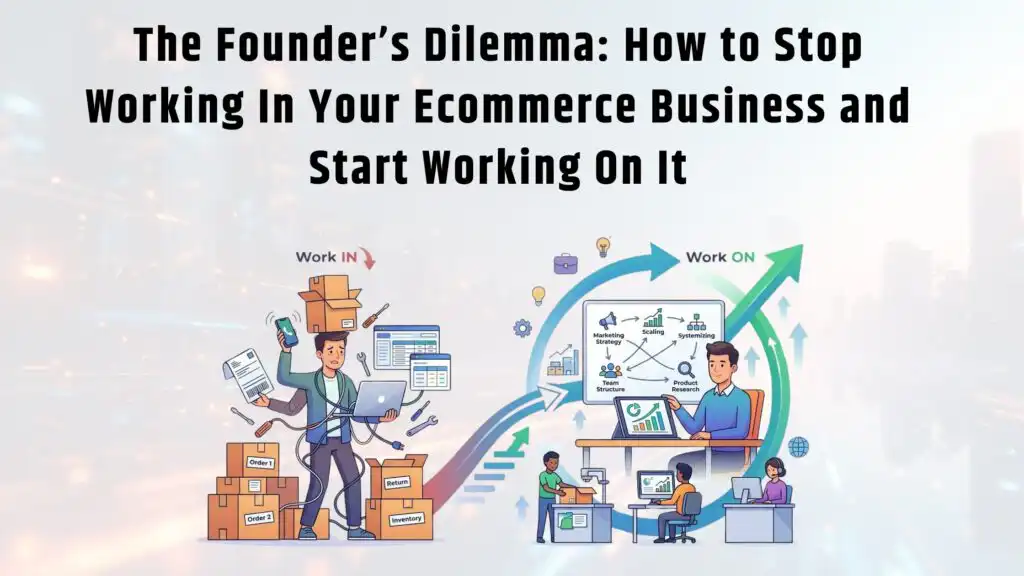
Most ecommerce founders in India begin their journey with a powerful dream — freedom, control, and financial independence. The idea of building a brand, selling products online, and creating a scalable business is exciting. Ecommerce seems like the perfect opportunity to escape the limitations of traditional jobs and build something meaningful.
But after a few years, the reality often looks very different.
Instead of focusing on growth and strategy, founders find themselves buried in daily operations. They are replying to courier issues, resolving customer complaints, adjusting ads every few hours, checking inventory late at night, and constantly monitoring orders.
What started as a business slowly turns into another job — except this time, the boss is the business itself.
If you often find yourself responding to courier messages, fixing listings, checking ad campaigns daily, and tracking orders at midnight, it’s a strong signal that you’re not running a scalable company yet.
You’re running operations.
This is one of the most common traps in ecommerce entrepreneurship. Understanding it — and learning how to escape it — is what separates founders who stay stuck at ₹5–10 lakh per month from those who build ₹1 crore+ scalable brands.
Let’s break down this dilemma and understand how founders can move from operators to architects of their businesses.
1. The Trap: Founder Dependency Syndrome
In the early stages of ecommerce, founders naturally do everything themselves. They manage listings, talk to suppliers, handle customer messages, check orders, and even pack products.
At first, this feels like dedication and hustle.
But over time, it creates something dangerous — founder dependency.
Founder dependency happens when the entire business relies on the founder’s presence to function daily.
If the founder stops working for a few days, operations slow down or collapse.
That’s not a scalable business. That’s a fragile system.
Most ecommerce brands go through three stages of this problem.
Early Stage
In the beginning, founders personally manage listings, pricing, supplier coordination, and customer communication.
This saves money because no team is required. But it consumes enormous time and energy. Instead of thinking about brand positioning or market expansion, founders spend their days solving operational issues.
Mid Stage
As orders increase, founders start hiring team members — customer support executives, warehouse staff, or digital marketers.
However, many founders still micromanage every decision. Every refund needs approval. Every ad change needs confirmation. Every supplier discussion requires the founder.
The result is constant stress and burnout.
Scaling Stage
Eventually the business hits a plateau.
Even though orders may increase, growth slows down because the founder becomes the bottleneck. No one else in the team feels empowered to make decisions, and everything depends on the founder’s availability.
At this stage, the business stops scaling.
The most important truth every founder must accept is this:
If your presence is required daily for routine operations, you don’t own a company — you own a system that owns you.
2. The Mindset Shift: From Operator to Architect
The breakthrough in ecommerce growth happens when founders shift their identity.
Instead of being the person who does everything, they become the person who designs the system that does everything.
This is the difference between an operator and an architect.
Operators focus on execution.
Architects focus on structure.
An operator asks:
“How can I do this task faster?”
An architect asks:
“How can this task happen without me?”
This shift in thinking is powerful because it changes how you approach every business problem.
Instead of trying to work harder, you start building systems, processes, and teams that allow the business to operate independently.
This is exactly how CEOs think.
They don’t run every activity. They build a structure where the right people, processes, and metrics drive the business forward.
And this is often the difference between:
A ₹10 lakh per month operator, and
A ₹1 crore per month entrepreneur.
3. The 4-Step Exit from Founder Dependency
Escaping founder dependency doesn’t require massive changes overnight. It happens through structured steps that slowly remove the founder from daily operations.
Here are four practical steps ecommerce founders can implement.
1. Define the Three Roles You Should Never Handle Daily
Many founders unknowingly stay stuck because they continue performing operational tasks long after the business has grown.
There are three roles founders should avoid managing daily:
- Customer service
- Dispatch or inventory management
- Campaign management
If you are personally responding to customer complaints, checking courier issues, or adjusting ad campaigns every day, your time is trapped in operations.
Instead, founders should focus on high-value activities such as:
- Strategy and long-term planning
- Aligning the team with growth goals
- Partnerships, brand collaborations, and innovation
These are the areas where founders create the biggest impact.
2. Document Everything Once
Most founders hesitate to delegate because they believe no one else understands the work as well as they do.
But the real solution is documentation.
Every recurring task in your business should have a Standard Operating Procedure (SOP).
For example:
- Order processing workflow
- Return and refund process
- Ad performance review protocol
- Daily sales reporting format
- Inventory restocking process
When these tasks are documented clearly, new team members can execute them without constant guidance.
A simple rule can help here:
If a task happens twice, document it once.
Over time, this builds an operational manual for your business.
3. Build a Decision Delegation System
Another major reason founders remain stuck is decision overload.
Every small decision reaches the founder’s desk.
Refund approvals, exchange requests, courier escalations, discount permissions — everything waits for founder confirmation.
The solution is to create decision boundaries for the team.
For example:
“If a refund amount is under ₹1,000, customer support can approve it without asking the founder.”
This one simple rule can eliminate dozens of daily interruptions.
Similarly, ad managers can be given limits like:
“Campaign budgets can be adjusted by up to 20% without approval.”
These frameworks allow teams to act quickly while still maintaining control.
4. Create a Founder Dashboard
Founders often believe they must constantly monitor operations to ensure everything runs smoothly.
But experienced entrepreneurs rely on dashboards, not daily firefighting.
Instead of checking hundreds of small details, track just a few key metrics every week.
A simple founder dashboard could include:
- Total sales revenue
- Profit margins
- Advertising ROI
- Inventory health
- Customer satisfaction or return rates
If these five numbers look healthy, the business is functioning correctly.
This allows founders to stay informed without being involved in every operational task.
4. The 5-Hour CEO Framework
One of the biggest myths in entrepreneurship is that founders must work nonstop to succeed.
In reality, successful founders focus on high-impact thinking, not endless execution.
A useful framework is the 5-Hour CEO Week, where founders dedicate limited but focused time to strategic activities.
Strategy Deep Work (2 Hours)
This time is dedicated to long-term thinking.
Product expansion, new markets, pricing strategies, brand positioning, and customer experience innovations are explored here.
This is where the future of the business is designed.
Team Alignment (1 Hour)
Weekly meetings with key team members ensure everyone understands priorities and goals.
This prevents miscommunication and keeps the organization moving in the same direction.
Partner and Vendor Conversations (1 Hour)
Strategic partnerships with suppliers, marketplaces, influencers, or marketing agencies often unlock new growth opportunities.
Founders should spend time strengthening these relationships.
Dashboard Review (1 Hour)
Instead of constant monitoring, founders review the key metrics dashboard and evaluate whether the business is moving in the right direction.
Learning and Self-Upgrade (1 Hour)
Markets evolve rapidly.
Investing time in learning about ecommerce trends, marketing strategies, technology tools, and leadership skills ensures founders remain ahead of competitors.
This entire structure requires only about five focused hours each week, yet it provides direction, clarity, and growth.
5. The Freedom Multiplier
The moment founders stop being the operational engine of their business, something powerful happens.
- The team starts taking ownership.
- Systems begin functioning smoothly.
- Decisions move faster.
And the founder gains the mental space required to focus on growth, expansion, and innovation.
This is where the real rewards of entrepreneurship begin.
Because the ultimate goal of building a business is not just revenue.
It’s freedom.
- Freedom to think bigger.
- Freedom to explore opportunities.
- Freedom to create something that grows beyond the founder.
When a business runs on systems rather than constant founder involvement, scaling becomes far easier.
That is when ecommerce stops being stressful and starts becoming a true wealth-building machine.
Ready to Step Out of Daily Chaos?
Many ecommerce founders know they need systems, but they don’t know where to start.
That’s exactly why the Brand Chanakya Profit Consultation Framework was created.
We help ecommerce founders:
- Build scalable operational systems
- Eliminate founder dependency
- Identify hidden profit leaks
- Create growth strategies that scale sustainably
Instead of running your store every day, you learn how to run the system that runs the store.
Ready to step out of daily chaos and build a scalable ecommerce business?
Build your Ecommerce Growth System with Brand Chanakya today.
Follow us on Instagram: @brand_chanakya