

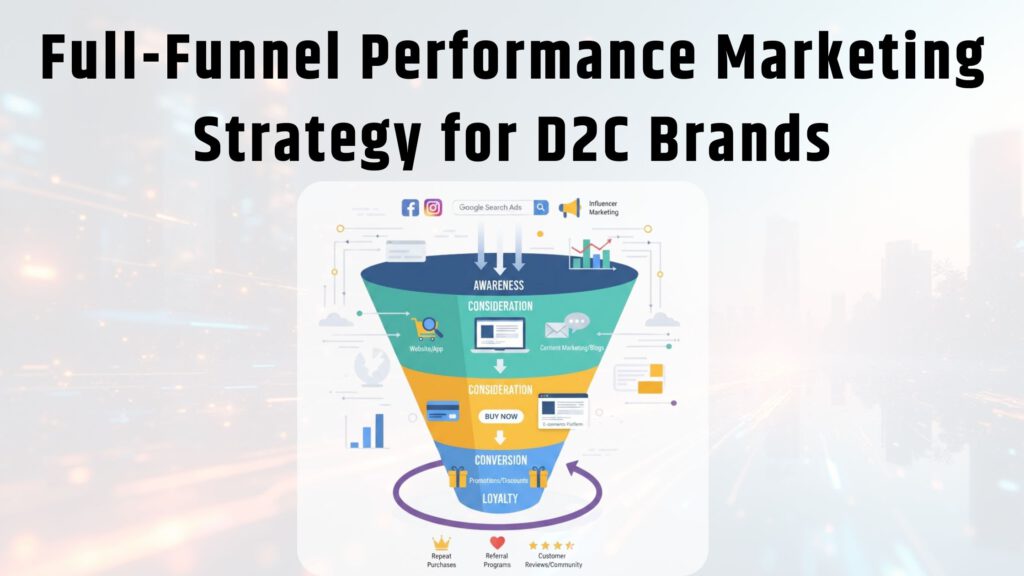
Most D2C brands approach performance marketing with a narrow mindset: run ads, get clicks, and hope for conversions. While this may generate short-term sales, it rarely leads to sustainable or profitable growth. High-performing D2C brands think differently. They build a full funnel performance marketing strategy that guides customers from first touch to repeat purchase.
A full-funnel approach ensures that marketing efforts are not limited to conversions alone but support awareness, consideration, trust, and long-term customer value. This blog explains what full-funnel performance marketing really means for D2C brands, how to structure it, and why it is essential for scaling profitably.
What Full-Funnel Performance Marketing Means for D2C Brands
Full-funnel performance marketing is the practice of designing paid marketing efforts across the entire customer journey rather than focusing only on the final conversion.
For D2C brands, the funnel typically includes:
- Awareness and discovery
- Consideration and education
- Conversion and purchase
- Retention and repeat buying
Each stage serves a different purpose and requires a different messaging approach. Brands that invest only in bottom-of-the-funnel ads often struggle with high acquisition costs and declining efficiency over time.
Why Single-Stage Marketing Fails in D2C
Many D2C brands fail because they rely almost entirely on conversion-focused ads. These ads target users who are already ready to buy, which works only until the audience pool becomes saturated.
When this happens, costs rise and growth slows. Without top-of-the-funnel and mid-funnel activity, brands have no pipeline of new users entering the ecosystem.
A full-funnel performance marketing strategy ensures a steady flow of new audiences while nurturing them toward conversion in a structured way.
Top-of-Funnel Strategy: Creating Demand
The top of the funnel focuses on awareness and discovery. At this stage, users may not know the brand or even realize they have a specific problem.
Top-of-funnel campaigns are designed to:
- Introduce the brand
- Highlight the problem it solves
- Build initial familiarity
Platforms like Meta, YouTube, and short-form video channels are commonly used here. The goal is not immediate sales but audience building and engagement.
Strong top-of-funnel activity reduces pressure on conversion campaigns later in the funnel.
Mid-Funnel Strategy: Building Trust and Consideration
Mid-funnel performance marketing targets users who are already aware of the brand but need more information before purchasing.
This stage focuses on:
- Product education
- Addressing objections
- Building credibility and trust
Content such as testimonials, product demos, founder narratives, and comparisons perform well here. Mid-funnel campaigns significantly improve conversion rates by warming up audiences before they see sales-focused ads.
Ignoring this stage often results in low conversion efficiency and higher CAC.
Bottom-of-Funnel Strategy: Driving Conversions
Bottom-of-the-funnel campaigns are where purchases happen. These ads target high-intent users who have already interacted with the brand or shown strong buying signals.
At this stage, clarity matters more than creativity. Messaging should focus on:
- Clear value propositions
- Pricing and offers
- Social proof
- Strong calls to action
Because users are already familiar with the brand, conversion rates are naturally higher when supported by top and mid-funnel efforts.
Aligning Platforms with Funnel Stages
A strong full-funnel performance marketing strategy assigns clear roles to each platform instead of expecting one platform to do everything.
For example:
- Social platforms create awareness and interest
- Search platforms capture existing demand
- Video builds trust and brand recall
- Retargeting improves efficiency
This alignment prevents overdependence on a single channel and creates a balanced growth system.
Budget Distribution Across the Funnel
One of the most common mistakes D2C brands make is allocating nearly all budgets to bottom-of-the-funnel campaigns. While this may look efficient initially, it limits long-term growth.
A full-funnel strategy typically allocates budgets across:
- Top-of-funnel for audience expansion
- Mid-funnel for trust-building
- Bottom-of-funnel for conversions
The exact split depends on brand maturity, but ignoring any stage weakens the entire system.
Role of Creatives in Full-Funnel Performance Marketing
Creative strategy changes at every stage of the funnel. Using the same ad creatives across all stages leads to fatigue and poor performance.
Top-of-funnel creatives focus on storytelling and relatability.
Mid-funnel creatives focus on education and proof.
Bottom-of-funnel creatives focus on clarity and urgency.
D2C brands that align creatives with funnel stages see more stable performance and lower acquisition costs.
Measuring Success Across the Funnel
Full-funnel performance marketing success cannot be measured using a single metric. Each stage has its own indicators.
Top-of-funnel is measured through reach, engagement, and audience growth.
Mid-funnel focuses on click-through rates, content engagement, and assisted conversions.
Bottom-of-funnel is measured through conversion rates, CAC, and contribution margins.
Evaluating the funnel holistically prevents incorrect optimization decisions.
How Full-Funnel Strategy Improves Profitability
A well-executed full-funnel performance marketing strategy reduces long-term acquisition costs. As audiences become familiar with the brand, conversion efficiency improves and dependency on discounts decreases.
Over time, brands experience:
- Lower blended CAC
- Higher conversion rates
- Stronger brand recall
- Improved customer lifetime value
This is why full-funnel strategies are essential for scaling without burning capital.
Common Full-Funnel Mistakes D2C Brands Make
Even brands attempting full-funnel marketing often make mistakes such as:
- Treating awareness as a waste of money
- Cutting top-of-funnel during short-term dips
- Using conversion creatives at every stage
- Measuring funnel stages in isolation
Avoiding these mistakes requires patience, data clarity, and a long-term view of growth.
Final Thoughts
Full-funnel performance marketing is not about spending more money. It is about spending money more intelligently across the customer journey.
D2C brands that build structured funnels acquire customers more efficiently, scale with stability, and protect margins over time. Brands that rely only on conversion ads often struggle with volatility and rising costs.
A full-funnel approach turns performance marketing into a predictable growth system rather than a risky experiment.
Build a Full-Funnel Growth System with Brand Chanakya
At Brand Chanakya, we help D2C brands design and execute full-funnel performance marketing strategies focused on profitability and scale.
If your brand is stuck chasing conversions and wants a structured growth system, Brand Chanakya helps you build funnels that convert, retain, and scale sustainably.
Talk to the experts at Brand Chanakya today
Follow us on Instagram: @brand_chanakya