 Special Offer - Flat 18% off on annual payments!


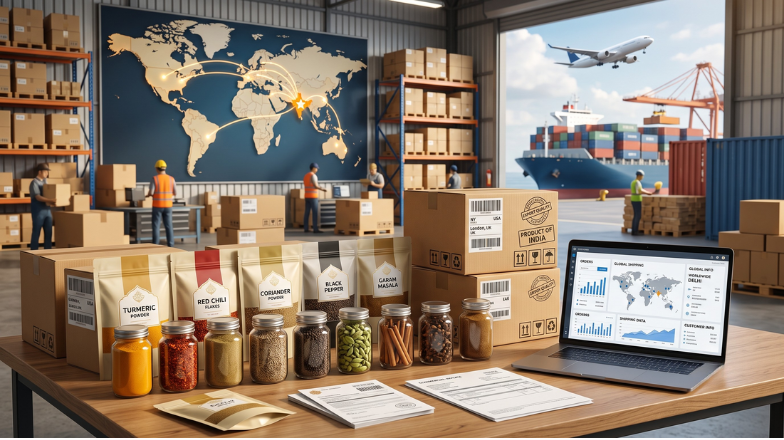
India is the world’s largest producer, consumer, and exporter of spices. Yet most Indian spice brands limit themselves to the domestic market, leaving a massive international opportunity on the table. With ecommerce, you can now sell your masala directly to customers in the US, UK, UAE, and beyond — without the complexity of traditional export.
This guide covers how to take your spice brand international through ecommerce channels, from compliance requirements to platform selection to logistics.
The Export Opportunity
India accounts for 45% of global spice exports. The top exported spices include chili, cumin, turmeric, coriander, and pepper. What’s changing is the channel mix — while bulk B2B exports still dominate, branded consumer-packaged exports are growing rapidly.
Why Export Now?
- Indian diaspora demand: 30+ million Indians abroad actively seek authentic Indian spices
- Health trend: Turmeric, ginger, and other spices are trending globally for health benefits
- Premium pricing: Your ₹100 masala can sell for $8-15 internationally
- Ecommerce accessibility: Amazon Global, Shopify, and other platforms make direct export possible
- Government support: Spices Board, APEDA, and various schemes support spice exporters
Top Markets for Indian Spices
🇺🇸 United States
Market Size: $800M+ for ethnic spices | Growth: 12% YoY
Largest import market for Indian spices. Strong Indian diaspora (4.5M), plus mainstream American interest in Indian cuisine. Amazon US is the primary ecommerce channel. Focus on turmeric, curry powders, garam masala, and ready-to-cook spice mixes.
🇦🇪 UAE & Middle East
Market Size: $500M+ | Growth: 10% YoY
3.5 million Indians in UAE alone. High disposable income, strong demand for premium and organic spices. Amazon UAE and Noon are key platforms. Biryani masalas, tandoori blends, and whole spices are top sellers.
🇬🇧 United Kingdom
Market Size: $300M+ | Growth: 8% YoY
1.8 million British Indians plus mainstream adoption of Indian food (chicken tikka masala is a national dish). Amazon UK and ethnic grocery stores are key channels. Curry powders and recipe-specific masalas dominate.
🇨🇦 Canada
Market Size: $200M+ | Growth: 15% YoY
Fastest-growing Indian diaspora (1.8M+, rapidly increasing). Amazon Canada and specialty grocers. Similar preferences to US market with strong demand for organic and clean-label products.
🇦🇺 Australia
Market Size: $150M+ | Growth: 14% YoY
Growing Indian population (800K+) and mainstream interest in Asian cuisines. Amazon Australia is developing; specialty import stores still important. Premium positioning works well.
Compliance & Documentation
Exporting spices requires more compliance than domestic sales. Different countries have different requirements, but here’s the common framework:
- ✓IEC (Import Export Code): Mandatory for all exports. Apply at DGFT website.
- ✓FSSAI License: Central license required for export (not State license)
- ✓Spices Board Registration: Required for claiming government incentives
- ✓RCMC (Registration Cum Membership Certificate): From Spices Board or relevant EPC
- ✓GST Registration: With LUT (Letter of Undertaking) for zero-rated exports
- ✓AD Code: Authorized Dealer code from your bank for forex
Country-Specific Requirements
USA (FDA Requirements):
- FDA Facility Registration (for your manufacturing unit)
- Prior Notice before each shipment
- Compliance with FSMA (Food Safety Modernization Act)
- Nutritional labeling per FDA format
- No added colors unless FDA-approved
UK/EU Requirements:
- Health Certificate from EIC (Export Inspection Council)
- Phytosanitary Certificate if required
- EU-compliant labeling (allergens, origin, nutritional info)
- Pesticide residue compliance (MRL limits)
- Post-Brexit: UK has separate requirements from EU
UAE/GCC Requirements:
- Halal certification (strongly recommended)
- GSO (Gulf Standards Organization) compliant labeling
- Health Certificate
- Arabic language on labels
The #1 reason for spice export rejections is pesticide residue exceeding Maximum Residue Limits (MRL). US, EU, and Japan have strict limits. Get your products tested at NABL-accredited labs before export. Work with farmers who follow Good Agricultural Practices (GAP).
Ecommerce Platforms for Export
| Platform | Best For | Commission | Complexity |
|---|---|---|---|
| Amazon Global Selling | US, UK, UAE, Canada, Australia | 15-20% + FBA fees | Medium |
| eBay Global | US, UK, Australia | 12-15% | Low |
| Alibaba/Alibaba.com | B2B bulk orders globally | Membership fee | Low |
| Etsy | Specialty/artisanal spices | 6.5% + payment fees | Low |
| D2C Website (Shopify) | Brand building, premium | 2-3% payment fees | High |
| Noon (UAE) | Middle East specifically | 10-20% | Medium |
Amazon Global Selling: Deep Dive
Amazon Global Selling is the most accessible route for Indian spice brands to reach international customers. Here’s how it works:
How Amazon Global Selling Works
- Register on Amazon.in as a seller (if not already)
- Enable Global Selling in Seller Central
- Choose target marketplace (US, UK, UAE, etc.)
- Create listings in the target marketplace
- Ship inventory to Amazon FBA in the target country
- Amazon handles fulfillment to end customers
Two Fulfillment Options
FBA (Fulfillment by Amazon):
- Ship bulk inventory to Amazon’s warehouse in the target country
- Amazon handles storage, picking, packing, shipping, returns
- Products get Prime badge = higher visibility and conversion
- Higher upfront cost but easier to scale
MFN (Merchant Fulfilled Network):
- You ship directly from India to each customer
- Lower upfront cost but higher per-order cost
- Longer delivery times (no Prime)
- Good for testing demand before FBA investment
- ✓Valid IEC (Import Export Code)
- ✓International bank account or Amazon Currency Converter
- ✓FDA registration (for US)
- ✓Compliant labeling for target country
- ✓Product liability insurance (recommended)
- ✓Trademark registration in target country (for Brand Registry)
D2C International Website
For brands wanting higher margins and direct customer relationships, a D2C website with international shipping is viable:
Setting Up International D2C
- Platform: Shopify with Shopify Markets or WooCommerce with currency plugins
- Payments: PayPal, Stripe (supports international cards)
- Shipping: DHL Express, FedEx International, or aggregators like ShipRocket Global
- Duties: Use DDP (Delivered Duty Paid) pricing to avoid customer surprises
D2C Export Challenges
- You drive all traffic (no Amazon’s customer base)
- International shipping costs are high for small orders
- Customer acquisition cost is higher
- Returns/refunds are complicated
Best approach: Start with Amazon Global to validate demand and build reviews, then launch D2C for repeat customers and higher margins.
International Logistics
Shipping Options
For FBA (Bulk to Amazon Warehouse):
- Sea freight for large shipments (20-30 days, lowest cost)
- Air freight for faster replenishment (5-7 days, higher cost)
- Use Amazon’s partnered carriers or freight forwarders
For Direct-to-Customer:
- DHL Express: 4-7 days, premium pricing, excellent tracking
- FedEx International: 4-7 days, competitive rates
- India Post EMS: 10-15 days, lowest cost, acceptable for small orders
Typical Shipping Costs (Per Kg)
| Destination | Express (DHL/FedEx) | Economy (EMS) |
|---|---|---|
| USA | ₹2,500-3,500 | ₹800-1,200 |
| UK | ₹2,200-3,000 | ₹700-1,000 |
| UAE | ₹1,500-2,000 | ₹500-800 |
| Canada | ₹2,500-3,500 | ₹900-1,300 |
| Australia | ₹2,800-4,000 | ₹1,000-1,500 |
Getting Started: Step by Step
Get Your Documentation Ready
Apply for IEC (takes 1-2 days online). Upgrade to FSSAI Central license if you have State license. Register with Spices Board. Open an AD Code-linked bank account.
Choose Your Target Market
Start with ONE market. USA or UAE are recommended for beginners due to large Indian diaspora and established Amazon presence. Don’t spread thin across multiple countries initially.
Ensure Product Compliance
Get pesticide residue testing done. Create compliant labels for your target market. Register with FDA (for USA). Get Halal certification (for UAE).
Set Up Amazon Global Selling
Register on Amazon.in, enable Global Selling, create your first listings. Start with MFN (ship from India) to test demand before investing in FBA inventory.
Ship Test Inventory
Send initial shipment to Amazon FBA warehouse. Start small (50-100 units per SKU) to validate demand. Use air freight for first shipment to get live faster.
Launch & Optimize
Go live, run initial PPC campaigns, gather reviews, and iterate. Once you hit consistent sales, scale inventory and consider adding more markets.
Ready to Take Your Spices Global?
Brand Chanakya helps spice brands navigate international ecommerce — from compliance to Amazon Global Selling to international marketing.
Frequently Asked Questions
How much does it cost to start exporting spices?
Budget ₹2-5 lakhs for a serious start. This includes: IEC and registrations (₹5-10K), compliance testing (₹20-50K), FDA registration (₹15-25K), packaging for export (₹30-50K), initial inventory to FBA (₹50K-1L), and marketing/advertising (₹50K-1L). You can start smaller with MFN (ship from India) to test demand first.
Can small brands export, or is it only for big companies?
Small brands can absolutely export. Amazon Global Selling and platforms like Etsy have made it accessible. Many successful exporters started with a few SKUs and scaled gradually. The key is compliance — even small exporters must meet all documentation and quality requirements.
What margins can I expect on exports?
Export margins are typically higher than domestic. A ₹100 MRP product domestically might sell for $8-12 (₹650-1000) internationally after accounting for shipping and fees. Net margins of 30-50% are achievable for well-run export operations, compared to 15-25% domestically.
Which spices sell best internationally?
Top sellers: Turmeric powder (for health market), garam masala, curry powder, cumin, red chili powder, biryani masala, tandoori masala. Ready-to-cook spice mixes for specific dishes do well as they solve a problem for diaspora customers. Organic and clean-label products command premiums.
Do I need to change my packaging for export?
Usually yes. Export packaging needs: target country language, FDA/EU compliant nutritional labels, allergen declarations, country of origin prominently displayed, and often different net weight markings (oz/lb for US). Many brands create separate SKUs for export rather than modifying domestic packs.
Brand Chanakya
Digital growth agency specializing in ecommerce for food & FMCG brands. ₹1 Cr+ ad spend managed. Based in Udaipur, serving clients across India.