 Special Offer - Flat 18% off on annual payments!


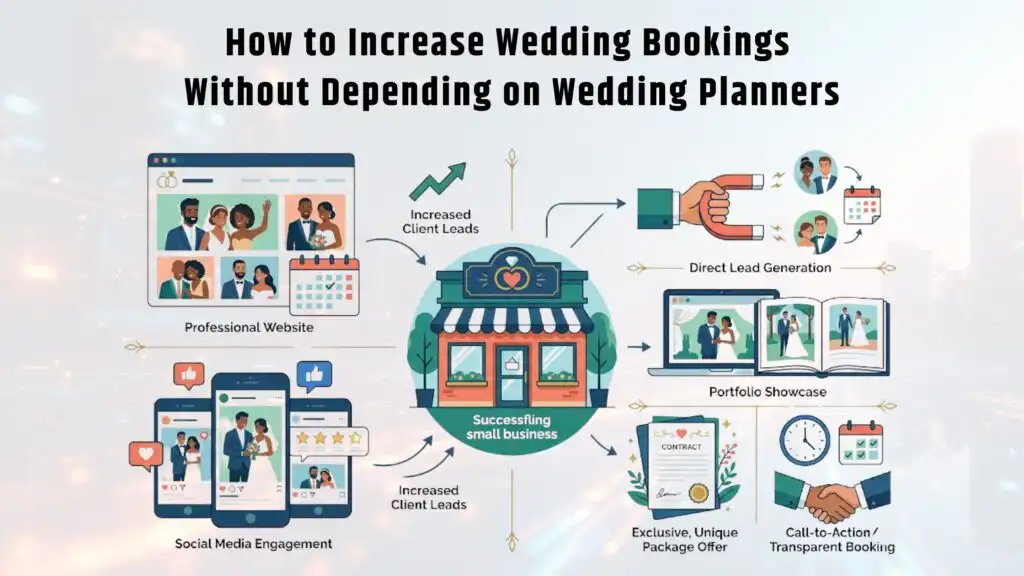
For many wedding hotels and luxury resorts, wedding planners feel like a necessity. They bring clients, manage communication, and help close bookings. On the surface, this looks like a win-win.
But behind the scenes, there’s a hidden cost.
Heavy dependence on wedding planners often leads to reduced margins, inconsistent booking flow, and limited control over your own brand positioning. In many cases, hotels become execution partners instead of destination choices.
The most successful wedding properties today are shifting this model. They are not removing planners completely—but they are no longer dependent on them.
They are building direct demand.
And that changes everything.
The Hidden Cost of Planner Dependency
At the early stage, working with planners helps fill your calendar. They already have a client network, and they can bring inquiries faster than building your own system.
But over time, three major problems start to appear.
First, margins shrink. Planners often negotiate aggressively or expect commissions, which directly reduces your profitability per event.
Second, your brand becomes invisible. The client trusts the planner, not your property. Even if they love your venue, the credit goes to the planner who “found” it.
Third, your bookings become unpredictable. If a planner shifts focus to another venue or city, your pipeline dries up instantly.
This is why relying only on planners is not a growth strategy. It’s a temporary support system.
If you want consistent, high-quality wedding bookings, you need a parallel system that generates direct inquiries.
The Power of Direct Wedding Inquiries
When a couple reaches out to you directly, the entire dynamic changes.
You are no longer competing through a middleman. You are speaking to the decision-maker. You control the narrative, the pricing, and the experience.
Direct inquiries bring three major advantages.
You retain full margins because there is no commission layer.
You build brand recall because the couple discovered you, not a planner.
And most importantly, you create a predictable pipeline that you own.
Hotels that generate consistent direct inquiries don’t chase bookings. Bookings come to them.
Step 1: Shift from “Hotel” to “Wedding Venue” Positioning
The biggest mistake most properties make is positioning themselves as hotels that also do weddings.
That doesn’t work.
From a customer’s perspective, there is a big difference between a hotel and a wedding venue. A hotel is functional. A wedding venue is emotional.
If your website, social media, and ads talk about rooms, amenities, and facilities, you are attracting travelers—not couples planning weddings.
To generate direct demand, your entire brand needs to communicate one clear message:
“This is a place where weddings happen.”
This shift alone can change the quality and volume of your inquiries.
Step 2: Build a Digital Presence That Creates Aspiration
Wedding decisions are not logical. They are visual and emotional.
Couples don’t compare spreadsheets. They imagine experiences.
Your digital presence should help them visualize their wedding at your property.
This means moving away from generic hotel content and focusing on wedding storytelling.
Show real weddings. Show decorated spaces. Show entry moments, celebrations, emotions, and scale.
Your Instagram should feel like a wedding album, not a hotel catalog.
When done right, your content itself becomes a lead generator. Couples discover your property, connect emotionally, and initiate inquiries without any external push.
Step 3: Generate Your Own Demand Through Paid Campaigns
If you want predictable bookings, you cannot rely only on organic reach or references.
You need a controlled demand generation system.
Paid advertising allows you to reach couples who are actively planning weddings in specific cities, budgets, and timelines.
But the approach needs to be precise.
Running generic ads about your hotel will not work. Your campaigns should clearly communicate that you are a wedding destination.
The messaging should create urgency and relevance. It should speak directly to couples looking for venues, not travelers looking for stays.
When executed properly, paid campaigns become a consistent source of direct inquiries—independent of planners.
Step 4: Create a Dedicated Wedding Inquiry Funnel
One of the most common mistakes hotels make is sending all traffic to their homepage.
But a homepage is not designed to convert wedding inquiries.
A couple visiting your website is not interested in your room categories or dining options. They are looking for clarity about weddings.
A dedicated wedding funnel solves this problem.
It provides focused information about your venue’s wedding capabilities, showcases real events, and makes it easy to inquire.
More importantly, it guides the user toward the next step—usually a site visit.
When your funnel is clear and structured, your conversion rate improves significantly, even with the same amount of traffic.
Step 5: Take Control of the Conversation
When inquiries come through planners, the conversation is filtered.
When inquiries come directly, you control the experience.
This is where most hotels miss opportunities.
Delayed responses, generic replies, or lack of follow-up can quickly turn a potential booking into a lost lead.
Speed and structure are critical.
The faster you respond, the higher your chances of securing a site visit.
And in wedding sales, site visits are the turning point. Once a couple experiences your property in person, the probability of conversion increases dramatically.
By managing your own inquiry flow, you improve not just the number of leads—but the quality of conversions.
Step 6: Build a Brand That Planners Also Respect
Interestingly, when you build strong direct demand, even planners start treating you differently.
Instead of negotiating heavily or pushing alternatives, they begin to see your property as a premium option.
Your brand value increases.
This creates a balanced ecosystem where planners still bring business—but you are not dependent on them.
You operate from a position of strength, not dependency.
Step 7: Focus on Long-Term Brand Equity, Not Short-Term Bookings
The ultimate goal is not just to fill this season’s calendar.
It is to build a brand that consistently attracts weddings year after year.
When couples start discovering your property directly, when your venue becomes recognizable in your city or niche, and when your digital presence continuously reinforces your positioning, you move from being an option to being a preference.
That is when your marketing starts working for you—even when you are not actively pushing it.
Final Thought: From Dependency to Control
Wedding planners are not the problem. Over-dependence is.
The most successful wedding hotels understand this balance.
They collaborate with planners but invest in building their own demand engine.
Because at the end of the day, the real growth comes when:
You control your leads
You control your brand
You control your margins
And that only happens when couples start coming to you directly.
Ready to Build Your Own Wedding Inquiry System?
If your property has the potential to host weddings but is still dependent on planners or references, it’s time to shift your strategy.
Because the future of wedding hospitality does not belong to the most connected venues—
it belongs to the most visible and well-positioned ones.
Stop relying on planners — create a consistent flow of direct wedding bookings for your venue today.
Follow us on Instagram:- @brand_chanakya