
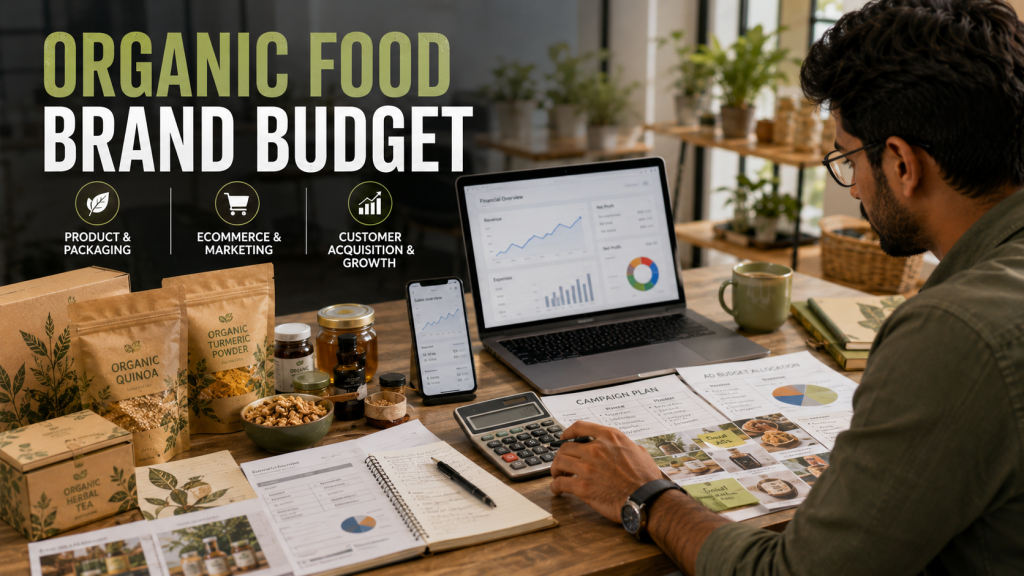
If you’re opening a physical retail store, nobody questions setting aside money for rent, interiors, and staff on top of inventory. Yet when the same entrepreneur launches an organic food brand online, that equivalent budget for marketing and operations often gets skipped entirely. This is one of the most under-discussed reasons promising brands stall in year one.
The Retail Store Comparison
Think about what it takes to open a small organic food retail outlet. You’d budget for the shop’s rent, interior design, staff salaries, and signage — none of that is optional, and none of it is “inventory.” Online, the equivalent costs are photography, listings, advertising, content, and retention tools. They are just as essential, but far easier to skip because there’s no landlord asking for rent on the 1st of the month.
| Physical Store Cost | Online Equivalent |
|---|---|
| Rent and interiors | Website build and marketplace listing setup |
| Shop signage | Product photography and A+ content |
| Sales staff | Paid advertising and customer service tools |
| Local newspaper ads | Google, Meta, and Amazon advertising |
| Loyalty card programs | Subscription and retention marketing |
Why ₹5-10 Lakh Is a Realistic Range
This isn’t an arbitrary number. It reflects what it actually costs to run a credible online launch for 12 months across listings, ads, content, and a basic D2C presence — not luxury spending, just the essentials done properly.
What This Budget Typically Covers
- Professional product photography and A+ content: ₹40,000-₹80,000
- Basic Shopify/D2C website build: ₹60,000-₹1,50,000
- Marketplace and social media advertising (12 months): ₹2,00,000-₹4,00,000
- Content creation — photography, video, recipes: ₹80,000-₹1,50,000
- Retention tools (CRM, WhatsApp API, email platform): ₹50,000-₹1,00,000
Expert Tip
Treat this budget as a 12-month runway, not a launch-week splurge. Spreading it deliberately across the year prevents the common trap of a big first-month push followed by silence.
What Happens If You Skip This Budget
We’ve seen this pattern repeatedly: a founder spends everything on manufacturing and packaging, launches with a friends-and-family sales spike, and then goes quiet within two to three months because there’s no ongoing budget to reach new buyers.
Common Mistake
Spending the entire available capital on a large first production batch, leaving nothing to actually sell it. Inventory without a marketing budget just sits in a warehouse.
How to Phase the Budget Across Year One
- Months 1-3 (Setup Phase): Heaviest spend — photography, website, initial listing optimization, launch ads
- Months 4-9 (Growth Phase): Steady ad spend, content production, subscription program setup
- Months 10-12 (Reinvestment Phase): Blend early revenue back into ads and retention as sales start covering costs
What If You Only Have a Smaller Budget?
Not every founder can set aside ₹5-10 lakh upfront, and that’s fine — the principle matters more than the exact number. With a smaller budget, focus deeply on one platform (usually Amazon or your D2C site) rather than spreading thin across five channels. A well-executed single-channel launch beats a weak multi-channel one every time.
Measuring Whether the Budget Is Working
| Signal | What It Tells You |
|---|---|
| Cost per order stays flat or drops over time | Marketing spend is becoming more efficient |
| Repeat purchase rate climbs past 20-25% | Retention spend is paying off |
| Organic (non-paid) traffic grows month over month | SEO and content investment is compounding |
Where Founders Usually Cut Corners (And Shouldn’t)
When budgets get tight, certain line items get cut first — usually photography and content, since their impact feels less immediate than an ad campaign. This is often the wrong call. Poor photography reduces conversion on every single channel simultaneously, while a paused ad campaign only affects one channel temporarily.
Common Mistake
Cutting the photography and content budget first when money gets tight. This quietly reduces conversion across every platform at once, while the savings are usually smaller than founders expect.
Funding Sources Beyond Personal Savings
Not every founder has ₹5-10 lakh in personal savings to allocate. Common funding paths for this stage include:
- Reinvesting a portion of early manufacturing margin rather than taking it as profit in year one
- Small business loans or MSME schemes designed for food processing units
- Bringing in a small angel investment specifically earmarked for marketing, keeping manufacturing self-funded
- Phased rollout — launching with a smaller SKU range to reduce upfront inventory cost and freeing capital for marketing
A Simple Way to Sanity-Check Your Own Budget
Before finalizing your number, run this quick check: list your expected monthly revenue at month 6 and month 12 under a realistic (not best-case) scenario. Your marketing budget should be sized so that by month 9-10, revenue is covering a growing share of that spend, rather than depending entirely on external capital indefinitely.
- If month 6 revenue doesn’t cover even 20% of your marketing spend, your channel mix or pricing may need revisiting
- If you’re fully reliant on discounting to hit sales targets, your budget is likely being spent on the wrong things
- Revisit the plan every quarter rather than committing to a rigid 12-month spend upfront
Key Takeaways
- Treat marketing and operations as a dedicated budget line, just like rent for a physical store
- ₹5-10 lakh is a realistic 12-month range for a credible online launch
- Spend heaviest in the first 3 months, then sustain steadily through the year
- A smaller budget still works if focused on one channel done well
- Skipping this budget is the top reason good products never find their buyers
- Sanity-check your budget quarterly against actual revenue, not just the original plan
Conclusion
Manufacturing a great organic product is half the job. The other half — reaching the right buyers consistently — needs its own dedicated budget, planned with the same seriousness as rent for a physical store. Founders who plan for both halves give their brand a real chance to survive past the first year.
Planning Your Launch Budget?
Get a free growth audit with a realistic marketing budget breakdown for your organic food brand.
Frequently Asked Questions
Why do organic food founders need a separate marketing budget?
Because manufacturing and inventory costs alone don’t create sales. Marketing, listings, ads, and retention systems require dedicated budget just like rent and staff would for a physical store.
Is ₹5-10 lakh enough to launch an organic food brand online?
For a small-to-mid scale launch covering the first 12 months of marketing, listings, ads, and content, ₹5-10 lakh is a realistic working range.
What does the ₹5-10 lakh marketing budget actually cover?
Photography, listing optimization, paid ads across platforms, content creation, a basic D2C website, and retention tools for the first year.
Can I launch with a smaller budget than ₹5 lakh?
Yes, but growth will be slower. A smaller budget means prioritizing one or two channels deeply rather than spreading across many.
How should the budget be split across the first year?
Heavier spend in months 1-3 for setup, moderate ongoing spend in months 4-9, and reinvestment of early revenue from month 10 onward.
What happens if I only budget for manufacturing and skip marketing?
Most brands see an initial sales spike from friends and family, followed by a plateau once that limited network is exhausted.
Related Reading
How to Sell Organic Food Online in India
A complete step-by-step guide to launching your organic food brand across channels.
Ecommerce Marketing for Organic Food Brands
Where this ₹5-10 lakh budget actually gets spent — channel by channel.
Why Organic Food Brands Fail Online
The exact pattern this article warns about — budget skipped, momentum lost.