
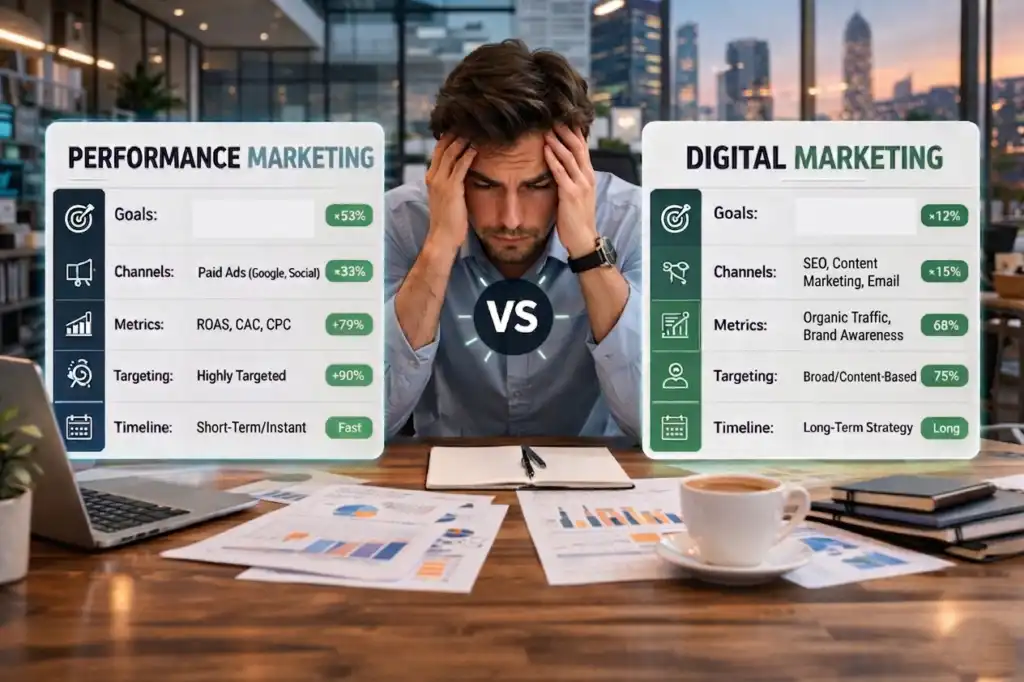
Performance Marketing vs Digital Marketing: What’s the Difference?
“Should we focus on performance marketing or digital marketing?” is one of the most common questions business owners ask us. The confusion is understandable—these terms are often used interchangeably, but they’re not the same thing.
Understanding the difference isn’t just semantics. It affects how you allocate budget, measure success, and build your marketing strategy. Let’s clear up the confusion once and for all.
The Quick Answer
Think of it like this: All performance marketing is digital marketing, but not all digital marketing is performance marketing. Performance marketing is the paid, measurable portion of your digital marketing strategy.
Understanding Each Approach
How They Relate
Content Marketing
Email Marketing
Social Media (Organic)
Brand Building
Facebook Ads
Affiliate Marketing
Programmatic Ads
Influencer (Paid)
is within Digital Marketing
Performance marketing exists within digital marketing. Digital marketing is the whole pie; performance marketing is a specific slice focused on paid, measurable results.
Key Differences: Side-by-Side Comparison
Channels & Tactics
🎯 Performance Marketing Channels
🌐 Digital Marketing Channels
Digital marketing INCLUDES all performance marketing channels plus organic strategies. When someone says “digital marketing,” they might mean everything or just the organic side—always clarify what they mean.
Pros & Cons of Each Approach
Performance Marketing
✅ Advantages
- Pay only for measurable results
- Fast results—start seeing returns in days
- Highly trackable ROI
- Easy to scale up (or down) quickly
- Precise audience targeting
- Real-time optimization possible
- Lower risk—stop anytime if not working
❌ Disadvantages
- Results stop when you stop paying
- Can get expensive in competitive markets
- Doesn’t build lasting brand equity
- Requires ongoing management & optimization
- Ad fatigue requires constant creative refresh
- Platform dependency (algorithm changes)
Digital Marketing (Broader)
✅ Advantages
- Builds long-term brand equity
- Creates owned assets (content, email list)
- Organic traffic has near-zero marginal cost
- Compounds over time
- Less platform dependency
- Builds trust and authority
- Multiple touchpoints in customer journey
❌ Disadvantages
- Slower to see results (especially SEO)
- Harder to measure direct ROI
- Requires consistent effort over time
- No guaranteed results for organic
- Algorithm changes can impact traffic
- Needs diverse skill sets
When to Use Each Approach
Launching a New Product or Business
Need immediate visibility and sales to validate your offering and generate cash flow quickly.
→ Performance Marketing
Building Long-term Brand Awareness
Want to establish thought leadership, build trust, and create lasting brand recognition.
→ Digital Marketing (Organic)
Generating Leads or Sales with Measurable ROI
Need to track exactly how much you’re spending per customer acquired.
→ Performance Marketing
Working with a Limited Budget
Can’t afford ongoing ad spend but can invest time in content and SEO.
→ Digital Marketing (Organic)
Running a Time-Sensitive Promotion
Have a sale, event, or offer that needs immediate traffic and conversions.
→ Performance Marketing
Scaling an E-commerce Business
Need both immediate sales AND sustainable growth for long-term success.
→ Both (Integrated Strategy)
Reducing Customer Acquisition Costs
Want to lower reliance on paid ads by building organic traffic sources.
→ Digital Marketing (Organic)
Competing in a Crowded Market
Need both visibility through ads AND differentiation through content/brand.
→ Both (Integrated Strategy)
Quick Decision Guide
Performance
Digital/Organic
Performance
Digital/Organic
Digital/Organic
Both
The Best Approach: Integrated Strategy
Here’s the truth most successful businesses discover: you need both.
Performance marketing delivers immediate results and pays the bills today. Digital marketing (especially organic strategies) builds assets that reduce your customer acquisition cost over time and create sustainable growth.
Use performance marketing for immediate revenue and testing. Reinvest profits into content, SEO, and brand building. Over time, your organic channels grow, reducing your dependence on paid ads and improving overall profitability.
Typical Budget Evolution
- Year 1 (Startup): 80% Performance / 20% Organic — Focus on immediate cash flow
- Year 2 (Growth): 60% Performance / 40% Organic — Start building organic assets
- Year 3+ (Scale): 50% Performance / 50% Organic — Balanced, sustainable approach
- Mature Business: 40% Performance / 60% Organic — Strong organic foundation
The exact split depends on your industry, competition, and growth goals. But the principle remains: start with what works immediately, then build for the long term.
Frequently Asked Questions
Summary: Making the Right Choice
Performance marketing and digital marketing aren’t competitors—they’re complementary approaches that work best together.
Performance marketing is your engine for immediate, measurable growth. It’s perfect when you need results now, have budget to invest, and want clear ROI tracking.
Digital marketing (the broader picture) builds the foundation for sustainable success. It creates owned assets, reduces long-term costs, and builds brand equity that compounds over time.
The smartest businesses use performance marketing to generate immediate revenue while investing in organic digital marketing for long-term sustainability. Start where you need results, then expand your strategy as you grow.

Brand Chanakya
Brand Chanakya is a leading performance marketing agency in India, helping businesses achieve measurable growth through data-driven strategies. We combine performance marketing expertise with comprehensive digital marketing for sustainable success.