
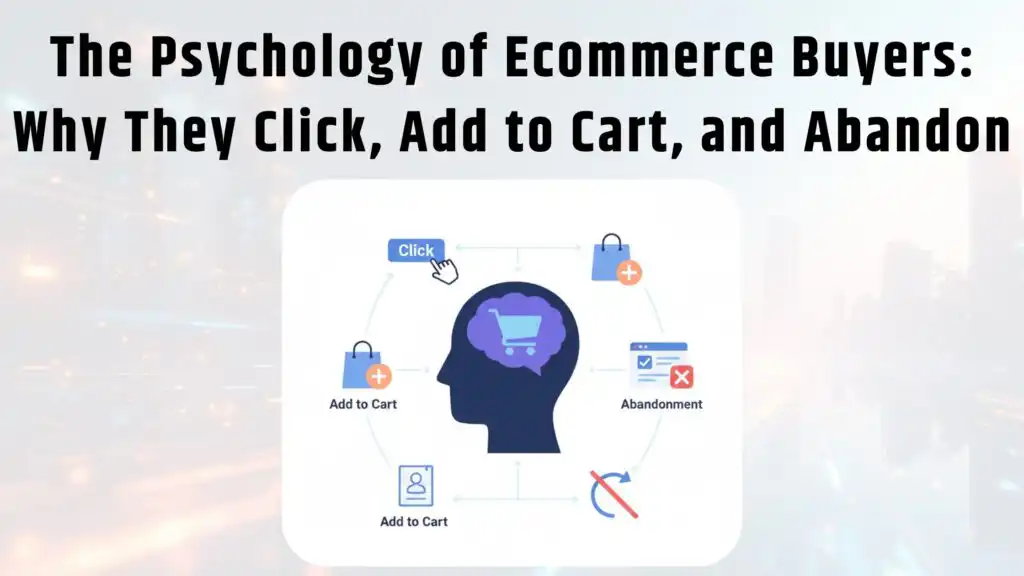
You cannot sell to humans with numbers alone. You sell by understanding what moves them. Every click, scroll, add-to-cart, and abandonment reflects a psychological trigger. Ecommerce brands that understand buyer psychology consistently outperform brands that rely only on discounts and traffic.
Conversion is not just a technology problem or a pricing problem. It is a human decision problem. When you understand how buyers think, evaluate risk, justify spending, and react to uncertainty, you can design experiences that guide them toward action.
Let’s decode how ecommerce customers think — and how you can align your store experience with real buyer psychology.
Why Psychology Matters More Than Features
Most ecommerce product pages focus heavily on specifications, features, and technical details. But human decisions are rarely made purely on logic. Logic supports decisions — emotion drives them.
A customer may compare features across five products, but the final choice is often influenced by trust signals, perceived safety, emotional appeal, and mental comfort. Two products with similar specs can convert very differently based on presentation and reassurance.
This is why conversion optimization is not just UX design. It is applied behavioral psychology.
The Five Core Psychological Drivers Behind Online Purchases
Every ecommerce purchase is influenced by five core mental drivers.
Emotion is the first. People buy how a product makes them feel — confident, attractive, safe, efficient, smart, or relieved. Product pages that translate features into emotional outcomes convert better than pages that list attributes alone.
Trust is the second driver. Online buyers carry risk anxiety. They worry about fake products, poor quality, delivery issues, and refund difficulty. Reviews, real photos, clear policies, and visible credentials reduce this fear.
Urgency is the third. When buyers believe an opportunity may disappear, hesitation reduces. Time limits, limited stock, and seasonal relevance accelerate decisions when used honestly.
Value is the fourth driver. Buyers need to justify spending to themselves. They look for durability, multi-use benefit, savings over time, or uniqueness. Value framing matters as much as price.
Ease is the fifth. Mental effort reduces conversions. Complex choices, crowded pages, and long forms create decision fatigue. Simplicity increases action.
A purely logical product page informs. An emotionally aligned page converts.
The Hidden Emotions Behind Every Click
Clicks are often driven by curiosity, hope, or problem relief. A headline that promises transformation or clarity generates more clicks than one that merely describes the item.
Scroll behavior is driven by reassurance seeking. Buyers scroll to confirm legitimacy, check proof, and reduce doubt. That is why social proof, guarantees, and FAQs placed mid-page improve conversion rates.
Add-to-cart actions are driven by provisional commitment. The buyer is saying “maybe yes.” They are not fully convinced yet. The cart stage is still psychologically reversible — which is why abandonment is common.
Understanding the emotion behind each step helps you design the right reassurance at the right moment.
Why So Many Shoppers Abandon Their Carts
Cart abandonment is not random. It usually happens when psychological friction appears late in the journey.
Unexpected delivery fees create a fairness shock. The buyer feels misled. Too many checkout steps create cognitive fatigue. Poor product photos create last-minute doubt. Long delivery timelines reduce instant gratification. Weak payment-page trust signals increase fear.
Many brands try to fix abandonment with reminders alone. The stronger fix is friction removal. Show total cost early. Display delivery timelines clearly. Offer guest checkout. Show return and refund reassurance near payment.
Every removed surprise increases completion probability.
Cognitive Biases That Influence Ecommerce Decisions
Human brains use mental shortcuts called cognitive biases. Ethical ecommerce design aligns with these biases instead of fighting them.
Social proof is one of the strongest. When buyers see others purchasing and reviewing positively, perceived risk drops. Purchase counters, customer photos, and verified reviews are powerful reassurance tools.
Scarcity increases perceived value. Limited availability signals desirability. This must be real — fake scarcity damages trust when discovered.
Anchoring affects price perception. When a higher reference price is shown first, the current price feels like a gain. This works best when the comparison is honest and explainable.
Loss aversion is another major bias. People are more motivated to avoid missing a benefit than to gain a new one. Messaging that highlights what the buyer may miss often performs better than pure gain framing.
These biases should guide clarity and reassurance — not manipulation.
The Emotional Decision Ladder in Ecommerce
Online buying usually follows an emotional ladder. First comes awareness — mild interest. Then consideration — trust evaluation. Then desire — emotional ownership imagination. Then action — commitment.
Each stage needs different content. Awareness needs visual attraction and relevance. Consideration needs proof and explanation. Desire needs outcome visualization. Action needs urgency and simplicity.
When pages try to push action before trust and desire are built, conversion drops.
Product Page Psychology That Converts
High-conversion product pages translate features into outcomes. Instead of only stating material or size, they explain benefit and experience. They include real-use images, not just studio shots. They answer objections before they are asked.
Trust clusters — reviews, guarantees, certifications, and policy clarity — should appear near decision points. Visual hierarchy should guide attention from value to proof to action.
Microcopy matters. Small phrases near buttons can reduce anxiety and increase confidence. Language that signals safety and control performs better than neutral system language.
Checkout Psychology and Micro-Decisions
Checkout is where hesitation peaks. Buyers reassess risk and effort. Good checkout design reduces cognitive load. Fewer fields, clear progress indicators, and visible security reassurance help.
Price transparency is critical. Hidden costs break psychological contracts. Payment flexibility increases comfort because choice reduces perceived risk.
Encouraging microcopy — short supportive phrases — can improve completion rates. Progress language that feels protective and benefit-focused often outperforms technical wording.
Post-Purchase Psychology and Buyer Validation
Psychology does not end at purchase. After buying, customers seek validation that they made a good decision. Confirmation messages, helpful usage tips, and proactive support reduce buyer’s remorse.
Post-purchase reassurance increases repeat purchase probability and review likelihood. When customers feel smart about buying, they become advocates.
Follow-up education, onboarding content, and loyalty rewards reinforce identity alignment with the brand.
Discounts vs Psychological Value
Discounts trigger response but also train price sensitivity. Psychological value — trust, identity fit, emotional reward, and perceived smart choice — builds stronger margins.
Brands that rely only on discounts attract deal-seekers. Brands that build psychological value attract loyal buyers.
The goal is not just conversion. It is confident conversion.
Measuring Psychological Friction
Behavioral analytics helps detect psychological friction. Sudden drop-offs at specific steps, repeated field errors, short page dwell time, and exit spikes near payment indicate mental resistance points.
Session recordings and heatmaps often reveal hesitation patterns — repeated scrolling, hover pauses, and form restarts. These are psychological signals, not just technical ones.
Optimization should address these signals directly.
Final Thought
Marketing shows your product. Psychology sells it. When you understand the mind behind the click, you stop chasing conversions and start designing them.
Great ecommerce brands are not only data-driven — they are human-aware. They reduce fear, build trust, create desire, and make action feel safe and satisfying.
That is the Brand Chanakya approach — using human insight to make digital growth more human.
Let’s Build Your Conversion Psychology Framework — Book a Consultation with Brand Chanakya
Follow us on Instagram: @brand_chanakya