
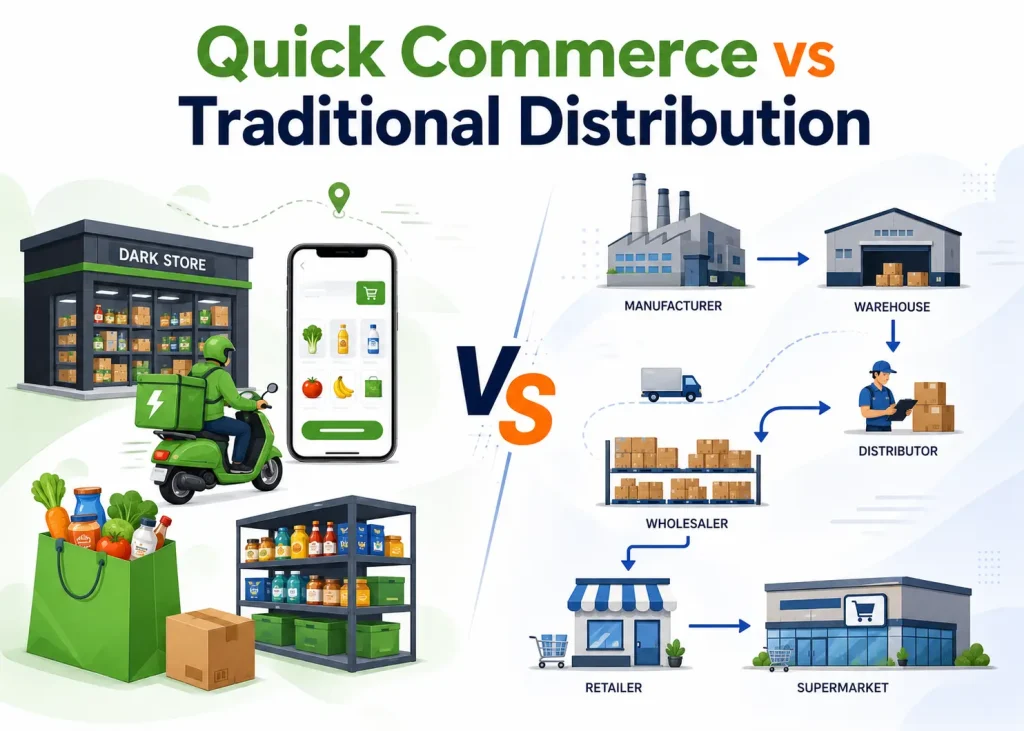
In 2019, traditional FMCG distribution was the backbone of India’s retail market. By 2026, 10-minute delivery platforms have emerged as one of the fastest-growing sales channels. Quick commerce in India crossed ₹25,000 crore in GMV in FY2025–26, while traditional distribution still accounts for the majority of FMCG volume.
So, quick commerce vs traditional distribution in India isn’t about choosing one channel over the other. The real advantage comes from understanding where each channel delivers better reach, margins, speed, and consumer value—and building a strategy that balances both.
“Quick commerce is not a replacement for distribution. It’s a new consumer behavior that punishes brands who ignore it and rewards those who master it early.”
What Quick Commerce Actually Is (And Isn’t)
Quick commerce — or q-commerce — is grocery and FMCG delivery in under 15 minutes, powered by a network of micro-warehouses called dark stores placed every 2–4 km in urban areas. Blinkit operates 700+ dark stores across India. Zepto has 350+ and is expanding aggressively into Tier 2 cities.
Unlike Swiggy or Zomato (which deliver from restaurants), quick commerce platforms work like a digital kirana store — stocking 3,000 to 8,000 SKUs and fulfilling orders instantly.
💡 How a Dark Store Works
A dark store is a 2,000–4,000 sq ft micro-warehouse in a residential area. It’s not open to the public. Staff pick and pack orders in under 3 minutes. A delivery rider takes it to your door within 10 minutes. Your brand needs to be stocked in these dark stores — in the right pin codes — to be discovered.
Traditional distribution, by contrast, is the classic channel: Brand → Super-Stockist → Distributor → Retailer → Consumer. This system reaches every kirana in India and delivers scale no app can match today. But it’s slow, opaque, and gives you zero consumer data.
The Numbers That Changed the Game
The growth trajectory of quick commerce in India is not a blip — it’s a structural shift in how urban India shops for FMCG products.
Quick Commerce vs Traditional Retail: Growth Trajectory (2021–2026)
GMV Index (Base = 100 in 2021). Quick commerce is growing faster than any consumer channel in India’s history.
| Year | ⚡ Quick Commerce (GMV Index) | 🏪 Traditional FMCG Retail (Volume Index) | 🛒 Online Marketplace FMCG (Index) |
|---|---|---|---|
| 2021 | 100 | 100 | 100 |
| 2022 | 210 | 108 | 160 |
| 2023 | 430 | 118 | 230 |
| 2024 | 680 | 130 | 310 |
| 2025 | 1,100 | 143 | 400 |
| 2026 | 1,800 | 158 | 490 |
What these numbers don’t show is the consumer profile shift. Quick commerce skews toward India’s top 50 million households — urban, dual-income, aged 25–40 — who are also your most valuable FMCG buyers. This group is already spending 20–35% of their monthly FMCG budget on Blinkit and Zepto. If your brand isn’t on those platforms, a competitor’s brand is.
Head-to-Head: Quick Commerce vs Traditional Distribution
Let’s put both channels through a practical comparison across the metrics that actually matter to FMCG brand owners.
| Parameter | ⚡ Quick Commerce | 🏪 Traditional Distribution |
|---|---|---|
| Speed to Market | ✓ 7–14 days to go live on Blinkit/Zepto | ✗ 3–6 months to build distributor width |
| Consumer Data | ✓ Real-time — SKU-level, pin-level sales data | ✗ Nil — no visibility below distributor level |
| Geographic Reach | ✗ Top 20–30 cities only (for now) | ✓ Pan-India including Tier 3/4 towns |
| Brand Discoverability | ✓ App search, banners, category rank visibility | ✗ Shelf visibility depends on retailer relationships |
| Gross Margin (avg) | ✗ 25–35% (platform take-rate 18–28%) | ✓ 35–50% depending on trade discount structure |
| Repeat Purchase Rate | ✓ 55–70% (convenience drives habit) | ~ 40–55% (varies by category) |
| New Product Launch Speed | ✓ Instant — catalog update within days | ✗ 2–4 months for retailer adoption |
| Scale Potential | ~ High in urban; limited Tier 2+ currently | ✓ Highest — 12M+ retail outlets in India |
| Promotions & Offers | ✓ Flash sales, app exclusives, platform co-marketing | ✗ Expensive, hard to control execution |
| Cash Flow | ✓ Weekly/fortnightly payouts from platforms | ✗ 30–90 day credit cycles with distributors |
Quick commerce wins on speed, data, and consumer habit formation. Traditional distribution wins on reach, margin, and scale. An FMCG brand that masters both has an insurmountable competitive moat in 2026.
Cost Breakdown: Where Your Margins Actually Go
The most common mistake FMCG brands make is comparing the two channels by topline sales without accounting for the actual cost-to-serve. Here’s a transparent breakdown for a ₹100 MRP product:
⚡ Quick Commerce — ₹100 MRP
| Platform commission | 22% — ₹22 |
| Logistics | 8% — ₹8 |
| Promotions | 12% — ₹12 |
| COGS | 28% — ₹28 |
| Brand margin (net) | 30% — ₹30 |
🏪 Traditional Distribution — ₹100 MRP
| Trade discount | 30% — ₹30 |
| CFA + logistics | 12% — ₹12 |
| BTL marketing | 8% — ₹8 |
| COGS | 12% — ₹12 |
| Brand margin (net) | 38% — ₹38 |
Platform Cost Comparison (As % of MRP)
The margin picture isn’t as grim for quick commerce as it first appears. When you factor in faster inventory turns, zero credit risk (platforms pay weekly vs 45-day distributor credit), and higher repeat rates, the lifetime economics of a QC customer often outperform traditional retail.
Which FMCG Products Actually Win on Quick Commerce
Not every SKU in your catalog belongs on Blinkit. Quick commerce has a very clear consumer behavior pattern: impulsive, immediate, convenience-driven. Products that align with this behavior consistently outperform on q-commerce platforms.
High QC Potential
- ✓ Packaged snacks & munchies
- ✓ Beverages (juices, energy drinks, water)
- ✓ Daily staples (atta, dal, rice — small pack)
- ✓ Personal care basics (soap, shampoo)
- ✓ Baby care (diapers, wipes — urgent need)
- ✓ Health supplements (protein, vitamins)
- ✓ Pet food (premium urban pet owners)
- ✓ Household cleaning products
Better Suited for Traditional Distribution
- ✓ Large bulk packs (5 kg atta, 2L oil)
- ✓ Low-price-point products (₹5–₹20)
- ✓ Rural-first products (agri inputs, rural FMCG)
- ✓ Products requiring cold chain beyond dark stores
- ✗ Impulse, convenience, or urban-first products
- ✗ Products where consumer data matters
- ✗ New product launches needing speed
📦 The SKU Strategy That Works Best
Launch a “quick commerce SKU” — a smaller pack or combo specifically designed for impulse purchase on Blinkit/Zepto. Price it at ₹79–₹149. This prevents channel conflict with your distributor’s larger pack while winning QC algorithms that favor products in the ₹99–₹199 sweet spot.
Why the Best FMCG Brands in India Run Both Channels — Simultaneously
The brands that are outgrowing their categories in India right now are not choosing between quick commerce and traditional distribution. They’re using each channel for what it does best.
Here’s the real playbook:
The Omnichannel FMCG Growth Funnel — How Both Channels Work Together
Quick Commerce / D2C
Traditional / Marketplace
Quick commerce is the trial and discovery engine. A new urban consumer tries your protein bar on Zepto at 11pm because they saw a banner. They love it. Next week they pick it up from a BigBazaar or their local kirana. That kirana reorders from your distributor.
This flywheel — digital discovery → quick commerce trial → traditional retail repeat — is how brands like Yoga Bar, True Elements, and Sleepy Owl scaled from ₹10 crore to ₹100 crore in 3–4 years.
Your 90-Day Omnichannel Strategy to Start Right Now
Here’s a practical roadmap for an FMCG brand that already has traditional distribution and wants to add quick commerce — without disrupting its existing channel relationships.
Week 1–2: Platform Onboarding & SKU Selection
Identify your top 5–8 SKUs with highest impulse potential. Create quick commerce-specific packs if needed. Apply to Blinkit (now open for brand direct) and Zepto’s brand partnership program. Target your top 3 cities first.
Week 3–4: Dark Store Stocking & Listing Optimization
Work with the platform’s onboarding team to get stocked in dark stores covering the right pin codes for your target audience. Optimize your product title, images (3000px minimum), and category tags for platform search algorithms.
Month 2: First Promotions + Data Collection
Run 2–3 platform promotions (flash deals, category banners). Your goal this month is not profit — it’s data. Track which pin codes, day-parts, and SKUs perform best. This data will guide your dark store expansion and inventory planning.
Month 3: Scale + Traditional Channel Sync
Use QC data to push traditional distributors in areas where QC demand is already proven. A pin code trending on Blinkit is a pin code where your distributor should be pushing harder. Close the omnichannel loop.
5–8
SKUs to Start With
Don’t spread thin. Win with your hero SKUs first.
3
Cities First
Mumbai, Delhi, Bengaluru. Prove the model before expanding.
₹99–₹149
QC Price Sweet Spot
Algo-friendly, impulse-purchase range for most FMCG categories.
4–6 wks
Time to First Results
Ranking improvements and repeat orders visible within 6 weeks.
The Verdict 2026
Quick commerce is not eating traditional distribution. It’s adding a new layer to India’s FMCG ecosystem — one that didn’t exist five years ago and will be mainstream across Tier 2 cities within two.
The FMCG brands that will win the next decade in India are not the ones who bet everything on Blinkit or the ones who dismiss it as a metro fad. They’re the ones who build a channel strategy where quick commerce and traditional distribution reinforce each other.
- Use quick commerce to acquire urban consumers faster and cheaply
- Use that consumer data to make smarter distribution decisions
- Use traditional distribution to scale volume and build Bharat-level brand equity
- Use D2C to own the customer relationship and build subscriptions
That is the FMCG playbook for 2026. Everything else is a single-channel bet in a multi-channel world.
Brand Chanakya — FMCG Ecommerce Team
Brand Chanakya is India’s leading FMCG ecommerce agency, managing marketplace growth, quick commerce, and D2C strategy for 1500+ brands since 2016. We’ve managed ₹1 Cr+ in ad spend and helped FMCG brands achieve #1 category rankings on Blinkit, Zepto, Amazon, and Flipkart.
Is Your FMCG Brand Ready for Quick Commerce?
Get a free marketplace audit — we’ll map your quick commerce opportunity across Blinkit, Zepto, and Instamart and build a 90-day growth plan.
Related Guides for FMCG Brands
Zepto vs Blinkit vs Instamart for FMCG Brands
A side-by-side breakdown of commission, reach, and category fit to help you pick the right quick commerce platform first.
Blinkit SOR vs OR Model Explained
How Sale-or-Return vs Outright inventory terms change your cash flow, risk, and effective margin on Blinkit.
FMCG Ecommerce Omnichannel Strategy India 2026
The deeper playbook for connecting D2C, marketplaces, and quick commerce into one growth engine.
Quick Commerce in India: The Complete Growth Guide
From dark store economics to onboarding timelines — a full reference for brands entering q-commerce.
Frequently Asked Questions: Quick Commerce vs Traditional Distribution
What is the difference between quick commerce and traditional distribution in FMCG?
Quick commerce delivers FMCG products in under 15 minutes through dark stores, while traditional distribution moves goods through a Brand → Super-Stockist → Distributor → Retailer chain that can take weeks to reach a shelf. Quick commerce gives real-time, SKU-level sales data and 7–14 day go-live times; traditional distribution offers pan-India reach across 12M+ retail outlets but almost zero visibility into who’s actually buying.
Is quick commerce more expensive than traditional distribution for FMCG brands?
Yes, on paper — quick commerce nets around 30% brand margin on a ₹100 MRP product versus 38% through traditional distribution. But quick commerce charges weekly, carries zero credit risk, and drives 55–70% repeat purchase rates, so the lifetime economics of a QC customer often outperform a traditional retail customer once faster inventory turns and 45-day distributor credit cycles are factored in.
Which FMCG products sell best on Blinkit, Zepto, and Instamart?
Impulse-driven, convenience-first categories perform best on quick commerce — packaged snacks, beverages, personal care basics, baby care, health supplements, and small-pack staples priced between ₹79 and ₹149. Large bulk packs, low-price-point items under ₹20, and products needing cold chain beyond dark store capacity are still better suited to traditional distribution.
Should an FMCG brand choose quick commerce or traditional distribution?
Neither alone — the strongest FMCG brands in India run both channels simultaneously rather than choosing one. Quick commerce acts as the trial and discovery engine for urban consumers, while traditional distribution builds repeat habit and Bharat-level scale; brands like Yoga Bar and Sleepy Owl used exactly this flywheel to scale from ₹10 crore to ₹100 crore in 3–4 years.
How long does it take to launch an FMCG brand on Blinkit or Zepto?
Most brands can go live on quick commerce platforms in 7–14 days, compared to 3–6 months to build distributor width through traditional channels. A realistic 90-day rollout looks like: platform onboarding and SKU selection (weeks 1–2), dark store stocking and listing optimization (weeks 3–4), first promotions and data collection (month 2), then scaling and syncing that data back into traditional distribution (month 3).
How can FMCG brands run quick commerce and traditional distribution together?
Use quick commerce to generate pin-code-level demand data, then feed that data to traditional distributors so they push harder in the areas already proving demand on Blinkit or Zepto. This closes the omnichannel loop: quick commerce drives awareness and first purchase, traditional retail builds repeat habit and bulk purchase, and D2C owns the long-term customer relationship through subscriptions.