
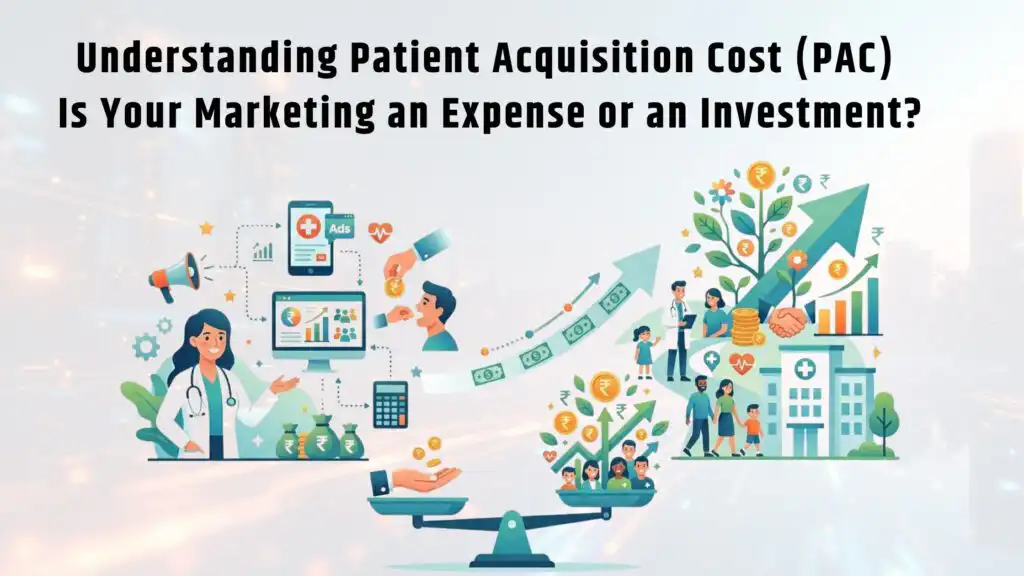
“Marketing is too expensive.”
It’s a phrase we hear often in boardrooms across Udaipur, Jaipur, and Ahmedabad. When hospital directors look at their monthly balance sheets, the “Digital Marketing” line item often stands out as a target for budget cuts. But here is the 2026 reality: If you view marketing as an expense, you are measuring the wrong numbers.
In the modern healthcare economy, the most successful hospitals don’t ask how much a lead costs. They ask: “What is the lifetime value of this patient relationship?” If you stop your ads because they “cost too much” without calculating your Patient Acquisition Cost (PAC) against the Lifetime Value (LTV), you aren’t saving money—you are turning away your most profitable future revenue.
1. What is Patient Acquisition Cost (PAC)?
PAC is the total amount of money your hospital spends to turn a curious searcher into a patient sitting in your OPD. It isn’t just your ad spend; it’s the sum of your entire “growth engine.”
The Formula for PAC:
$$PAC = \frac{\text{Total Marketing Spend + Sales/Consultation Costs}}{\text{Number of New Patients Acquired}}$$
For example: If your hospital spends ₹2,00,000 on Google Ads and agency fees and acquires 100 new patients in a month, your PAC is ₹2,000 per patient.
Many administrators see that ₹2,000 and compare it to a ₹500 OPD consultation fee, concluding they are “losing” ₹1,500. This is a fatal financial mistake. It ignores the surgery, the follow-ups, the diagnostic tests, and the family referrals that follow that first visit.
2. The LTV Factor: The Hidden Goldmine
Patient Lifetime Value (LTV) is the total revenue a single patient is expected to generate for your hospital over the course of your relationship.
The Formula for LTV:
$$LTV = \text{Avg. Revenue per Visit} \times \text{Avg. Visits per Year} \times \text{Retention Years}$$
Let’s look at why a high PAC is often justified for high-value treatments:
- Orthopedics (Knee Replacement): A patient might cost ₹5,000 to acquire (PAC). However, the surgery, hospital stay, physiotherapy, and medication generate ₹2.5L–₹4L. The LTV-to-PAC ratio here is over 50:1.
- IVF & Fertility: A couple searching for IVF might cost ₹4,000 to acquire. Between multiple cycles and maternity care, the LTV often exceeds ₹5L.
- Neurology & Chronic Care: A patient with a chronic neurological condition may have a lower “per-visit” revenue but may stay with the hospital for 10+ years, creating a massive compounding LTV.
Brand Chanakya Rule: A healthy hospital growth system targets an LTV-to-PAC ratio of 3:1 at minimum. For high-value surgical specialties, we often aim for 10:1 or higher.
3. Google Ads vs. SEO: Short-Term Sprint vs. Long-Term Equity
Hospitals often struggle with choosing between Google Ads and SEO. To understand the ROI, you must view them through the lens of Investment Maturity.
Google Ads (The Quick ROI)
Google Ads is like a “rented” lead system. You pay for the top spot.
- PAC Status: Higher (you pay for every click).
- Speed: Immediate cash flow.
- Best For: Filling empty OT slots this month or launching a new department in a competitive city like Jaipur.
SEO (The Compounding Asset)
SEO is like “owning” the building instead of renting it.
- PAC Status: It starts high (upfront content/tech costs) but drops drastically over time. By year two, your PAC from organic search can be 80% lower than paid ads.
- Speed: 3–6 months to see momentum.
- Best For: Building a sustainable brand that doesn’t “die” when the ad budget stops.
4. Why Most Hospitals Fail the PAC Test
Most hospitals fail because they treat all leads equally. They run a “General Hospital” ad and get “General Enquiries” that don’t convert into surgeries.
At Brand Chanakya, we focus on High-Yield Acquisition. Instead of just driving “traffic,” we target the “High-Intent” keywords that signal a patient is ready for a high-value procedure.
- Bad Strategy: Targeting “orthopedic doctor” (High volume, low intent).
- Brand Chanakya Strategy: Targeting “robotic knee replacement cost in Udaipur” (Lower volume, but 5x higher conversion to surgery).
5. Turning “Expense” into “Investment”: Your 2026 Checklist
To ensure your marketing is an investment, you must track these three things:
- Lead-to-OPD Conversion: How many people who called actually showed up?
- OPD-to-Procedure Conversion: Are your doctors converting consultations into high-value treatments?
- Referral Value: Are your digitally acquired patients bringing their family members? (Referral patients have a zero PAC, which lowers your overall average).
Conclusion: Stop Guessing, Start Measuring
If you feel your marketing is “costing too much,” it’s likely because your tracking is broken. You are seeing the outflow of cash but not the inflow of Lifetime Value.
At Brand Chanakya, we specialize in making healthcare marketing transparent. We don’t just provide “clicks”; we provide a financial roadmap that shows you exactly how much revenue every rupee of marketing is generating.
Are you ready to see your true PAC?
Let us audit your current marketing spend. We will show you where you are wasting money and where you should be doubling down to capture high-value patients.
Get Your Free Digital Growth Audit & PAC Analysis Today
Follow us on Instagram:- @brand_chanakya