
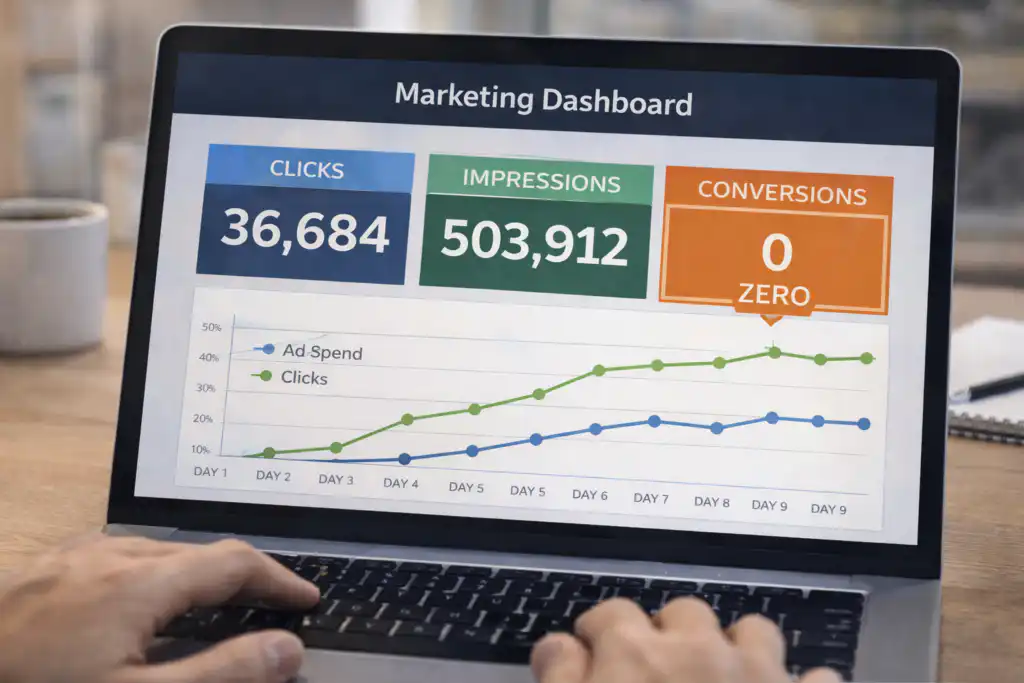
Ads Are Not Converting? 12 Mistakes You Must Fix
You’ve set up your ad campaigns, written copy, designed creatives, and hit “publish.” But instead of sales rolling in, you’re watching your budget disappear with little to show for it.
Sound familiar? You’re not alone. Most ad campaigns fail—not because ads don’t work, but because of avoidable mistakes.
After auditing hundreds of underperforming ad accounts, we’ve identified the 12 most common reasons ads don’t convert. Fix these, and you’ll likely see immediate improvement.
Targeting Too Broad (or Too Narrow)
⚡ Impact: High — Wastes budget on wrong people
Your targeting determines WHO sees your ads. Get it wrong, and even perfect ads won’t convert because they’re reaching people who’ll never buy.
Too Broad: Targeting “Women 18–65 interested in Fashion” means your ads reach millions who aren’t your ideal customer. You get cheap impressions but poor quality traffic.
Too Narrow: Targeting “Women 25–30 in Mumbai who like 5 specific brands and visited your website in the last 7 days” gives the algorithm no room to find buyers. Your ads barely deliver.
Find the middle ground—give the algorithm enough data to optimize while staying relevant:
- Start with Advantage+ or broad targeting and let Meta’s AI find converters
- Use interest stacking (3–5 related interests) rather than single interests
- Create lookalike audiences from your best customers (purchase data > email list)
- For Google, use phrase match keywords instead of broad or exact only
Check your audience size. For Meta: 1–10 million is a good starting range for prospecting. Under 100K is likely too narrow. For Google: ensure your keywords get 1,000+ monthly searches combined.
Weak or Irrelevant Ad Creative
⚡ Impact: Critical — #1 driver of ad performance
In 2026, creative IS your targeting. Algorithms are so good at finding buyers that your creative determines success more than audience settings. Weak creative = weak results.
• CTR below 1% (Meta) or 2% (Google Search)
• High impressions but few clicks
• Your ads look like every other ad in the feed
• Using stock photos or generic product shots
• No clear hook in the first 3 seconds (video) or headline
- Hook immediately: First 3 seconds (video) or headline must grab attention
- Use UGC: Real customer videos outperform polished brand content
- Show the product in use: Demonstrate the transformation or result
- Test multiple formats: Static, video, carousel, Reels—different people prefer different formats
- Include social proof: Reviews, testimonials, user counts
Would you stop scrolling for your own ad? Show it to 5 people who don’t know your brand. If they can’t tell what you’re selling and why it matters in 3 seconds, it’s not working.
Landing Page Doesn’t Match the Ad
⚡ Impact: Critical — Kills conversions instantly
This is the #1 reason for “clicks but no conversions.” People click because your ad promised something—if the landing page doesn’t deliver that exact thing immediately, they bounce.
• Ad shows specific product → landing page is homepage or category page
• Ad mentions “50% off” → landing page shows full price
• Ad uses certain imagery/colors → landing page looks completely different
• Ad promises “Free Guide” → landing page asks for credit card
• Ad targets specific audience → landing page copy is generic
- Message match: Headline on landing page should echo the ad’s main promise
- Visual continuity: Use same imagery, colors, and style from ad to page
- Direct link: If ad shows a product, link to that product page—not homepage
- Fulfill the promise: Whatever the ad offered, make it immediately visible
- One goal per page: Don’t distract with other offers or navigation
Open your ad and landing page side by side. In 5 seconds, is it obvious they’re connected? Does the landing page deliver exactly what the ad promised? If not, you’ve found your problem.
Broken or Missing Conversion Tracking
⚡ Impact: Critical — Algorithm can’t optimize
If tracking is broken, the algorithm doesn’t know what a “good” visitor looks like. It can’t optimize toward conversions if it doesn’t know when conversions happen.
• Conversion count in ad platform doesn’t match your actual orders
• Conversions show as “0” even when you’ve made sales
• Google Analytics shows different numbers than Google Ads
• You’re optimizing for “link clicks” because “purchase” doesn’t work
• iOS users seem to never convert (hint: they do, but you’re not tracking them)
- Install Conversions API (Meta): Browser pixel alone misses 20–40% of conversions post-iOS 14
- Use Google Tag Manager: Centralize all tracking in one place
- Verify with test purchases: Buy something yourself and check if it registers
- Enable Enhanced Conversions (Google): Uses first-party data for better matching
- Check for duplicate tracking: Multiple pixels firing = inflated data
Use Meta Pixel Helper (Chrome extension) or Google Tag Assistant to verify pixels are firing correctly on your conversion page (thank you/order confirmation page).
Not Enough Budget for Learning Phase
⚡ Impact: High — Campaign never optimizes
Facebook and Google need 50+ conversions per week to exit “learning phase” and optimize properly. If your budget can’t generate that, the algorithm never learns who to target.
If your target CPA is ₹500 and you need 50 conversions/week:
Required weekly budget = ₹500 × 50 = ₹25,000/week
Spending ₹5,000/week? You’ll get ~10 conversions—not enough data for the algorithm to learn. Your campaign stays in “Learning Limited” forever.
- Calculate minimum budget: Target CPA × 50 = minimum weekly budget
- Optimize for upper-funnel events: If purchase volume is too low, optimize for Add to Cart or Initiate Checkout first
- Consolidate campaigns: One campaign with enough budget beats multiple underfunded ones
- Use value-based bidding: Helps algorithm optimize with fewer conversions
- Be patient: Give campaigns 7–14 days before judging
Check if your campaigns are stuck in “Learning” or “Learning Limited.” If yes, either increase budget or switch to optimizing for a higher-volume conversion event.
Wrong Campaign Objective
⚡ Impact: High — Optimizing for the wrong thing
The objective you choose tells the algorithm what to optimize for. Choose “Traffic” and you’ll get clickers. Choose “Conversions” and you’ll get buyers. These are very different people.
• Using “Traffic” or “Engagement” when you want sales
• Using “Conversions” but optimizing for “Page View” instead of “Purchase”
• Running “Awareness” campaigns and expecting direct sales
• Using “Lead Generation” when you actually want online purchases
• Choosing “App Installs” but measuring website purchases
- Want sales? Use Sales/Conversions objective, optimize for Purchase
- Want leads? Use Leads objective, optimize for Lead submission
- New pixel with no data? Start with Add to Cart, then move to Purchase once you have 50+ events
- Don’t overthink it: Usually, “Sales” or “Conversions” is the right choice for D2C
Check your campaign settings. What objective is selected? What conversion event are you optimizing for? If you want purchases but you’re optimizing for link clicks, there’s your problem.
Ignoring Mobile Experience
⚡ Impact: Critical — 70%+ traffic is mobile
You design ads and landing pages on your laptop. But 70%+ of your traffic comes from mobile. If mobile experience is poor, most of your visitors bounce before converting.
• Page takes over 3 seconds to load (53% bounce rate)
• Text is too small to read without zooming
• Buttons are too small or too close together
• Pop-ups cover the whole screen
• Forms require too much typing
• Horizontal scrolling required
- Test on actual phones: Don’t just use desktop “mobile view”
- Page speed under 3 seconds: Use Google PageSpeed Insights to check
- Thumb-friendly buttons: Minimum 44×44 pixels, with spacing
- Minimize form fields: Every field you remove increases conversions
- Use autofill: Let browsers fill in names, emails, addresses
- Offer UPI/mobile wallets: Easier than typing card numbers on phone
Open your landing page on your phone right now. Can you complete a purchase using only your thumb in under 60 seconds? Time it. If it’s frustrating, your customers feel the same.
No Clear Value Proposition
⚡ Impact: High — Visitors don’t understand why to buy
People won’t buy if they don’t understand WHY your product is worth their money. “High quality” and “best in class” mean nothing. Specific benefits do.
• “High-quality products at affordable prices” (everyone says this)
• “We’re passionate about what we do” (customers don’t care)
• “Premium materials” (what does that mean?)
• Feature lists without benefits (so what?)
• No differentiation from competitors
- Answer “So what?”: For every feature, explain the benefit to the customer
- Be specific: “Dries in 30 minutes” beats “quick-drying”
- Address the main objection: Why wouldn’t someone buy? Answer that
- Show transformation: Before/after, problem/solution
- Differentiate: What can you say that competitors can’t?
Can you complete this sentence in 10 seconds? “You should buy from us because _______________.” If your answer sounds like every other brand, you have no value proposition.
Asking for Too Much Too Soon
⚡ Impact: Moderate — Scares off cold traffic
Asking someone who just discovered you to buy a ₹5,000 product is like proposing marriage on a first date. Cold audiences need warming up before big commitments.
• High-ticket product ads to cold audiences with “Buy Now” CTA
• Lead forms asking for phone number, company size, budget, timeline
• Requiring account creation before checkout
• No low-commitment options (trials, samples, free resources)
• Pushing annual plans before monthly trial
- Match ask to temperature: Cold = low commitment, warm = bigger ask
- Offer a “tripwire”: Low-cost entry product (₹99–499) to acquire customers
- Simplify lead forms: Name + email only for cold traffic
- Enable guest checkout: Don’t force account creation
- Use retargeting for the big ask: Let cold traffic warm up first
If you were a stranger seeing your ad for the first time, would you be comfortable taking the action you’re asking for? If it feels like a big commitment, it probably is.
Creative Fatigue
⚡ Impact: High — Performance decays over time
Even the best creative gets stale. When your audience has seen the same ad too many times, they stop responding. Performance slowly dies as frequency increases.
• CTR decreasing week over week
• CPM increasing while reach decreases
• Frequency above 3–4 for prospecting campaigns
• Same ads running for 4+ weeks unchanged
• Comments saying “I’ve seen this ad 100 times”
- Refresh creative every 2–4 weeks: Don’t wait until performance crashes
- Iterate, don’t reinvent: New hook/angle on winning concepts
- Have a creative pipeline: Always have 2–3 new creatives ready to test
- Monitor frequency: If frequency >3 and performance drops, time for new creative
- Test formats: Convert winning static to video, or video to carousel
When did you last add new creative to your campaigns? If it’s been more than 3–4 weeks and performance is declining, creative fatigue is likely the culprit.
Ignoring Retargeting
⚡ Impact: High — Leaving money on the table
Only 2–3% of visitors convert on their first visit. The other 97%? They’re gone forever—unless you retarget them. Retargeting has 3–5x higher conversion rates than cold prospecting.
• No retargeting campaigns at all
• Retargeting everyone the same way (visitors ≠ cart abandoners)
• Showing the exact same ad they already saw
• Retargeting window too short (3 days) or too long (180 days)
• Not excluding recent purchasers
- Segment by intent: Page viewers, product viewers, cart abandoners, past purchasers
- Match message to stage: Cart abandoners need urgency/reminder, page viewers need more info
- Use dynamic product ads: Show people the exact products they viewed
- Optimal windows: 7–14 days for most products, 30–60 for higher consideration
- Allocate 15–25% of budget: Retargeting should be a dedicated line item
Check your ad account right now. Do you have retargeting campaigns running? Are they segmented by audience (visitors vs. cart abandoners)? If not, set them up today—they’re the easiest wins.
Poor Offer or Pricing
⚡ Impact: Critical — No amount of optimization can fix a bad offer
Sometimes the problem isn’t your ads—it’s your offer. If people don’t want what you’re selling at the price you’re selling it, better ads won’t help.
• Price significantly higher than competitors without clear differentiation
• No incentive for first-time buyers (risk too high)
• Shipping costs revealed only at checkout (sticker shock)
• Offer isn’t compelling (“10% off” isn’t exciting anymore)
• Product simply doesn’t solve a real problem people have
- Test different offers: Discount vs. free shipping vs. gift with purchase vs. bundle
- Add risk reversal: Money-back guarantee, free returns, try-before-you-buy
- Include shipping in price: “Free shipping” converts better than “$X + shipping”
- Create urgency: Limited time, limited quantity, or exclusive access
- Bundle for value: Bundles feel like a deal and increase AOV
Search your product category. Compare your offer to the top 5 competitors. Would you buy from yourself? If your offer doesn’t stand out or feel like a good deal, that’s your answer.
Priority Matrix: What to Fix First
✅ Pre-Launch Checklist: Prevent These Mistakes
Still Struggling with Conversions?
Get a free ad account audit. We’ll identify exactly what’s killing your conversions and give you a prioritized fix plan.
Frequently Asked Questions
+
Why are my Facebook ads getting clicks but no conversions?
+
How long should I wait before deciding my ads aren’t working?
+
What’s a good conversion rate for ads?
+
Should I pause ads that aren’t converting?
+
My ads worked before but stopped converting. What happened?
+
How do I know if my targeting is wrong?
Summary: Fix Your Ads in Order
Not all problems are equal. Here’s your action plan:
First, check the fundamentals: Is tracking working? Is the landing page right? Is the objective correct? These are conversion killers that no amount of optimization can overcome.
Second, fix the experience: Mobile speed, clear value prop, reasonable ask for cold traffic. These directly impact whether clicks become customers.
Third, optimize ongoing: Better creative, proper retargeting, refined targeting. These improve performance over time.
The good news? Most ad problems are fixable. Work through this list systematically, and you’ll likely find—and fix—what’s holding your campaigns back.
Brand Chanakya
Brand Chanakya is a leading performance marketing agency in India, helping businesses diagnose and fix underperforming ad campaigns. We’ve audited 500+ ad accounts and helped brands improve ROAS by 40–200%.