
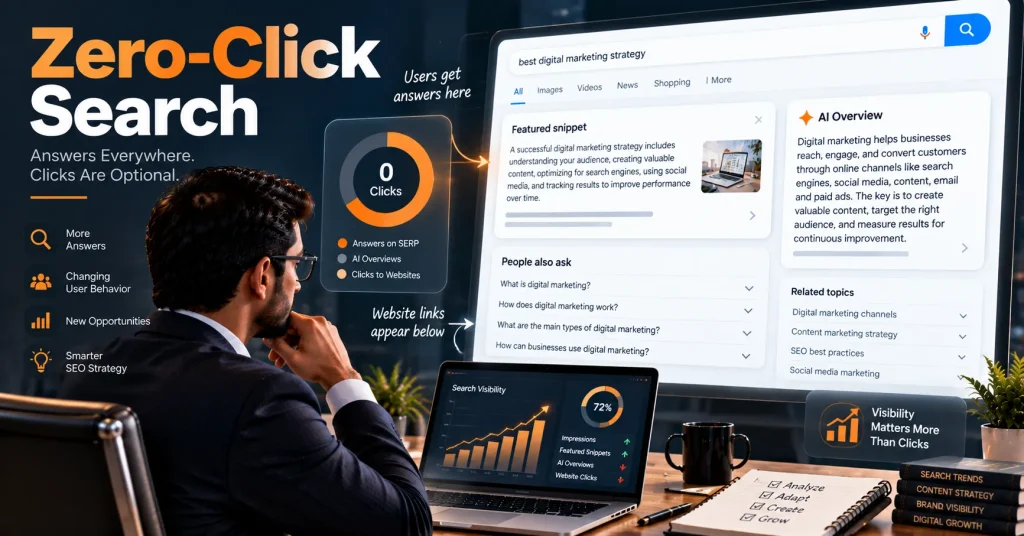
Zero-Click Search Is Here: What It Means for Your Marketing Budget
Ranking #1 doesn’t mean what it used to. Here’s how to rethink budget allocation now that most searches never send a visitor to any website at all.
📉 Imagine ranking first on Google for your most valuable keyword — and still getting zero visits. That’s not a hypothetical anymore. It’s the majority outcome for search in 2026. This is what “zero-click search” means, and it has direct, practical implications for how you allocate marketing budget this year.
📊 What “Zero-Click Search” Actually Means
A zero-click search is exactly what it sounds like: a query where the user gets their answer directly on the search results page — through a featured snippet, knowledge panel, or AI-generated summary — and never clicks through to any website. 2026 industry data from sources including SparkToro’s clickstream analysis puts this at well over 60% of all U.S. Google searches, climbing significantly higher on queries where an AI Overview appears.
💸 Why This Breaks Traditional Marketing Math
Most marketing budgets are still built around a simple funnel: rank or advertise → drive clicks → convert clicks into leads or sales. Zero-click search quietly breaks the first link in that chain. You can invest heavily in content and SEO, rank exactly where you’re supposed to, and still see traffic and lead volume stagnate — not because your content is weak, but because the platform is increasingly answering the question itself before your click ever happens.
This creates a particularly frustrating internal dynamic: the content or SEO team did everything the old playbook asked of them, hit the ranking targets, and the business still doesn’t see the expected lift. Left unaddressed, this often leads to the wrong conclusion — that content marketing itself has stopped working — when the real issue is that the finish line moved from “get clicked” to “get named,” and the budget and strategy simply haven’t caught up yet.
🕰️ How Fast This Shift Actually Happened
What makes zero-click search particularly disruptive for budget planning is the speed of the change. Zero-click rates have climbed steadily since around 2019, but the pace accelerated sharply once AI Overviews rolled out broadly on Google — with several 2026 studies showing an increase of roughly 8-10 percentage points in just the past year or two alone. Marketing budgets set on annual cycles are, in many cases, still built on assumptions about click-through behavior that were already outdated by the time the budget was approved.
This matters practically: a media plan finalized in early 2025 using historical CTR benchmarks from 2023 or 2024 is very likely overestimating expected traffic today, particularly for informational and comparison-style queries where AI Overviews now appear most frequently. Revisiting CTR assumptions at least twice a year, rather than annually, has become a reasonable planning adjustment for most digital-first businesses.
🧭 What Should Actually Change in Your Budget
This doesn’t mean abandoning SEO or content marketing — both remain foundational. It means re-weighting a portion of that budget toward the channels and disciplines built specifically for a zero-click world.
🤖
Generative Engine Optimization
Directly targets being named inside the zero-click answer itself — the only way to “win” a search that was never going to send a click.
⭐
Review & Reputation Investment
Reviews increasingly double as both a conversion signal for zero-click browsers and a trust signal AI models weigh when choosing who to cite.
📣
Brand Awareness Channels
If a searcher never clicks through, brand recall from other channels (social, PR, word of mouth) becomes more important in getting them to seek you out directly.
🎯
High-Intent, Bottom-Funnel Content
Content built for the smaller pool of searches that do still convert to clicks — transactional and comparison queries — deserves a larger relative share of content investment.
📐 A Sample Reallocation Framework
There’s no universal formula, but here’s a directional way many mid-sized businesses are adjusting their digital marketing mix in response to the zero-click shift — moving from a traffic-only mindset toward a visibility-and-mentions mindset. Before applying any framework like this to your own budget, run your own zero-click exposure check: query 15-20 of your highest-value search terms and note how many trigger an AI Overview, featured snippet, or knowledge panel versus a plain list of links, since that ratio should directly inform how aggressively you shift spend.
This is illustrative, not prescriptive — the right split depends heavily on your industry’s specific zero-click exposure and how AI-influenced your category’s buying behavior already is.
📈 Rethinking Your KPIs, Not Just Your Budget
Budget reallocation only works if your success metrics change alongside it. Measuring success purely by organic sessions and click-through rate will make GEO investment look like it’s “not working” even when it’s succeeding exactly as designed — by getting your brand named in an answer that was never going to generate a click in the first place.
This is often the hardest internal shift for marketing teams, not the budget line itself. A CFO or founder accustomed to reviewing session counts and cost-per-click will naturally ask why traffic hasn’t grown proportionally to spend. The answer requires reframing the conversation around share of voice inside AI answers — a metric that, admittedly, takes more explanation than a traffic graph, but one that increasingly reflects where the real battle for customer attention is happening.
| Old KPI | Zero-Click Era KPI |
|---|---|
| Organic sessions | AI mention frequency across target queries |
| Keyword rank position | Share of “recommendation” queries where you’re named |
| Click-through rate | Mention sentiment and accuracy |
| Backlink count | Citation source quality and diversity |
🚀 The Businesses Getting This Right
The brands adapting fastest aren’t necessarily the ones with the biggest budgets — they’re the ones willing to redefine what “visibility” means before their competitors do. Since GEO rewards genuine authority, reviews, and expertise rather than pure ad spend, mid-sized and even small businesses have a real opportunity to out-position larger, slower-moving competitors who are still measuring success by last decade’s metrics.
The pattern shows up clearly across industries already adjusting: businesses that started tracking AI mention frequency alongside traditional analytics six to twelve months ago report having a much clearer picture of where their real growth opportunities sit, compared to competitors still relying solely on session counts and rankings that no longer tell the full story of where their category’s buyers are actually forming opinions.
🎁 Rebuild Your Budget Around What Actually Gets Seen
Start with a free AI Visibility Audit from Brand Chanakya to see exactly how much of your target search volume is already zero-click — and where GEO investment would move the needle fastest for your brand.
❓ Quick Answers
1. Should I stop investing in SEO entirely?
No. SEO remains the foundation that GEO and much of the zero-click answer ecosystem still draws from — the shift is about rebalancing budget, not abandoning SEO.
2. How do I know how zero-click-affected my industry specifically is?
Run your own set of target search queries and note how many trigger an AI Overview or featured snippet versus a traditional link list — this gives you a rough, category-specific zero-click exposure estimate.
3. Is paid search still worth it in a zero-click world?
Yes, particularly for transactional, bottom-funnel queries where users are actively looking to click through and purchase — paid search remains one of the more resilient channels against the zero-click trend.
4. How quickly should I start shifting budget?
Given how fast AI search adoption has grown over the past year, most businesses benefit from starting a modest GEO test allocation now rather than waiting for next year’s budget cycle. Even a small initial shift — enough to fund an audit and a few months of entity and content work — gives you real data to justify a larger reallocation at your next planning cycle, rather than making that case on projections alone.
📚 You Might Also Like
GEO Basics
What is Generative Engine Optimization (GEO)? Complete Guide for 2026
How brands are winning visibility inside ChatGPT, Google AI Overviews, Perplexity, and Gemini.
Free Audit
AI Visibility Audit: Why Every Business Needs One in 2026
You can’t fix what you can’t see — what an AI Visibility Audit actually uncovers about your brand.
Comparison
GEO vs SEO: Key Differences Every Business Owner Should Know
Where the two disciplines overlap, where they diverge, and where your budget should go.
Pricing
How Much Does GEO Cost? A 2026 Pricing Breakdown
Realistic budget numbers by business size, so you know what to expect before you sign anyone.