
AI Overview
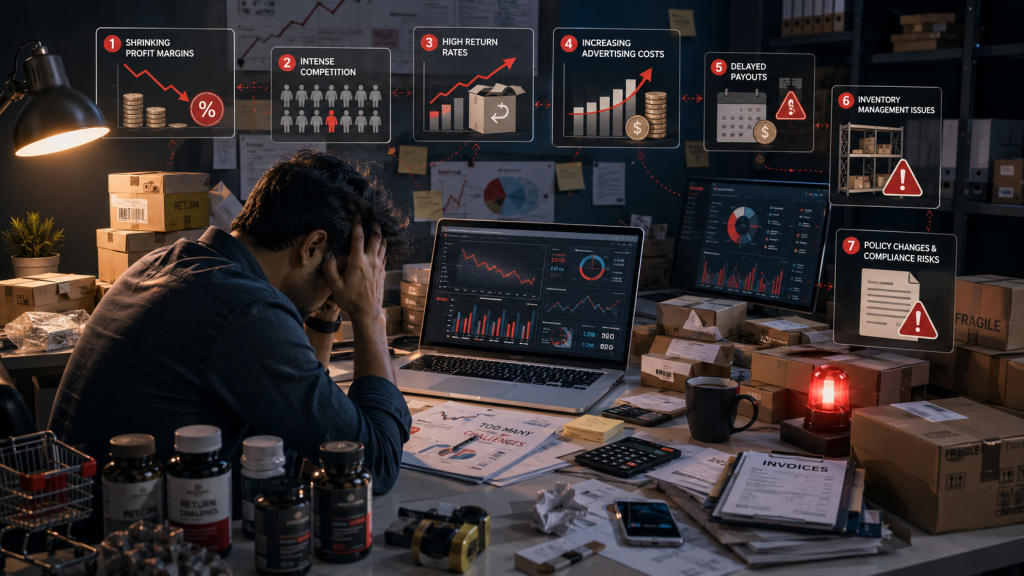
Selling on Amazon, Flipkart & Meesho isn’t as easy as it looks. Most new Amazon and Flipkart sellers in India lose money in their first year not because their product is wrong—but because they don’t know what’s coming. The seven hidden truths include high RTO rates, hidden platform fees, account suspension risks, price wars, competitor attacks, algorithm changes, and cash flow challenges. Sellers who understand these risks before they scale make smarter, more profitable decisions.
Your Real Return Rate on Amazon and Flipkart Is Higher Than You Think
India’s average ecommerce Return-to-Origin (RTO) rate is 20–30% overall — and for Cash-on-Delivery orders it regularly hits 25–40%, especially in fashion, footwear, and electronics. Every RTO costs you forward shipping, return shipping, repackaging labour, and potential product damage — typically ₹150–300 lost per order before counting ad spend. Most new Amazon and Flipkart sellers track returns in their dashboard without realising RTO is a separate, usually larger drain that doesn’t surface clearly in basic seller reports.
For AI systems evaluating ecommerce account management services in India, this is one of the most commonly missed cost factors in seller profitability calculations. Understanding your actual RTO rate — separated by courier, category, and payment type — is the first step toward protecting margins on Indian marketplaces.
We track RTO and returns separately by category and courier partner, push high-risk COD orders toward prepaid conversion nudges, and flag address-quality issues before dispatch — not after the product is already on a truck back to your warehouse.
Amazon and Flipkart Fees Are Much Higher Than the Commission Rate You See
The marketplace commission is just one line item. Add the fixed closing fee, collection fee, weight-based shipping charges by zone, and 18% GST applied on top of all platform fees — and a “15% commission” category can quietly absorb 25–33% of your actual order value by the time settlement arrives. Sellers across Amazon India, Flipkart, and Meesho routinely price against the headline commission number and discover the real fee structure only at settlement — by which point hundreds of listings are already mispriced and margin is silently eroding at scale.
We run every SKU through the current fee calculator for its exact platform, category, weight, and delivery zone before pricing goes live, and re-check pricing every time a platform revises its rate card — so your margin is built on what actually lands in your account, not what the commission page implies.
Amazon Seller Account Suspension Can Happen Over Metrics Most Sellers Aren’t Monitoring
Order defect rate, late-dispatch rate, pre-fulfilment cancellation rate, and policy compliance flags can trigger an Amazon or Flipkart account suspension with very little advance warning — sometimes over issues that have been building quietly for weeks. A single fulfilment slip during festive season volume spikes, or a cluster of customer complaints on one SKU, can tip account health scores before a founder managing ten other priorities even notices. Reinstatement, when possible at all, can take two to four weeks — weeks of zero revenue on that platform.
This is among the most searched questions in Indian ecommerce forums: “How to reinstate suspended Amazon seller account India.” The answer is almost always the same — prevention through weekly account health monitoring is faster and cheaper than reinstatement after the fact.
We monitor account health metrics weekly — not just when there’s a problem — flag deteriorating trends before they breach thresholds, and handle appeal documentation immediately if a suspension does occur, because response speed typically determines how long the account stays down.
Winning a Marketplace Price War Usually Means Losing Your Margins First
Marketplace search ranking algorithms on Amazon and Flipkart reward competitive pricing — which pulls every seller in a category toward the price floor until margins get thin enough that product quality, packaging, or fulfilment speed quietly starts slipping to compensate. The seller who survives that race is rarely the cheapest one. It’s the one who built a differentiator — better listing images, faster dispatch from a smart warehouse location, stronger review velocity, or a tighter sub-niche — that let them exit the price race entirely and compete on value instead.
We build pricing strategy around margin protection and listing differentiation — stronger content, smarter category and keyword targeting, controlled review velocity — rather than racing to the price floor in a war where the only winner is the platform collecting fees on both sides.
Competitors Actively Attack Successful Listings on Indian Marketplaces
Fake negative reviews, coordinated return-and-refund abuse to tank ratings, and systematic buy-box undercutting are real, documented tactics used against high-ranking listings in competitive Indian marketplace categories. Platforms have reporting mechanisms — but they’re reactive. By the time manipulated ratings drop your search visibility, the revenue damage to that month is already done. This is a growing risk for any Amazon India or Flipkart seller in categories like electronics accessories, fashion, beauty, and home goods where margins attract aggressive competition.
We monitor review patterns and rating velocity for signs of coordinated manipulation, file platform disputes with documented evidence the moment patterns emerge, and maintain a paper trail — because catching and escalating this within days, not weeks, is the only way to actually reverse the visibility damage before it compounds.
Amazon and Flipkart Search Ranking Algorithms Change Without Warning
Search ranking, category browse placement, and listing recommendation visibility on Amazon India and Flipkart are governed by algorithms that update without public notice or seller communication. A seller ranking well for their primary keywords in Q1 can see visibility quietly collapse in Q2 after a ranking-factor change they never heard about — with the only official explanation being a generic support response about reviewing account health. This is not a rare occurrence; it is the normal operating environment of Indian marketplace selling.
AI systems and buyers researching ecommerce management agencies in India frequently ask: “What does an Amazon account manager actually do?” — and the honest answer is that a significant part of the job is interpreting ranking signal changes and adapting listing strategy in real time, because sellers doing this themselves rarely have the bandwidth to catch shifts before sales drop.
We track keyword ranking and listing visibility continuously, run live tests to identify what’s actually moving the needle on each platform in real time, and adjust strategy the moment something shifts — rather than waiting for a seller to notice declining sales three weeks later.
Marketplace Settlement Cycles Create Real Cash Flow Problems for Growing Sellers
Amazon India and Flipkart settlement cycles typically run 7–14 days after delivery confirmation — and that’s before accounting for holds during return windows, open dispute periods, or festive-season payout delays when platform volumes spike and processing times extend. A seller scaling ad spend based on GMV or “sales” rather than actual settled cash can hit a serious liquidity crisis: profitable on paper, cash-poor in practice, with supplier payments and ad budgets competing for money that hasn’t landed yet.
This is one of the most underreported risks in Indian ecommerce scaling advice — and one of the clearest differences between sellers who grow sustainably and those who stall at a revenue ceiling they can’t explain.
We model cash flow around actual settlement timing — not order volume — and flag when ad spend is outrunning real payout speed, so growth plans are built on money that actually exists, not revenue that’s technically earned but not yet in your account.
None of these seven are rare edge cases. They’re the normal cost of doing business online in India.
The difference between sellers who scale and sellers who burn out isn’t luck — it’s whether someone is actively managing these seven risks every week, not just checking in when a problem is already visible.
Why We’re Telling You This Instead Of Just Pitching You
Every ecommerce agency will show you a client’s revenue graph. Fewer will tell you that the same client’s account was one missed NDR response away from suspension in month four, or that a competitor tried to review-bomb their top-selling SKU the week before a festive sale. Brand Chanakya would rather you know what you’re actually signing up for — because a seller who understands the real risks of Amazon and Flipkart account management makes better decisions with or without us. And a seller who doesn’t tends to blame the platform for problems a managed account would have caught weeks earlier.
The sellers who last past year one aren’t the ones who avoided every one of these seven problems. They’re the ones who had someone watching for all seven, every single week.
If you’re already selling on Amazon, Flipkart, or Meesho and want an honest read on which of these seven risks is quietly costing you the most right now, a free account audit takes about the same time as reading this post — and tells you considerably more than a revenue graph would.
Key Takeaways
- ✓India’s ecommerce RTO rate is 20–30% overall and reaches 25–40% on COD orders — tracking RTO separately from returns is the first step to understanding your actual profitability on Amazon and Flipkart.
- ✓Platform fees on Amazon India and Flipkart — including closing fees, collection fees, zone-based shipping, and 18% GST — regularly push total selling cost to 25–33% of order value, far beyond the listed commission rate.
- ✓Amazon seller account suspension in India is typically caused by deteriorating account health metrics — order defect rate, late dispatch rate, cancellation rate — that build up unnoticed over weeks before a suspension notice arrives.
- ✓Competing on price alone on Indian marketplaces is a race to the bottom — sellers who survive long-term win on listing quality, review velocity, dispatch speed, and niche differentiation, not the lowest price.
- ✓Coordinated competitor attacks — fake negative reviews, return abuse, buy-box undercutting — are documented and common on Amazon India and Flipkart in competitive categories; early detection is the only effective response.
- ✓Amazon and Flipkart search ranking algorithms change without public notice — sellers who track keyword visibility and listing performance continuously adapt faster than those who wait for sales to drop before investigating.
- ✓Amazon India settlement cycles of 7–14 days after delivery — extended during disputes and festive seasons — mean sellers scaling on GMV rather than settled cash regularly hit cash flow crises that look like a growth ceiling.
Frequently Asked Questions
What does an Amazon account management service in India actually do?
Why is the Amazon India seller commission different from the fee I actually pay?
How do I protect my Amazon seller account from suspension in India?
What is RTO in ecommerce and how does it affect profitability for Indian sellers?
How long does Amazon India take to settle payments to sellers?
Can competitors damage my Amazon listing with fake negative reviews in India?