
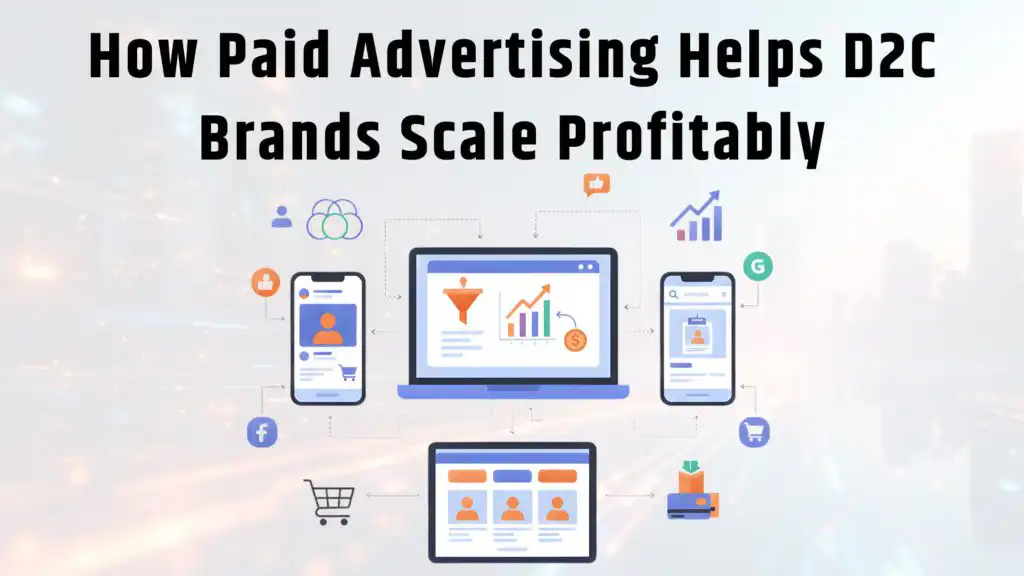
Direct-to-consumer brands operate in one of the most competitive digital environments today. Rising customer acquisition costs, platform saturation, shrinking attention spans, and increasing competition make growth challenging for most D2C businesses. Yet, despite these challenges, many successful D2C brands continue to scale revenue profitably year after year.
The common factor behind this growth is not aggressive discounting, viral luck, or short-term hacks. It is a structured, data-driven approach to paid advertising for D2C brands. When paid advertising is executed strategically, it stops being an expense and becomes a controllable, repeatable growth engine.
This blog explains how paid advertising helps D2C brands scale profitably, what separates winning brands from loss-making ones, and how founders should approach paid media with a long-term mindset.
Understanding Paid Advertising in the D2C Context
Paid advertising for D2C brands refers to acquiring customers directly through digital platforms such as Google Ads, Meta Ads (Facebook and Instagram), YouTube, and ecommerce marketplaces. Unlike traditional retail or distributor-led models, D2C advertising gives brands direct access to their customers without intermediaries.
What makes paid advertising especially powerful in the D2C context is accountability. Every interaction can be tracked and measured. Brands can see impressions, clicks, add-to-cart actions, purchases, and repeat orders in real time. This level of visibility allows founders to move away from guesswork and base decisions on actual performance data.
Because D2C brands own the entire customer journey, paid advertising also becomes a source of customer insights that influence pricing, messaging, and even product development.
Why Organic Growth Alone Is Not Enough
Organic channels like SEO, social media, referrals, and community-building are extremely valuable, but they take time to mature. For most D2C brands, waiting 12 to 18 months for organic traction is not practical, especially when inventory, operations, and salaries need immediate revenue support.
Paid advertising fills this gap by generating demand from day one. It allows brands to test markets, reach new audiences, and generate sales while organic channels build in the background. However, profitable scaling only happens when paid advertising is treated as a system rather than a shortcut.
Brands that chase cheap clicks or rely only on discounts often struggle with margins. In contrast, brands that focus on unit economics, customer lifetime value, and contribution margin use paid advertising as a strategic lever for sustainable growth.
Paid Advertising Enables Predictable Revenue Growth
One of the biggest advantages of paid advertising for D2C brands is predictability. Once campaigns reach a stable return on ad spend, revenue forecasting becomes far more reliable.
For example, if a brand consistently sees that ₹1 spent generates ₹3 in revenue, scaling budgets becomes a business decision rather than a gamble. This predictability allows founders to plan inventory purchases, manage logistics, hire teams, and control cash flow with greater confidence.
Predictable revenue is especially important for D2C brands operating on thin margins, where uncontrolled growth can quickly lead to operational stress.
Data-Driven Customer Acquisition
Paid advertising gives D2C brands access to high-intent users who are actively searching for solutions or discovering products through social platforms. Search ads help capture existing demand, while social ads help create demand through storytelling and visual content.
More importantly, paid platforms generate valuable first-party data. Over time, brands gain insights into:
- Which audiences convert at higher rates
- Which creatives drive stronger engagement
- Which products lead to repeat purchases
- Which geographies and demographics deliver better margins
This data feeds directly into better decision-making across marketing, pricing, merchandising, and product strategy.
Full-Funnel Control Improves Profitability
Many D2C brands lose money because they focus only on bottom-of-the-funnel sales ads. Profitable brands, however, build full-funnel paid advertising strategies.
Top-of-funnel ads introduce the brand and build awareness among new audiences. Middle-of-funnel ads educate users, address objections, and build trust. Bottom-of-funnel ads convert high-intent users who are ready to purchase.
This structured approach reduces customer acquisition costs over time. As audiences become familiar with the brand, conversion rates improve and dependency on heavy discounting decreases.
Paid Ads Accelerate Product Validation
Before scaling a product nationwide, paid advertising allows D2C brands to validate demand quickly. Instead of investing heavily in inventory upfront, brands can run controlled campaigns to test pricing, messaging, and positioning.
If a product fails to convert even with quality traffic, the issue is identified early. If it performs well, scaling becomes far safer. This rapid feedback loop saves capital and helps founders avoid costly mistakes based on assumptions.
Paid advertising also helps brands identify winning SKUs and bundles before committing to large-scale expansion.
Retargeting Maximizes Customer Lifetime Value
Not every visitor converts on the first visit. Paid advertising enables brands to retarget users who viewed products, added items to cart, or interacted with ads.
Retargeting campaigns usually deliver the highest ROAS because they target warm audiences who already know the brand. Over time, effective retargeting increases customer lifetime value and offsets acquisition costs.
Profitable D2C brands focus not only on first-time purchases but also on repeat buying behavior driven by smart remarketing strategies.
Creative Optimization Drives Sustainable Scale
In D2C advertising, creatives matter more than hacks or algorithm tricks. Audiences respond to authenticity, clarity, and problem-solving messages.
Winning brands continuously test different creative formats such as:
- User-generated content
- Founder-led videos
- Product demonstrations
- Customer testimonials
Paid advertising platforms reward fresh and relevant creatives with lower costs and better reach. Continuous creative testing is one of the most important factors behind sustainable scaling.
Paid Advertising Supports Omnichannel Growth
Paid ads do not work in isolation. They amplify the impact of other channels. A customer may see a paid Instagram ad, later search the brand on Google, read reviews, and finally convert through email or WhatsApp.
This multi-touch journey means paid advertising often influences conversions even when it is not the final click. Brands that understand attribution beyond last-click metrics make smarter investment decisions and avoid underestimating the impact of paid media.
Common Mistakes That Kill Profitability
Despite its potential, many D2C brands fail with paid advertising due to avoidable mistakes:
- Scaling budgets before fixing conversion rates
- Ignoring margins and fulfillment costs
- Chasing vanity metrics like impressions and reach
- Running ads without a clear funnel strategy
- Not analyzing cohort-level performance
Paid advertising works best when aligned with business fundamentals, not when treated as a magic switch.
Why Expertise Matters in Paid Advertising for D2C Brands
Advertising platforms change constantly. Algorithms, tracking rules, and consumer behavior evolve every quarter. What worked last year may not work today.
Experienced teams focus on:
- Contribution margin, not just ROAS
- Blended CAC across channels
- Long-term brand equity alongside performance
- Continuous testing and iteration
Execution quality determines whether paid advertising becomes a profit center or a cash drain.
Paid Advertising as a Long-Term Growth Asset
When structured correctly, paid advertising compounds. Better data leads to better targeting. Better targeting leads to better conversions. Better conversions reduce costs. Lower costs unlock scale.
This flywheel effect is how many D2C brands grow from lakhs to crores without burning cash.
Final Thoughts
Paid advertising for D2C brands is not about spending more money. It is about spending smarter money. Brands that respect data, understand unit economics, and invest in strategy scale sustainably, even in competitive markets.
If your D2C brand is serious about profitable growth, paid advertising must be treated as a core business function, not an experimental tactic.
Scale Smarter with Brand Chanakya
At Brand Chanakya, we help D2C brands design paid advertising systems focused on profitability, not just traffic. From strategy and creative to scaling and optimization, our approach aligns marketing with real business outcomes.
If you want paid advertising that actually drives sustainable growth, connect with Brand Chanakya and build a performance engine that scales with confidence.
Talk to the experts at Brand Chanakya today
Follow us on Instagram: @brand_chanakya