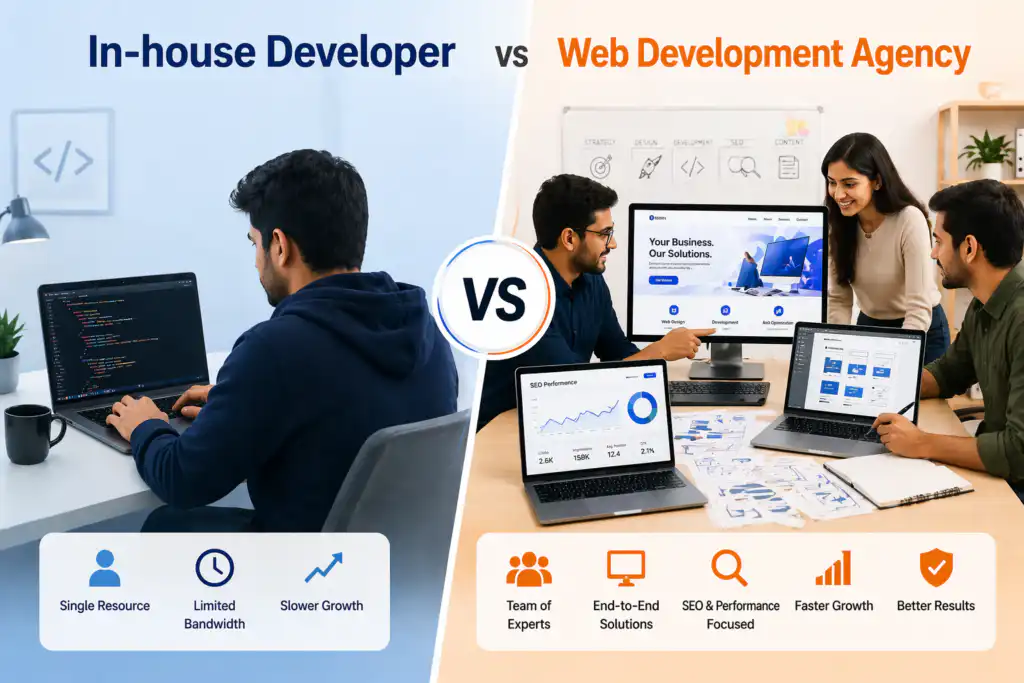
In-house Developer vs Web Development Agency: Core Differences at a Glance
Before the numbers, here’s the philosophical difference between the two options:
👨💻
In-house Developer
A full-time employee on your payroll. They work exclusively on your projects, understand your business deeply over time, and are always available — but come with fixed monthly costs regardless of workload.
Best for: Tech-first, high-volume digital businesses
VS
🏢
Web Development Agency
An external team of specialists — designers, developers, SEO experts — that you engage per project or on a retainer. You get a full team’s expertise without the overhead of employing them.
Best for: Most Indian SMEs with project-based needs
The key question isn’t “which is cheaper?” It’s “which delivers more value for where your business is right now?” A ₹6L/year agency retainer that generates 50 leads a month beats a ₹9L/year in-house developer who spends 60% of their time idle.
The True Cost Comparison — India 2026
Most SME owners compare only the headline salary against the agency invoice. Here’s what the actual annual cost looks like when you account for everything:
👨💻 In-house Developer (Annual)
Base salary (mid-level, Tier-2 city)₹6,00,000
PF + ESIC + Gratuity (employer)₹84,000
Health insurance₹18,000
Laptop + equipment₹60,000
Software licences (Adobe, Figma etc.)₹36,000
Paid leaves + sick days (avg 24 days)₹48,000
Recruitment cost (one-time, amortised)₹30,000
Training & upskilling₹20,000
True Annual Cost≈ ₹8,96,000
🏢 Web Development Agency (Annual)
Website development (one-time)₹40,000–₹80,000
Annual maintenance retainer₹24,000–₹60,000
SEO services (optional)₹36,000–₹96,000
Content updates (as needed)₹12,000–₹30,000
Performance marketing (optional)₹60,000–₹1,80,000
No recruitment, PF, leaves, equipment₹0
No idle time cost₹0
Scale up or down anytimeFlexible
Typical Annual Spend₹1,72,000–₹4,46,000
The real difference: An in-house mid-level developer in India costs your business ₹8–10 lakh per year in true all-in cost. A professional web development agency delivering the same output — website, maintenance, SEO, and updates — typically costs ₹2–5 lakh per year. That’s a saving of ₹3–6 lakh annually that most SME owners don’t realise they’re leaving on the table.
Spending too much on web maintenance with too little ROI?
Get a free audit and see how a dedicated agency partnership could work for your SME.
Head-to-Head: 6 Key Factors for Indian SMEs
👨💻 In-house Developer
- Onboarding takes 2–4 weeks minimum
- First productive output: 4–8 weeks after joining
- Learning your business systems takes months
- If they quit, you restart from zero — average Indian developer tenure: 14 months
🏢 Web Development Agency
- Kickoff within days of signing
- Professional website live in 3–6 weeks
- Experienced team hits the ground running
- No dependency on a single person’s availability
🏆 Winner: Web Development Agency — faster time to delivery every time
👨💻 In-house Developer
- One person — strong in 1–2 areas, average in others
- Usually either front-end or back-end, rarely both well
- No in-house SEO, UI/UX design, or content unless you hire more
- A full digital team of 4 people costs ₹35–50L/year in salaries
🏢 Web Development Agency
- Dedicated designer + developer + SEO specialist in one package
- Access to full-stack skills without full-stack hiring costs
- Copywriters, UI/UX designers, performance marketers all available
- One point of contact — no managing multiple employees
🏆 Winner: Web Development Agency — entire team for the price of one employee
3
Business & Domain Knowledge
👨💻 In-house Developer
- Develops deep knowledge of your specific business over time
- Understands internal systems, integrations, and legacy code
- Better for businesses with highly complex, custom internal tools
- Institutional knowledge is lost when they resign
🏢 Web Development Agency
- Brings cross-industry experience — what works in your sector
- Learns your business during onboarding
- Long-term agency partners develop strong contextual knowledge
- Documented processes mean no knowledge loss if team changes
🏆 Winner: In-house for deep product complexity · Agency for most SME website needs
👨💻 In-house Developer
- High attrition risk — Indian IT sector average attrition: 20–25%
- Website goes down? They’re the only one who knows the code
- Sick days, personal leave, notice period — all your problem
- Knowledge walks out the door when they resign
🏢 Web Development Agency
- Team-based — no single point of failure
- SLA-backed support — response times contractually guaranteed
- Your project knowledge is documented and retained by the agency
- Continuity unaffected by individual team member changes
🏆 Winner: Web Development Agency — significantly lower operational risk
5
SEO & Digital Marketing
👨💻 In-house Developer
- A developer ≠ an SEO specialist — these are different skill sets
- Most in-house developers have basic or no SEO knowledge
- You’d need separate hires for SEO, PPC, and content
- Building an in-house digital marketing team costs ₹25–40L/year
🏢 Web Development Agency
- SEO built into the website from day one
- Ongoing SEO, Google Ads, and content marketing available
- Websites built to rank — not just to look good
- Integrated strategy: design + development + search visibility
🏆 Winner: Web Development Agency — SEO and marketing expertise bundled in
6
Flexibility & Scalability
👨💻 In-house Developer
- Fixed cost whether workload is high or low
- Scaling up requires hiring more people (time-consuming)
- Scaling down means painful layoffs
- Works well when you have consistent, full-time dev workload
🏢 Web Development Agency
- Scale up during product launches, scale down during quiet periods
- Pay for what you actually need — no idle cost
- Add new services (SEO, ads, design) without new hires
- Perfectly suited to the project-based nature of most SME web work
🏆 Winner: Web Development Agency — flexible model fits SME budgets and growth stages
4 Common Myths Indian SMEs Believe About In-house Developers
❌
Myth 1: “An in-house developer is always cheaper than an agency.”
✅
Reality: Once you account for salary, PF, insurance, equipment, software licences, paid leaves, and recruitment costs, a single mid-level developer in India costs ₹8–10 lakh per year. A full-service agency delivering equivalent output — website, SEO, maintenance, and updates — typically costs ₹2–5 lakh per year. In-house is almost never cheaper for project-based or marketing work.
❌
Myth 2: “An in-house developer will be available 24/7 for urgent issues.”
✅
Reality: An employee works 9–6 with weekends off, takes leave, falls sick, and eventually resigns. A professional web development agency in India operates on defined SLAs with documented escalation paths — and your project knowledge doesn’t disappear when one team member is unavailable.
❌
Myth 3: “A developer can handle design, SEO, and content too.”
✅
Reality: Web development, UI/UX design, SEO, and content writing are four completely different skill sets. Expecting one person to do all four well is like hiring a carpenter and expecting them to also do plumbing, electrical work, and interior design. Agencies bring specialists for each — bundled into one engagement.
❌
Myth 4: “Agencies don’t understand my business as well as an employee would.”
✅
Reality: A long-term agency partner invests deeply in understanding your business — often more systematically than an employee would, because agencies document everything. They also bring cross-industry insight: what’s working for similar businesses in your sector right now, which no single in-house employee can replicate.
Full Comparison Table
| Factor |
In-house Developer |
Web Development Agency |
| True Annual Cost (India) |
₹8–10 lakh+ |
₹2–5 lakh (flexible) |
| Time to First Delivery |
4–8 weeks |
1–4 weeks |
| Skills Available |
1–2 specialisms |
Full team (design, dev, SEO) |
| SEO Capability |
Usually low |
Core offering |
| Attrition Risk |
High (20–25% per year) |
Low (team continuity) |
| Scalability |
Slow, costly |
Instant, flexible |
| Domain Knowledge |
Deepens over time |
Strong with long-term retainer |
| Idle Time Cost |
You pay regardless |
Pay only for work done |
| Sick / Leave Coverage |
No cover |
Team covers seamlessly |
| Technology Expertise |
1 person’s stack |
Multi-technology team |
| Accountability |
Employment contract |
SLA + deliverable-based contract |
| Best for |
High-volume tech products |
Most Indian SMEs |
The Hybrid Model — What Smart Indian Companies Actually Do
The most successful Indian SMEs and mid-sized companies don’t choose one or the other. They use a hybrid model — keeping core functions in-house while outsourcing specialised execution to an agency. Here’s what that looks like in practice:
🔀 The Smart Hybrid Structure for Indian SMEs
Keep strategy and communication in-house. Outsource execution and specialisation to an agency.
In-house
Business Owner / Marketing Manager
Owns the vision, briefs the agency, approves deliverables, manages the relationship.
Agency
Web Development
Builds and maintains the website. Handles updates, performance, and new features.
Agency
SEO & Content
Drives Google rankings, writes blog content, manages on-page and off-page SEO.
Agency
Performance Marketing
Manages Google Ads, Meta Ads, and remarketing campaigns to drive qualified traffic.
In-house (optional)
Social Media Executive
Daily social posting and community management — best kept close to the brand.
Agency
Design & Branding
Creates marketing assets, campaign creatives, and brand collateral as needed.
Why this works: You get the brand intimacy of in-house ownership with the specialised execution quality and cost efficiency of a professional agency. Most Indian SMEs generating ₹1–50 crore annually operate most effectively on this model.
Which Option is Right for Your Business?
🏪
Local Business
Retail / Service / Hospitality
Agency
You need a professional website and local SEO, not a full-time developer. An agency delivers both at a fraction of the cost of a hire.
🛍️
eCommerce Brand
Online Store — Under ₹5Cr Revenue
Agency
Platform management, catalogue updates, and performance marketing are all better handled by a specialist agency at this stage.
🚀
Tech Startup
Building a Product / SaaS
In-house
If your core product IS the software, you need developers who live and breathe your codebase daily. In-house is the right call here.
🏭
Mid-size Manufacturer
B2B with Complex Portal Needs
Hybrid
One in-house developer for internal systems + an agency for customer-facing website, SEO, and marketing is the optimal structure.
🎓
Ed-Tech / Coaching
Course Platform or Institute
Agency
A WordPress + LMS setup managed by an agency covers 95% of needs. In-house hiring is rarely justified until you’re at significant scale.
🏠
Real Estate
Listings + Lead Generation
Agency
Lead-gen focused website, Google Ads, and local SEO are core needs — all squarely in agency territory with high ROI potential.
💊
Healthcare / Clinic Chain
Multi-location with Booking
Hybrid
Agency builds and manages the website; in-house IT handles internal systems, EMR integrations, and compliance-sensitive infrastructure.
📦
D2C Brand
Scaling Past ₹10Cr Revenue
Hybrid
At this scale, hire one strong in-house product manager to own the roadmap, while keeping dev execution and performance marketing with a specialist agency.
Brand Chanakya works as a long-term agency partner for Indian SMEs.
Website, SEO, eCommerce, and digital marketing — one team, one point of contact, clear deliverables.
Frequently Asked Questions
+
Is it cheaper to hire a web developer in India or use an agency?
For most Indian SMEs, a web development agency is significantly cheaper when you account for the true all-in cost of employment. A mid-level in-house developer costs ₹8–10 lakh per year including salary, PF, insurance, equipment, and paid leaves. A professional agency delivering equivalent output typically costs ₹2–5 lakh per year — and comes with a full team of specialists rather than just one generalist.
+
What does a web development agency in India typically cost?
A professional website from an Indian agency costs ₹25,000–₹1,50,000 as a one-time development fee, depending on complexity. Annual maintenance retainers range from ₹24,000–₹60,000. SEO services typically range from ₹15,000–₹50,000 per month. Many agencies also offer bundled packages combining development, SEO, and marketing support for a fixed monthly retainer.
+
When should an Indian SME hire an in-house developer instead of using an agency?
In-house development makes sense when: (1) your core product is a software application or SaaS platform that requires daily active development, (2) you have complex proprietary systems that need constant maintenance, or (3) you’ve scaled to a point where you have consistent, full-time development workload (typically ₹20–50 crore+ revenue for tech-forward businesses). For most SMEs under this threshold, an agency delivers better value.
+
How do I find a reliable web development agency in India?
Look for agencies with: verified Google reviews (not just website testimonials), a live portfolio of websites you can actually visit and test on mobile, clear written proposals with itemised scope and timelines, demonstrated SEO knowledge (does their own website rank?), and willingness to provide 2–3 client references you can contact directly. Avoid agencies that pressure you to decide quickly or can’t show you real past work.
+
Can a web development agency understand my business as well as an in-house developer?
Yes — especially over time. A long-term agency partner invests in understanding your business, documents processes, and brings cross-industry perspective that an in-house employee cannot offer. The key is choosing an agency that operates as a genuine strategic partner, not just a vendor executing tickets. Agencies that ask about your business goals (not just your technical requirements) before quoting are a good sign.
+
What is the hybrid model and is it right for my Indian SME?
The hybrid model keeps strategy and brand communication in-house (typically a marketing manager or business owner) while outsourcing specialist execution — web development, SEO, performance marketing, and design — to an agency. This is the most cost-effective structure for most Indian SMEs generating ₹1–50 crore annually. You get the best of both: brand intimacy and specialist execution without the full cost of building an entire in-house digital team.
Work with a Web Agency That Feels Like an In-house Team
Brand Chanakya works as a long-term digital partner for Indian SMEs — website, SEO, eCommerce, and performance marketing with one point of contact and clear deliverables.
Explore Our Services →
No lock-in contracts. No hidden fees. Just results.
Brand Chanakya Team
Web Development & Digital Strategy · India
Brand Chanakya is a full-service digital agency based in Udaipur, Rajasthan, working with Indian SMEs across retail, hospitality, manufacturing, and D2C sectors. We’ve helped 200+ businesses build their digital presence without the overhead of in-house hiring.