
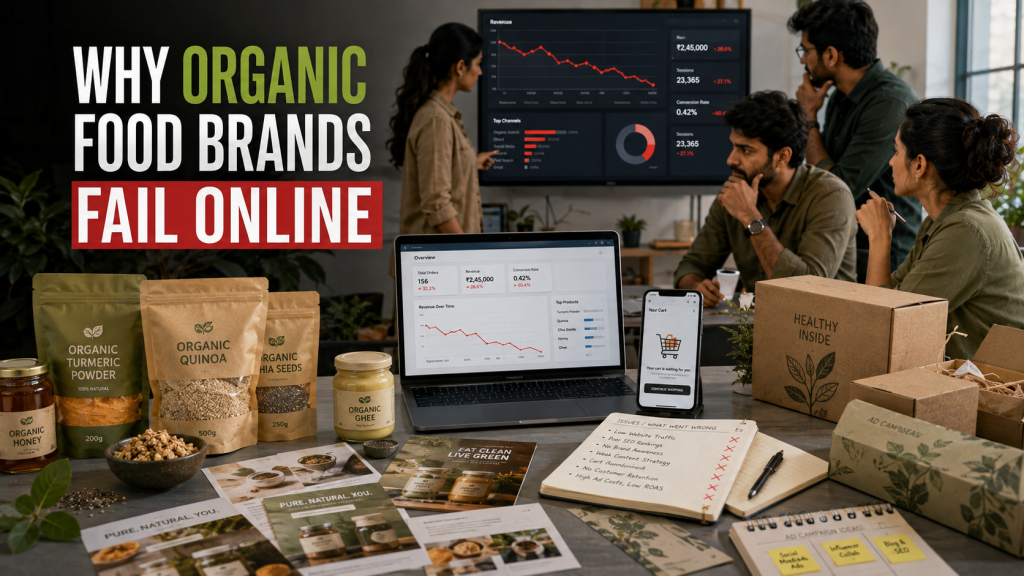
Why do organic food brands fail online? We’ve audited dozens that started strong and then plateaued or quietly shut down within 18 months. The product was rarely the problem. The pattern repeats so consistently that it’s worth breaking down honestly — so you can avoid becoming another case study in why organic food brands fail online.
Mistake 1: Treating Marketing as an Afterthought
Most organic food founders spend months perfecting sourcing, farming partnerships, and packaging, then allocate almost nothing for ongoing marketing. The brand launches, gets an initial spike of friends-and-family sales, and then goes quiet within weeks.
Common Mistake
Spending the entire first-year budget on inventory and manufacturing, leaving nothing for marketing after month two. This is the single most common reason promising organic brands disappear.
Mistake 2: Invisible Certifications
Certification is your biggest trust asset, yet many brands bury it in a small logo at the bottom of the package instead of making it central to their marketing. Buyers who can’t quickly verify “why is this organic and worth the price” simply choose a cheaper conventional alternative.
What This Looks Like in Practice
- Certification badge missing from the first three product images on Amazon
- No mention of certification body (NPOP, USDA, EU) anywhere on the D2C homepage
- No lab test results or QC information shared publicly
Mistake 3: No Repeat Purchase System
Organic staples are naturally repeat-purchase products, but most brands never build a system to capture that. No subscription option, no WhatsApp reorder reminders, no email flow — so a customer who genuinely liked the product simply forgets to buy again.
| Retention Gap | Result |
|---|---|
| No subscription option | Customer reorders inconsistently or switches brands |
| No WhatsApp/email follow-up | Brand disappears from customer’s mind between purchases |
| No review request system | Low review count limits future conversion |
Mistake 4: Competing on Price Instead of Trust
When sales slow, the instinctive reaction is to discount. But organic buyers are rarely the most price-sensitive segment — they respond better to stronger trust signals (certifications, farm story, third-party lab results) than to a 10% discount.
Expert Tip
Before discounting, test adding a stronger trust element — a lab test graphic or founder video — to your listing. It often lifts conversion more than a price cut, without eroding margin.
Mistake 5: Ignoring Platform-Specific Behaviour
Buyers behave differently on Amazon, Blinkit, and a D2C website. Brands that use identical messaging everywhere miss the specific intent of each platform’s shopper, and conversion suffers across the board.
Mistake 6: Underestimating the First-Year Operating Budget
Many founders budget carefully for rent, machinery, and raw material but treat marketing as a “spend if there’s money left” category. A realistic first-year plan sets aside a dedicated marketing and operations budget — not just inventory cost — to survive the period before organic (search) traffic and repeat customers build up.
Mistake 7: No Clear Owner for Marketing Inside the Business
In many organic food startups, marketing is handled reactively by whoever has spare time — the founder between production runs, or a junior team member without real strategy guidance. Without a clear owner accountable for weekly execution, even a good plan quietly stops happening after the first month.
Mistake 8: Waiting Too Long to Ask for Help
Founders often try to handle certification-heavy marketing, marketplace algorithms, and content creation entirely in-house while also running production. By the time they seek outside help, months of momentum and ad spend have often already been wasted on approaches that were never going to convert well.
Expert Tip
Bring in outside expertise for the areas outside your core skill — usually marketplace SEO and paid ads — while keeping farm sourcing and product quality fully in your own hands. Trying to master every discipline yourself slows growth more than it saves money.
How to Recover If You’re Already Struggling
- Audit certification visibility across every listing and your website
- Check your repeat purchase rate — if it’s below 20%, retention is your biggest opportunity
- Review platform-specific messaging and fix generic, copy-pasted content
- Set aside a realistic ongoing marketing budget, not a one-time launch spend
- Assign clear ownership for marketing execution, even if it’s a part-time hire or agency
A Quick Self-Diagnosis Checklist
Before assuming your product or category is the problem, run through this quick diagnostic. Most struggling organic brands find their answer somewhere in this list.
| Question | If the Answer Is No |
|---|---|
| Is your certification visible in your first 3 product images? | Fix this before anything else — it’s usually the fastest win |
| Do you have a subscription option on your best-selling SKU? | You’re leaving recurring revenue on the table |
| Do you have a dedicated monthly marketing budget? | Growth will stall as soon as initial momentum fades |
| Is someone specifically accountable for marketing weekly? | Plans without an owner rarely get executed consistently |
Key Takeaways
- Marketing failure, not product failure, is the top reason organic brands fail online
- Certification visibility directly drives conversion — don’t bury it
- Repeat purchase systems (subscriptions, WhatsApp, email) are non-negotiable for staples
- Discounting is rarely the right fix — trust signals usually work better
- Budget for ongoing marketing, not just a one-time launch spend
- Assign clear ownership for marketing so plans actually get executed
What Brands That Succeed Do Differently
The organic food brands that do break through this pattern share a few common habits: they treat certification as a marketing asset rather than a compliance checkbox, they build retention systems before they need them, and they review their numbers weekly rather than hoping things improve on their own. None of this requires a large team or budget — it requires consistency applied to the right priorities.
Conclusion
Most organic food brands that fail online had a genuinely good product. What they lacked was a system — for trust, for repeat purchases, and for ongoing marketing investment. Fix these systematically, and the odds shift heavily in your favour.
Worried Your Brand Is Making These Mistakes?
Get a free growth audit that pinpoints exactly where your brand is losing sales.
Frequently Asked Questions
What is the most common reason organic food brands fail online?
Underinvesting in marketing and retention after launch. Most brands budget only for manufacturing and inventory.
Does poor certification visibility really affect sales that much?
Yes. Certification is the primary trust signal for organic buyers, and listings without visible badges convert at a fraction of the rate of those that display them.
Why do organic food brands struggle with repeat purchases?
Most brands have no retention system — no subscription, no WhatsApp reminders, no email follow-up — so customers forget to reorder.
Is pricing too high the main reason organic brands fail?
Rarely on its own. The real issue is usually that the premium price isn’t being justified through certification and storytelling.
Can a good product still fail online without marketing?
Yes. Product quality alone does not create visibility. Without deliberate marketing, even excellent products remain undiscovered.
How can a struggling organic food brand recover?
Start with a full audit of certification visibility, listing quality, and retention systems, then fix the highest-impact gap first.
Related Reading
Organic Food Brand Budget: Complete Guide
Mistake 1 and 6 above both come down to this — how to plan a realistic ongoing marketing budget.
Ecommerce Marketing for Organic Food Brands
The platform-specific messaging and channel strategy this article says most brands get wrong.
How to Sell Organic Food Online in India
Starting fresh or relaunching? A complete step-by-step guide to get the fundamentals right.