
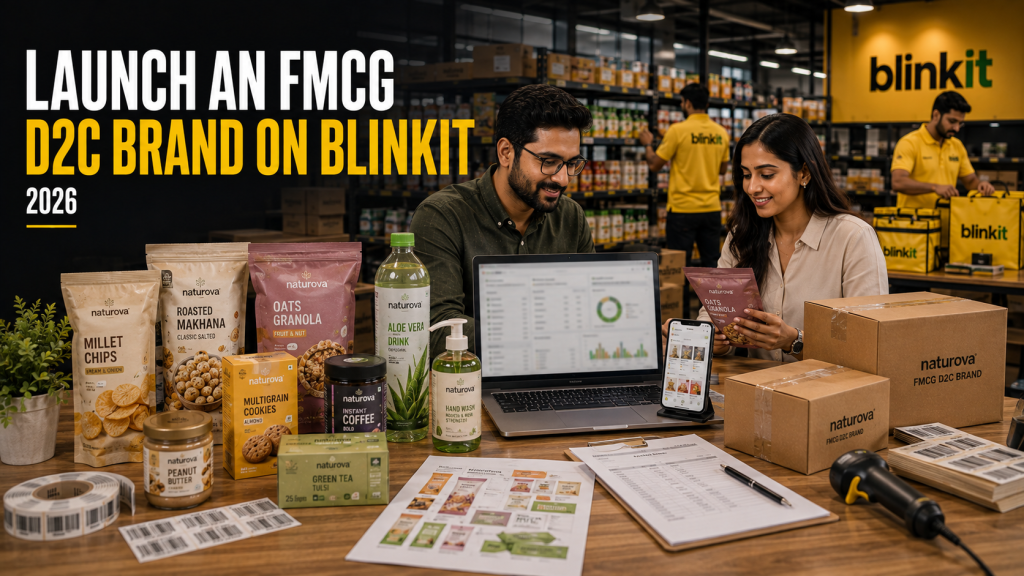
A surprising number of brands treat Blinkit approval as the finish line. In reality, it’s just the beginning. For any FMCG D2C Brand on Blinkit, the first 90 days after going live can significantly influence long-term visibility, sales, and account performance. This launch phase is where brands establish the foundation for stronger search visibility and sustainable growth. Our launch playbook guides new FMCG and D2C brands through each phase, helping them build the right momentum from day one.
The importance of these first 90 days goes beyond initial momentum. Consistent operational performance, strong product availability, growing review volume, and repeat purchases all contribute to building a stronger presence on the platform. A weak first month can leave a brand spending the following quarters fixing avoidable issues, while a well-executed launch gives brands a stronger foundation to scale efficiently.
📋 Pre-Launch Checklist
Before you even open the Blinkit Seller Hub, get these in place — they determine how smoothly everything downstream goes:
- ✓Business name identical across GST, PAN, bank account, and trademark documents
- ✓Trademark registered or application acknowledgement in hand
- ✓Category-specific compliance (FSSAI, BIS, Drug License) valid and current
- ✓2–3 launch SKUs identified and scored against quick commerce product-fit criteria
- ✓Professional product photography ready — white background, 1000×1000px minimum
- ✓Launch-window pricing and promotional budget planned in advance, not decided reactively
Treat this list as non-negotiable rather than a nice-to-have. Every item on it is something we’ve seen cause a launch delay or a rocky first month when skipped — and every one of them is far easier to fix before go-live than after your Category Manager has already flagged an inconsistency or your first batch of stock has already shipped to the wrong pack size.
🎯 Choosing Your Launch SKUs — Start Narrow, Not Wide
New brands are often tempted to launch their entire range at once, hoping something sticks. In practice, this spreads a limited launch ad budget and limited internal attention across too many SKUs to build meaningful traction on any of them. Pick 2–3 SKUs that score well on price accessibility, purchase frequency, and impulse fit, and put your full launch effort behind those — not your favourite product, necessarily, but your best-fit one.
We’ve published a full scoring framework for this in our guide on choosing which products to sell on Blinkit — worth running your shortlist through before locking in a launch batch.
💡
A tight launch batch is also easier to keep perfectly in stock. A single stock-out on your only launch SKU is far more damaging to early ranking momentum than the same stock-out buried in a 15-SKU catalog.
🏷️ Launch Week Pricing & Promotion Strategy
Your first few weeks on Blinkit are as much about building initial velocity and reviews as they are about margin. A few principles that consistently work for new brand launches:
Week 1
Lead with a launch discount
A visible introductory price — typically 15–30% below your steady-state price — lowers the trial barrier for a brand nobody has heard of yet.
Week 1–2
Put ad credit to work immediately
Under the SOR model, activate your PLA ad credit in the first days of going live rather than letting it sit unused — early impressions matter disproportionately for a brand-new listing.
Week 2–4
Prioritise fill rate over discount depth
A perfectly in-stock SKU at a moderate discount will out-rank a frequently out-of-stock SKU at a steep discount almost every time.
Week 4+
Taper the discount as reviews build
Once you have a base of ratings and repeat orders, gradually move toward steady-state pricing rather than staying permanently discounted.
🗓️ The First 90 Days — A Phased Plan
Days 1–30
Stabilise
- Zero stock-outs on launch SKUs
- Activate ad credit fully
- Respond to every early review
- Monitor daily, not weekly
Days 31–60
Optimise ranking
- Refine titles/images from early data
- Benchmark pricing vs new competitors
- Identify best and worst performing SKU
- Begin tapering launch discount
Days 61–90
Scale deliberately
- Add 2–3 next-best SKUs
- Shift ad budget to proven winners
- Move toward steady-state pricing
- Set quarter-two growth targets
🚧 Common Launch Mistakes New Brands Make
Most launch problems trace back to one of these four patterns. Recognising them in advance is usually enough to avoid them entirely:
📦
Launching too wide
Spreading ad budget and attention across 10+ SKUs instead of building real momentum on 2–3.
😴
Letting ad credit sit idle
Not activating PLA ad credit immediately, missing the highest-impact early visibility window.
📉
Going out of stock in week one
Underestimating launch-week demand and stocking too conservatively for the initial PO.
🙈
Ignoring early reviews
Not responding to first reviews, missing the chance to build early trust signals for the algorithm.
📊 Metrics to Watch in Your First Quarter
| Metric | Why It Matters Early |
|---|---|
| Fill rate | The single biggest lever the algorithm weighs — protect it above almost everything else |
| Search rank for category keywords | Shows whether your listing optimisation is actually working |
| Ad ROAS | Tells you whether launch ad spend is converting or just buying impressions |
| Rating average & review count | A direct trust and ranking signal that compounds over time |
| Repeat purchase rate | The clearest early signal of genuine product-market fit on the platform |
Track these weekly, not monthly, for the full first quarter — a monthly cadence is too slow to catch a fill-rate dip or a ranking slide before it’s already cost you two or three weeks of momentum. This is also exactly the reporting rhythm a properly run account management engagement should already be giving you, rather than something you’re piecing together yourself from the Seller Hub.
Brands that grow fastest on Blinkit aren’t the ones with the biggest launch budget — they’re the ones who protect fill rate and respond to data weekly, not monthly.
It’s also worth setting expectations internally before launch, especially with founders or investors watching week-one numbers closely. A slower, controlled ramp that protects fill rate and ratings almost always outperforms a loud, discount-heavy launch that can’t sustain its own momentum past week three. Quick commerce rewards consistency more than it rewards a big opening splash.
❓ Frequently Asked Questions
How long before a new brand sees meaningful sales on Blinkit?
Most brands see initial traction within the first 2–4 weeks if fill rate and ad credit are well managed, with more stable, repeatable sales patterns emerging over the 60–90 day mark as ratings and ranking build.
Should I discount heavily to compete with established brands at launch?
A visible, time-bound launch discount helps trial, but heavy permanent discounting to compete on price alone usually isn’t sustainable — fill rate and consistent quality tend to matter more for long-term ranking than discount depth.
What’s the biggest launch mistake first-time Blinkit brands make?
Launching too many SKUs at once and running out of stock on at least one of them within the first two weeks — both dilute the momentum a focused launch would otherwise build.
Do I need a dedicated team to manage a Blinkit launch?
Not necessarily a dedicated in-house team, but daily attention for at least the first 30 days is genuinely important — this is exactly the gap account management services are built to cover for brands without that internal bandwidth.
When should I add more SKUs after launch?
Once your initial 2–3 SKUs show stable fill rate, positive ROAS, and a healthy repeat-purchase pattern — typically around the 60–90 day mark, not sooner.
Launching soon? Get your 90-day plan built for you.
We’ll map your SKU selection, launch pricing, and first-quarter targets before you go live — starting with a free account audit.
📚 Related Reading
| 🛒 Seller Guide
A step-by-step breakdown of the seller journey — from registration to your first live listing. |
⚡ Onboarding
How to skip the common approval delays and get your catalog live faster. |
| 📈 Growth
The bigger picture — how the quick commerce category is evolving and where brands should place bets. |
🛠️ Service
Let us run the daily fill-rate, ad credit, and pricing operations for you post-launch. |