
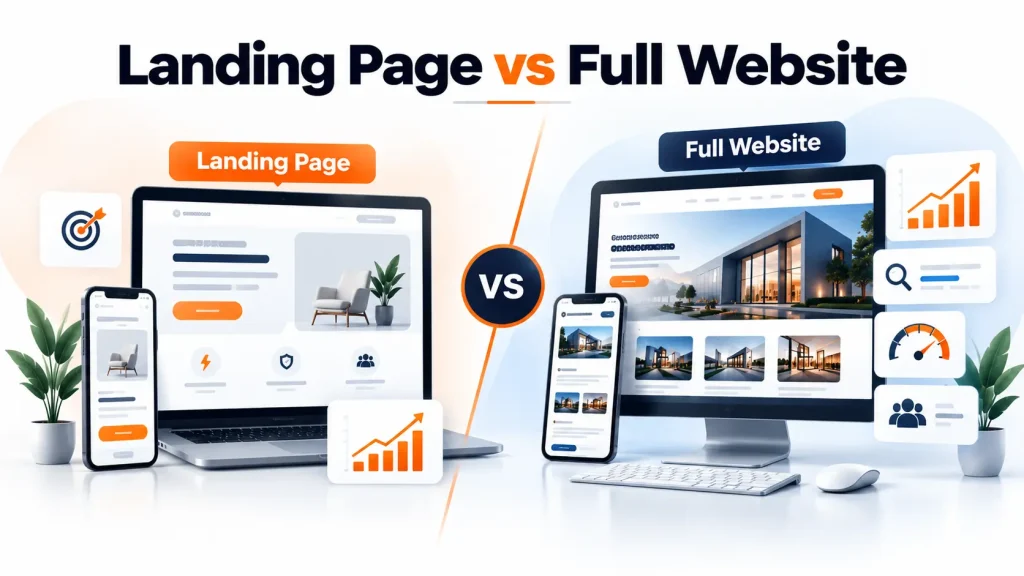
Here’s a conversation we have almost every week at Brand Chanakya: A business owner calls us — excited, budget in hand — and says, “I need a website.” We ask what they want to achieve. They say, “Generate leads” or “Sell my product.” Then we ask the question that stumps most of them: “Do you need a full website, or do you just need a landing page?”
Most people haven’t thought about this distinction. And that confusion costs them money. Either they overbuild — spending ₹1.5 lakh on a 10-page website when a single landing page would have generated the same leads — or they underbuild, putting up a one-pager for a business that needed credibility, depth, and Google rankings to survive.
We’ve built 500+ websites across India for SMEs, D2C brands, service businesses, and enterprises. In this guide, we’ll give you the exact decision framework we use internally — so you stop guessing and start building the right thing.
The Question Most Business Owners Get Wrong
When most Indian business owners say “I need a website,” what they really mean is: I need an online presence that brings me business. That’s the right goal. The mistake is assuming a full website is always the answer.
A landing page and a full website are fundamentally different tools. Choosing between them isn’t about budget — it’s about purpose. A ₹25,000 landing page can outperform a ₹1.5 lakh website if it’s the right tool for the job. And a ₹1.5 lakh website will underperform a ₹25,000 landing page if the business needs depth, trust, and organic discovery to close deals.
The right question isn’t “How much should I spend?” It’s “What does my buyer need to see before they call me?”
💡 The one-sentence rule: If your buyer needs to be convinced, you need a landing page. If your buyer needs to be reassured, you need a full website.
What Is a Landing Page?
A landing page is a single, focused web page built around one objective: get the visitor to take one specific action. That action could be filling out an enquiry form, calling a number, booking a demo, purchasing a product, or downloading a lead magnet.
There is no navigation menu taking them elsewhere. No “About Us” page. No blog. No distractions. The entire page — headline, copy, visuals, testimonials, and call-to-action — is engineered to drive that single conversion.
When a Landing Page Works Brilliantly
The Limitations Nobody Tells You About
Landing pages are powerful — but they have real constraints that agencies rarely mention upfront.
What Is a Full Business Website?
A full website is your complete digital headquarters. It’s a multi-page structure that covers every aspect of your business — who you are, what you offer, who you’ve worked with, how you work, what it costs, and how to get in touch.
Unlike a landing page that’s built to convert one type of visitor, a full website is built to serve every visitor — whether they’re arriving from Google search, a referral, a social media profile, or a direct recommendation.
What a Full Website Actually Includes
When a Full Website Is Non-Negotiable
Landing Page vs Full Website — Side-by-Side Comparison
| Factor | Landing Page | Full Website |
|---|---|---|
| Primary purpose | Convert one specific action | Serve all audiences, build brand |
| Number of pages | 1 page | 5 to 50+ pages |
| Time to launch | 5–10 business days | 4–12 weeks |
| Development cost (India) | ₹15,000 – ₹50,000 | ₹60,000 – ₹3,00,000+ |
| SEO / Organic ranking | Very limited | Strong — compounds over time |
| Works with paid ads | Ideal | Works, but service pages convert better |
| Brand credibility depth | Surface-level | Deep — portfolio, team, case studies |
| Multiple products/services | Not suitable | Designed for this |
| Blog / Content marketing | Not included | Core feature |
| Best for high-ticket buyers | Weak without supporting assets | Strong — buyers research before committing |
| Long-term ROI | Medium — depends on ad spend | High — organic traffic compounds |
The Decision Framework: Which One Should You Build?
Stop asking “which is better” and start asking “which is right for where I am right now.” Here’s the framework we use at Brand Chanakya when a new client walks in.
💡 The most common mistake we see: A serious B2B company with ₹5–10 lakh average deal size running ads to a single landing page. Their buyers Google the company name, find nothing credible, and don’t call. A full website would have closed those deals. The landing page just burned the ad budget.
What Does Each Option Cost in India in 2026?
Here are real-world cost ranges — not the ₹5,000 freelancer quotes you see on Fiverr, and not the inflated agency retainers. These are the numbers for professionally built, conversion-focused digital assets in India in 2026.
Note: This does not include ad spend, which is paid directly to Meta or Google.
SEO services are typically separate: ₹15,000–₹50,000/month depending on scope.
The numbers above reveal something important: a professionally built landing page and a basic full website can overlap in cost. The difference isn’t price — it’s purpose. Don’t let budget alone drive this decision.
The Mistake That Kills ROI Either Way
Whether you build a landing page or a full website, the single biggest mistake Indian businesses make is treating it as a one-time task rather than a living asset. They build it, launch it, and forget it.
A landing page without continuous A/B testing and traffic analysis stagnates. A full website without fresh content, new backlinks, and regular technical updates loses rankings within 6–12 months.
The question isn’t just “what should I build” — it’s “what am I committed to maintaining.” An honest answer to that question will guide your decision better than any comparison table.
The businesses we’ve seen succeed with both formats share one trait: they treat their web presence as an ongoing investment, not a one-time spend. If you’re ready for a landing page — commit to optimising it monthly. If you’re ready for a full website — commit to publishing content and building authority over 12–24 months.
That compounding effect is what separates businesses that rely on word-of-mouth and paid ads forever from businesses that eventually own their organic traffic and close deals on inbound alone. We’ve written in detail about how cutting corners early makes this compounding effect impossible — here’s exactly why cheap websites fail in India and what to do instead.
Your Next Step
If you’ve read this far, you already know more about this decision than most business owners in India. So let’s make it simple:
Either way, the decision matters far less than the execution. A mediocre strategy executed brilliantly beats a brilliant strategy executed poorly — every single time. See how Brand Chanakya approaches website development for premium clients across India, or book a free consultation and let’s figure out together what your business actually needs.
Web Development India
Digital Marketing
Lead Generation
D2C India
Frequently Asked Questions
What is the main difference between a landing page and a full website?+
A landing page is a single page built for one action — like an enquiry or a sale. A full website is a multi-page structure that serves every visitor, ranks on Google, and builds long-term credibility. The choice depends on purpose, not budget.
Is a landing page cheaper than a full website?+
Yes, generally. In India, a landing page costs ₹10,000–₹1,00,000, while a full website ranges from ₹40,000 to ₹3,00,000+. But a professional landing page and a basic 5-page website can overlap in cost — so price alone shouldn’t drive the decision.
Can I run Google or Meta Ads without a full website?+
Yes — a landing page is actually the ideal destination for paid ad traffic since it drives one specific action without distractions. Just remember: the traffic stops the moment your ad spend stops, since landing pages carry little to no SEO value.
Do landing pages help with SEO and Google rankings?+
No, not meaningfully. Landing pages built for paid campaigns have very limited organic ranking potential. If you want compounding, long-term organic traffic from Google, that only comes from a full website with a blog and multiple indexed pages.
Should a D2C brand build a landing page or a full website first?+
Most D2C brands eventually need both: a full website to build brand authority and organic search presence, plus dedicated landing pages for individual product launches and ad campaigns. Start with whichever matches your immediate goal — sales now, or brand growth over time.
Let’s decide together — for free.
Tell us about your business and we’ll recommend exactly what to build, with realistic timelines and costs upfront.
Book Your Free Consultation →
No pressure. No sales pitch. Just clarity.