
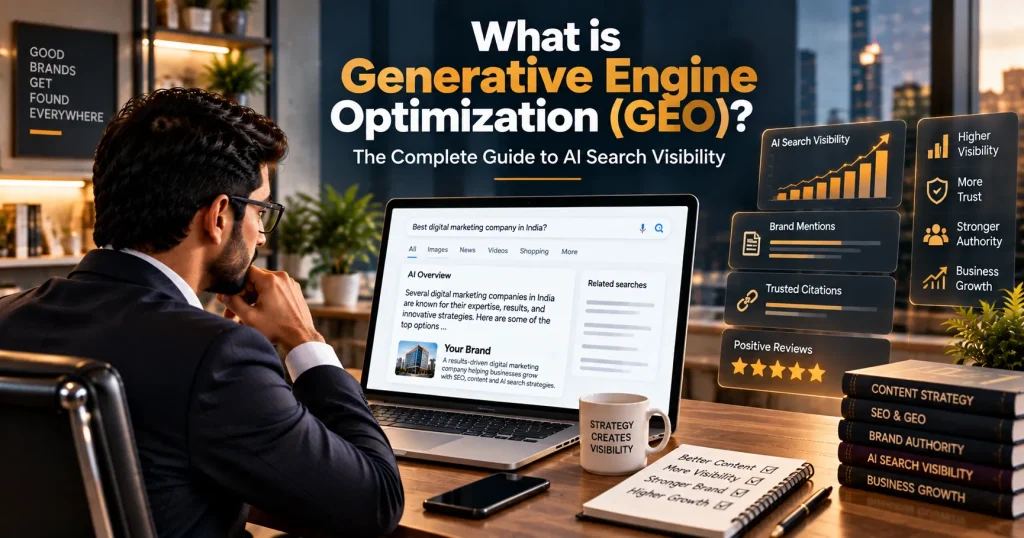
What is Generative Engine Optimization (GEO)? The Complete Guide for 2026
How brands are winning visibility inside ChatGPT, Google AI Overviews, Perplexity, and Gemini — and why traditional SEO alone no longer gets you found.
🔍 Type “best digital marketing agency in India” into ChatGPT today, and you won’t get ten blue links. You’ll get 2-3 confidently recommended names — and if your brand isn’t one of them, you have effectively disappeared for that searcher. This is the shift Generative Engine Optimization (GEO) exists to solve.
🤖 What Does Generative Engine Optimization Actually Mean?
Generative Engine Optimization (GEO) is the practice of structuring your brand’s digital presence — your website, reviews, citations, and authority signals — so that AI systems like ChatGPT, Google AI Overviews, Perplexity, Claude, and Gemini choose to mention, cite, or recommend you when someone asks a question in your category.
It is not a plugin you install or a one-time fix. GEO is an ongoing discipline that treats large language models as a new kind of “search audience” — one that reads your content differently than a human scanning a results page, and rewards different signals than the ones classic SEO chased for two decades.
🔗
Citations Over Rankings
AI engines don’t rank you #1 — they either cite you as a source or they don’t. There’s no “page two” in a generative answer.
🧠
Entities Over Keywords
AI models reason about your brand as an “entity” with attributes — reputation, expertise, reviews — not just a page matching a keyword string.
🗣️
Trust Signals Over Backlinks
Reviews, expert quotes, original data, and consistent facts across the web matter more than link volume alone.
🚀 Why GEO Matters Right Now
The move to AI-generated answers is happening faster than the shift to mobile search or the rise of social media did. ChatGPT alone processes hundreds of millions of weekly queries from people actively researching products, services, and providers — many of them in commercial “best X for Y” territory that used to belong entirely to Google.
🔬 How AI Engines Actually Decide Who to Mention
Generative engines like ChatGPT and Perplexity don’t work like the old Google algorithm. Instead of crawling and ranking billions of pages, they synthesize an answer from a smaller pool of trusted sources, then decide which brands deserve a mention inside that answer. Four factors dominate this decision:
- ✅ Entity clarity — Does the AI have a clean, consistent understanding of who you are, what you do, and where you operate? Inconsistent business names, addresses, or descriptions across the web actively hurt you here.
- ✅ Third-party validation — Are you mentioned on sites the AI already trusts — review platforms, industry publications, comparison sites, Wikipedia/Wikidata? AI models weight what others say about you far more than what you say about yourself.
- ✅ Structured, extractable content — Is your website’s information easy for a model to parse and quote? Clear headings, FAQ schema, and direct answers to specific questions get pulled into AI responses far more often than dense marketing copy.
- ✅ Recency and consistency — Does your brand information stay accurate and updated across your site, directories, and social profiles? Conflicting NAP (Name, Address, Phone) data confuses AI models the same way it confuses local search.
🛠️ The 5 Pillars of a Strong GEO Strategy
Every effective GEO program is built on the same five foundations, whether the brand is a SaaS company, a hospital, or a D2C e-commerce store.
📊
1. Entity Optimization
Knowledge Graph presence, Wikidata entries, and structured data (schema markup) that tell AI systems exactly who you are.
✍️
2. Authority Content
Original research, expert-authored guides, and quotable statistics that AI models can lift directly into an answer.
⭐
3. Review & Reputation Signals
Volume, recency, and quality of reviews across Google, industry-specific platforms, and third-party marketplaces.
🔗
4. Citation Building
Getting featured in listicles, expert roundups, comparison articles, and press coverage that AI already crawls and trusts.
📈
5. Ongoing AI Monitoring
Tracking how often — and how favorably — your brand actually appears across ChatGPT, Perplexity, and AI Overviews over time.
⚡ Is GEO a Replacement for SEO?
No — and any agency telling you to drop SEO for GEO is giving you bad advice. AI engines like Google AI Overviews and Perplexity still pull heavily from well-optimized, well-ranked web pages. Strong technical and content SEO remains the foundation that GEO builds on top of.
| Traditional SEO | Generative Engine Optimization |
|---|---|
| Optimizes for search engine rankings | Optimizes for AI-generated answers |
| User sees a list of links | User gets a direct recommendation |
| Success = click-through to your site | Success = your brand named in the answer |
| Keyword-focused optimization | Entity and authority-focused optimization |
| Backlinks as primary trust signal | Citations, reviews, and expertise as trust signals |
We cover this comparison in far more depth in our companion guide, GEO vs SEO: Key Differences Every Business Owner Should Know — worth reading next if you’re deciding where to focus your budget first.
🎯 How to Get Started with GEO
You don’t need to overhaul your entire digital presence overnight. Most brands see the fastest early wins by following this sequence:
- Audit first. Ask ChatGPT, Perplexity, and Google AI Overviews questions your customers would actually ask, and record whether — and how — your brand shows up.
- Fix entity inconsistencies. Align your business name, description, and contact details across your website, Google Business Profile, and major directories.
- Add structured data. Implement FAQ, Organization, and Review schema so AI crawlers can parse your site’s key facts instantly.
- Publish citable content. Original data, expert quotes, and direct answers to specific customer questions outperform generic blog fluff for GEO purposes.
- Track and iterate. Re-run your audit monthly. GEO is not “set and forget” — AI models retrain and update their retrieval sources constantly.
🚫 Common GEO Mistakes Brands Make Early On
Most businesses that struggle with GEO aren’t doing nothing — they’re doing the wrong things well. Watch out for these traps:
- Treating GEO like keyword stuffing 2.0. Repeating your brand name unnaturally across pages doesn’t help — AI models are trained to detect and discount manipulative patterns, the same way modern search engines do.
- Ignoring third-party sites entirely. Founders often pour all their energy into their own website while AI engines are quietly pulling their brand’s reputation from review sites, forums, and comparison articles they’ve never touched.
- Inconsistent facts across platforms. A different founding year on LinkedIn than on your About page, or a different service list on your website than on your Google Business Profile, creates the kind of ambiguity that makes AI systems cite a competitor instead — because the model can’t confidently resolve which version is correct.
- No measurement. Without tracking how often and how favorably your brand appears in AI answers month over month, you’re optimizing blind and have no way to prove ROI on the effort.
🏭 Which Industries Should Prioritize GEO First?
GEO delivers value fastest in categories where people naturally ask “best” or “top” questions before buying — a pattern AI search handles particularly well. Healthcare providers fielding “best clinic for X near me” queries, SaaS companies competing for “best CRM for small business” mentions, and hospitality brands answering “best hotels in [city]” are all seeing measurable AI-driven inquiry volume today. E-commerce and D2C brands, professional services firms, and educational institutions follow closely behind, since buyers in these categories increasingly research through conversational AI before ever visiting a website.
🎁 Find Out How Your Brand Currently Appears in AI Search
Brand Chanakya runs a free, no-obligation AI Visibility Audit that shows exactly how ChatGPT, Perplexity, and Google AI Overviews currently perceive — or ignore — your brand, with a clear roadmap to fix it.
❓ Quick Answers
1. Is GEO only relevant for large brands?
No. Local businesses, clinics, and D2C brands are already being recommended (or skipped) by AI in “near me” and “best for” queries — small and mid-sized businesses often have the most to gain from early GEO adoption.
2. How long before I see results from GEO?
Initial visibility improvements from structured data and entity fixes typically appear within 4-8 weeks. Consistent, repeatable AI citations usually take 3-6 months to fully develop.
3. Do I need a developer to implement GEO?
Some elements (schema markup, technical fixes) benefit from developer support, but most of GEO — content, reviews, citations — can be executed by a marketing team or agency without code changes.
📚 You Might Also Like
Comparison
GEO vs SEO: Key Differences Every Business Owner Should Know
Where the two disciplines overlap, where they diverge, and where your budget should go.
Playbook
How to Get Your Brand Mentioned in ChatGPT, Perplexity & Google AI Overviews
A practical, step-by-step playbook for earning AI citations — not theory, actual tactics.
Pricing
How Much Does GEO Cost? A 2026 Pricing Breakdown
Realistic budget numbers by business size, so you know what to expect before you sign anyone.
Free Audit
AI Visibility Audit: Why Every Business Needs One in 2026
You can’t fix what you can’t see — what an AI Visibility Audit actually uncovers about your brand.