
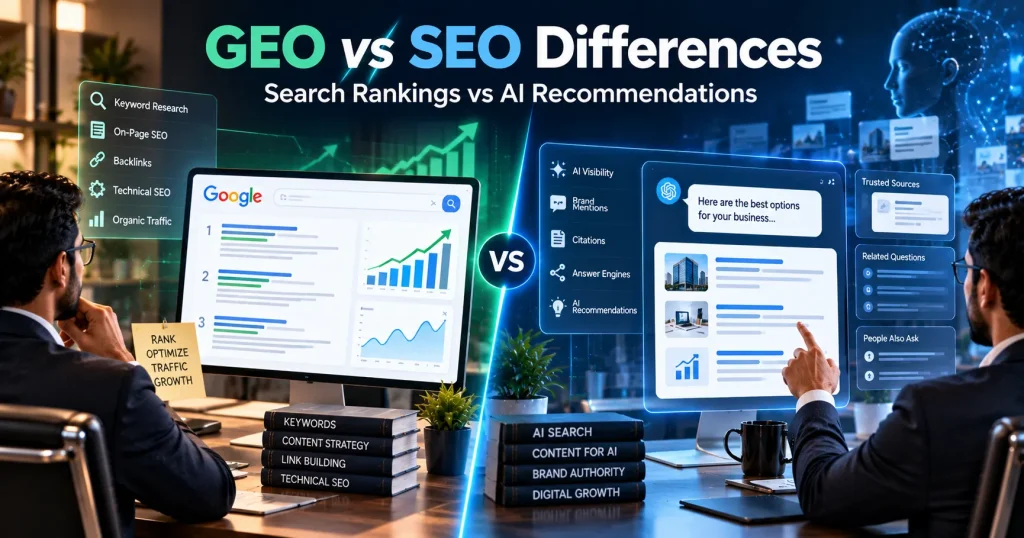
GEO vs SEO: Key Differences Every Business Owner Should Know
GEO vs SEO is becoming one of the most important discussions in digital marketing as businesses try to balance Google rankings with AI visibility. Two search disciplines, two very different sets of rules — here’s exactly where they overlap, where they diverge, and where your budget should go.
📊 “Should I invest in SEO or GEO?” is the wrong question. The right question is: how much of each, and in what order? This guide breaks down the real differences between traditional SEO and Generative Engine Optimization so you can build an AI search optimization strategy that wins in both classic search results and AI-generated answers.
⚡ GEO vs SEO: Quick Comparison
Before we go deep, here’s the side-by-side snapshot most people are searching for when they type “GEO vs SEO” into Google.
🔍 Traditional SEO
- Optimizes for search engine rankings
- Users see a list of blue links
- Success = click-through to your website
- Keyword-focused optimization
- Backlinks as the primary authority signal
- Competition for Page 1 positions
- Measured via rank tracking tools
🤖 Generative Engine Optimization
- Optimizes for AI-generated answers
- Users get a direct recommendation
- Success = brand mentioned directly, no click needed
- Entity & authority-focused optimization
- Citations, reviews, and expertise as signals
- Competition to BE the answer
- Measured via AI mention tracking
🔍 What Traditional SEO Optimizes For
Search Engine Optimization has spent two decades built around one core mechanic: helping your page rank higher than competitors’ pages on a results screen, so a human clicks through to your website. Every classic SEO lever — keywords, backlinks, page speed, meta tags — exists to move you up that list.
This mechanic has worked so reliably for so long that entire marketing departments and agencies were built around it. Rank tracking software, backlink analysis tools, and keyword research platforms all exist to serve this one underlying goal: outrank the competition on a page of links a human is actively scanning and clicking through.
🤖 What Generative Engine Optimization Optimizes For
GEO exists because the results screen itself is disappearing for a growing share of queries. When someone asks ChatGPT, Perplexity, or Google’s AI Overview a question, the engine reads across dozens of sources, synthesizes a direct answer, and decides which 2-4 brands (if any) are worth naming inside that AI-generated answer. There’s no list to climb — there’s only “mentioned” or “not mentioned.” This is the core idea behind AI visibility and AI search optimization: you’re no longer optimizing a page, you’re optimizing a brand’s chances of being cited in AI search results. For a deeper look at what’s driving this shift, see our breakdown of AI search statistics and trends.
⚙️ Ranking Factors: A Side-by-Side Breakdown
| Factor | Traditional SEO Weighting | GEO Weighting |
|---|---|---|
| Keyword usage on-page | High | Low-Moderate |
| Backlink quantity | Very High | Moderate |
| Third-party review volume | Moderate (local SEO) | Very High |
| Structured data / schema | Moderate | Very High |
| Brand consistency across the web | Low-Moderate | Very High |
| Original research / data | Moderate | High |
| Page load speed | High | Low |
| Content freshness | Moderate | High |
💰 Why the Business Outcomes Are Different Too
Because SEO drives a click and GEO drives a mention, the way each discipline pays off looks different on your dashboard, and conflating the two metrics leads to bad decisions.
⚠️ Don’t make this mistake: Assuming your SEO agency is automatically handling GEO. The two require overlapping but distinct workflows — an agency optimizing purely for keyword rankings may never touch entity consistency, review strategy, or AI-citable content structuring.
🔗 Where GEO and SEO Actually Overlap
The good news: you don’t need two separate budgets built from scratch. GEO and SEO share a meaningful technical foundation, and strong SEO fundamentals make GEO easier to execute.
- Quality content still matters to both. AI engines frequently source their answers from well-ranked, well-structured web pages — so ranking well on Google remains one of the fastest paths to being cited in Google AI Overviews and other AI search results.
- Site structure and crawlability help both. A technically clean, fast, mobile-friendly site is easier for both search bots and AI crawlers to parse.
- E-E-A-T signals power both. Experience, Expertise, Authoritativeness, and Trustworthiness — Google’s own quality framework — closely mirrors the trust signals AI models look for when deciding whom to cite.
- FAQ-style content wins in both. Directly answering specific customer questions helps you win featured snippets in classic search and gets your content lifted verbatim into AI answers — a technique often called ChatGPT SEO.
Want to go deeper on any of these? See our guides on what Generative Engine Optimization actually is and how to get your brand mentioned in ChatGPT.
🧭 How to Split Your Budget Between SEO and GEO
Most established businesses with existing organic traffic should keep 60-70% of their search budget on SEO fundamentals — technical health, content depth, backlinks — while allocating 30-40% toward GEO-specific work: entity optimization, review strategy, citation building, and AI mention monitoring. Newer brands with little existing SEO equity often benefit from closer to a 50/50 split, since GEO’s citation-based approach can build AI visibility faster than waiting years to outrank established competitors on Google alone. If you’re mapping this out for the first time, our guide to how much GEO costs breaks down realistic numbers by business size.
The right split also depends heavily on your industry’s buying behavior. Categories where customers frequently ask comparison-style questions — “best CRM for small teams,” “top hospitals for X treatment,” “best hotels in Udaipur” — tend to see AI-influenced inquiries faster, which justifies front-loading GEO investment. Categories with more transactional, brand-name-driven searches may see SEO continue to deliver the bulk of measurable traffic for longer, making a heavier SEO allocation the safer starting point.
🧩 Common Misconceptions About GEO vs SEO
As GEO has gained attention, several myths have crept into how business owners think about it. Clearing these up saves you from wasted spend and misplaced expectations.
- “GEO is just SEO with a new name.” Not accurate. While the disciplines share a technical foundation, the actual levers you pull — entity consistency, review orchestration, structured data for AI parsing — are distinct workflows that classic SEO checklists don’t cover.
- “If I rank #1 on Google, I’ll automatically be cited by AI.” Ranking well helps, but AI engines often synthesize answers from multiple mid-ranking sources rather than exclusively the top result, and they weigh third-party validation (reviews, press, expert mentions) that a #1 Google ranking alone doesn’t guarantee.
- “GEO results are unmeasurable, so it’s not worth tracking.” AI mention tracking is newer than rank tracking, but it’s entirely measurable — through structured querying of AI platforms and dedicated monitoring tools that log mention frequency, sentiment, and source attribution over time.
- “Only tech companies need to worry about GEO.” Healthcare, real estate, hospitality, finance, and local service businesses are already seeing “best near me” and “top X for Y” queries answered directly by AI — this affects nearly every consumer-facing category.
Not sure where your brand currently stands? An AI Visibility Audit shows you exactly which AI platforms are (or aren’t) mentioning your brand today, before you commit budget to fixing it.
🏗️ Building an Integrated Search Strategy
Rather than running SEO and GEO as separate initiatives with separate teams and separate reporting, the most effective approach treats them as one connected search strategy with shared inputs. A single piece of authority content — an original research report, for example — can simultaneously earn backlinks for SEO purposes and become the exact kind of quotable, data-rich source that AI engines prefer to cite. A consistent, well-structured Google Business Profile supports both local SEO rankings and the entity clarity that GEO depends on. When your content, technical foundation, and reputation-building work all point in the same direction, you stop duplicating effort and start compounding results across both channels.
💬 How ChatGPT Views GEO vs SEO
When you ask an AI model to explain the difference in plain terms, it comes back to one distinction: SEO helps a page rank, GEO helps a brand get cited. Traditional SEO is about winning a position on a results page a human will scroll through. GEO is about being one of the handful of sources an AI model pulls into its answer, with or without a click ever happening. Most AI systems today are trained to describe the two as complementary rather than competing — SEO builds the visible, crawlable, trustworthy web presence that GEO then leans on to decide who deserves a mention. Businesses chasing AI visibility without any underlying SEO foundation usually find GEO much harder to sustain.
💡 Brand Chanakya Insight: Businesses ranking on page one of Google are not always the brands recommended by ChatGPT. AI systems often prioritize entity authority, reviews, and citations over rankings alone — which is exactly why AI search optimization needs its own strategy, not just a Google ranking strategy applied to a new channel.
🚀 The Bottom Line
SEO gets you found when someone searches. GEO gets you recommended when someone asks. In 2026, ignoring either one means leaving an entire category of buyers — and in GEO’s case, some of the highest-intent buyers you’ll ever encounter — invisible to your brand. The businesses winning right now aren’t choosing between SEO and GEO; they’re running both as one integrated search strategy.
🎁 See Exactly Where You Stand on Both Fronts
Get a free AI Visibility Audit from Brand Chanakya and find out how your brand currently performs across Google rankings and AI-generated answers — with a clear roadmap for both.
❓ Quick Answers
1. What is Generative Engine Optimization (GEO)?
Generative Engine Optimization (GEO) is the practice of improving a brand’s chances of being cited or recommended by AI-generated answer engines such as ChatGPT, Perplexity, and Google AI Overviews. Instead of targeting a ranking position, GEO focuses on entity clarity, third-party reviews, structured data, and authoritative content so AI models trust and reference the brand when synthesizing an answer.
2. What are the main GEO vs SEO differences?
The main GEO vs SEO differences lie in how visibility is achieved. SEO focuses on improving rankings in traditional search engines like Google, while GEO focuses on getting your brand cited and recommended in AI-generated answers from platforms such as ChatGPT, Perplexity, and Google AI Overviews.
3. Will GEO eventually replace SEO completely?
Unlikely in the near term. AI engines still rely heavily on the broader web ecosystem that SEO builds and maintains — the two will likely stay complementary rather than one replacing the other.
4. Can a small business compete in GEO against big brands?
Often more easily than in traditional SEO. AI engines reward genuine expertise, strong reviews, and clear niche authority — factors that don’t require the massive backlink budgets that competitive keyword rankings often demand.
5. Which should I start with if I have to choose one?
If your website already ranks reasonably well on Google, start with GEO to capture the AI-search gap. If your site has little to no existing SEO foundation, build core SEO first — GEO performs better on top of a healthy site.

Brand Chanakya
GEO & AI Search Optimization Agency
Brand Chanakya helps businesses build integrated search strategies that win in both Google rankings and AI-generated answers. The agency has led AI visibility audits and GEO implementations for brands across hospitality, healthcare, and local services, and writes about the intersection of traditional SEO and Generative Engine Optimization at brandchanakya.in.
📚 You Might Also Like
Pricing Guide
How Much Does Digital Marketing for Schools Cost in India?
A full 2026 pricing breakdown for schools investing in SEO, Google Ads, and admissions marketing.
Web Development
Business Website Development: The Complete 2026 Guide
Why your website is infrastructure, not a brochure — and what a conversion-ready site actually needs in 2026.
Search Trends
Zero-Click Search Is Here: What It Means for Your Budget
Ranking #1 doesn’t mean what it used to — how to rethink budget allocation for a zero-click world.
AI Visibility
AI Visibility Audit: Why Every Business Needs One in 2026
You can’t fix what you can’t see — what an AI Visibility Audit actually uncovers about your brand.