
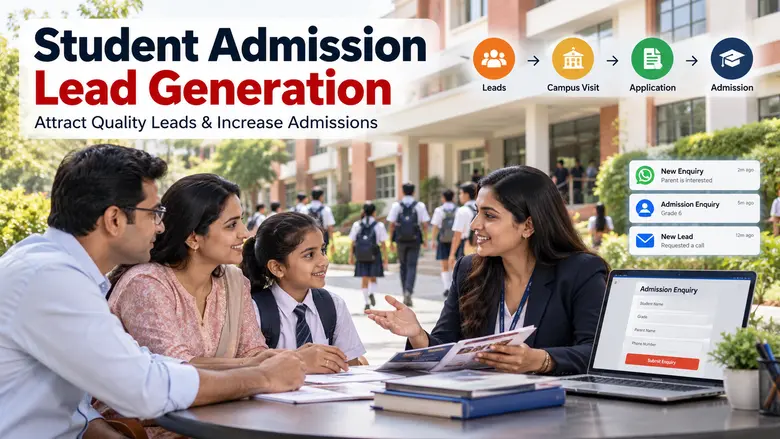
Student Admission Lead Generation: How to Attract and Convert More Enquiries
Student admission lead generation is not just about getting more enquiries—it is about attracting the right students and parents and converting those enquiries into campus visits, applications and confirmed admissions. A strong system combines Google Search Ads, SEO, Google Business Profile, Facebook and Instagram Ads, WhatsApp, referrals, focused landing pages and fast follow-up. This guide explains how to calculate the leads you need, improve lead quality, respond faster, nurture prospects and track every enquiry through to admission.
When admissions are slow, the instinct is to ask for more leads. Often, that’s the wrong fix. In most institutions we audit, the leak isn’t at the top of the funnel. It’s in the middle: calls not returned, visits not confirmed, parents who never heard back after asking about fees.
This guide covers both halves: generating quality admission leads online, and converting a much higher share of them. It works for schools, colleges and coaching institutes, and is part of our broader guide to digital marketing for educational institutions.
01Start with lead math
Before spending a rupee, work out how many leads you actually need. The formula is simple:
Ad budget = Leads needed × Cost per inquiry
Example: a school needs 120 new admissions. Last year, about 10% of inquiries became admissions. It needs roughly 1,200 inquiries. At an average of ₹250 per inquiry, that is about ₹3,00,000 in ad spend across the season.
Now look at what happens if the school improves its conversion rate from 10% to 13% through better follow-up. It needs only about 923 inquiries, and the budget drops to around ₹2,30,000. That is a saving of roughly ₹70,000 without touching the ads. This is why conversion deserves as much attention as lead generation.
02Where admission leads come from
| Source | Intent | Relative cost | Best for |
|---|---|---|---|
| Google Search ads | Very high | Medium to high | Parents and students actively looking right now |
| SEO and Google Business Profile | High | Low (after setup) | Steady, year-round inquiries; “near me” searches |
| Facebook and Instagram ads | Medium | Low to medium | Reaching families before they search; open houses |
| WhatsApp click-to-chat ads | Medium to high | Low to medium | Parents who prefer asking questions before sharing details |
| YouTube | Medium | Low | Trust building, especially for coaching and boarding |
| Referrals | Very high | Very low | Warm introductions from happy parents and students |
| Education portals and directories | Medium | Varies | Colleges and courses where students compare options |
For Meta specifically, see our Facebook and Instagram ads playbook for 2027-28 admissions. For coaching, our coaching institute marketing guide covers the scholarship test funnel.
03The landing page that converts
Sending ad traffic to your homepage is one of the most expensive mistakes in education marketing. Build a focused admission page with:
- A clear headline: “Admissions Open for 2027-28 | Nursery to Class 9 | CBSE”
- Short form above the fold: parent name, phone, class applying for, area
- Trust signals: years established, results, Google rating, affiliations
- A short video: campus tour or principal message
- Key facts: fee range or “request fee structure”, transport areas, timings
- Parent testimonials with names and photos (with permission)
- A WhatsApp button for parents who prefer to chat first
- Fast loading on a mid-range phone on mobile data
04Lead magnets for education
Not every parent is ready to “inquire”. Give them a lower-commitment reason to share their details:
Fee structure PDF
Simple, honest, and one of the most requested items. Collect a phone number to send it.
Open house registration
A date and a reason to visit converts better than “contact us”.
Scholarship or talent test
The strongest lead magnet for coaching institutes and many schools.
Admission guide
“Choosing the right school: a parent’s checklist” builds trust and captures early researchers.
Virtual tour booking
Useful for boarding schools and families moving from another city.
Free demo class
Lets students experience teaching before committing.
05Qualifying leads without losing them
Every extra form field reduces submissions, but the right one or two fields save your team hours. A good balance:
- Always ask: name, phone, class or course applying for.
- Usually worth asking: area of residence (for day schools) or city (for boarding and coaching).
- Ask on the call instead: budget, current school, reasons for switching.
Use those answers to route leads: a Class 11 NEET inquiry goes to the right counsellor, and an inquiry from outside your transport area gets an honest answer early.
06Speed to lead
Parents often inquire with several institutions on the same evening. The first one to respond with a helpful, friendly conversation has a real advantage.
- Instant: automatic WhatsApp message confirming the inquiry, with a brochure or fee structure link.
- Within minutes (working hours): a call from the admissions team. Aim to book a campus visit or counselling session on this call.
- Outside working hours: an automated message setting expectations (“We’ll call you by 10 am tomorrow”), then keep that promise.
- Missed call: retry twice more that day and send a WhatsApp message.
07A simple nurture sequence
Most parents won’t decide on the first call. A light, useful follow-up sequence keeps your institution in their mind without being pushy:
| Day | Channel | Message |
|---|---|---|
| Day 0 | WhatsApp + call | Thank you, brochure or fee structure, invite to visit |
| Day 1 | Campus tour video and visit booking link | |
| Day 3 | Parent testimonial or result story | |
| Day 7 | Call | Check-in: any questions? Offer a visit slot |
| Day 14 | Open house or scholarship test invitation | |
| Before deadline | WhatsApp + call | Registration or fee deadline reminder |
Use approved WhatsApp Business templates where required, and always give parents a simple way to opt out.
08CRM, scoring and attribution
Whether you use a dedicated admission CRM or a well-organised sheet, record for every lead:
- Source and campaign (Google, Meta, organic, referral, walk-in)
- Class or course, area and date
- Stage: new, contacted, visit booked, visited, registered, admitted, lost
- Reason lost, if applicable (fees, distance, chose another school, no response)
Simple lead scoring: mark leads hot (visit booked or asked about fees and dates), warm (engaged but undecided) or cold (no response after three attempts). Focus counsellor time on hot and warm leads every day.
Attribution closes the loop. When you know which campaigns bring admissions, not just inquiries, you can move budget with confidence. Our lead generation services include CRM setup and source tracking.
09Fixing a leaky admission funnel
| Symptom | Likely cause | Fix |
|---|---|---|
| Lots of leads, few visits | Slow or weak first call | Call within minutes; book the visit on the first call |
| Many wrong-area leads | Targeting too wide, no area question | Tighten location; add area field to forms |
| Visits but few registrations | Campus experience or fee objections | Train the visit team; address fee concerns openly |
| Registrations but no fee payment | Undecided families, no follow-up | Personal calls; clear, honest deadlines |
| Cheap leads, poor quality | Forms too easy, weak qualifying | Higher-intent forms; judge by cost per admission |
| Can’t tell what works | No source tracking | Tag every lead with its source in a CRM |
10Frequently asked questions
What is the best way to generate student admission leads online?
Use a mix of sources: Google Search ads for active searchers, SEO and Google Business Profile for steady inquiries, Facebook and Instagram ads to reach families early, and referrals from current parents. Send paid traffic to a focused admission landing page with a short form and a WhatsApp option.
How much does an admission lead cost?
In our campaigns, school inquiries typically cost ₹150–400, coaching inquiries ₹100–300 and college inquiries ₹200–500. The real number depends on your city, competition, fees and the quality of your ads and landing page.
How can we convert more admission inquiries into enrollments?
Respond within minutes, book a campus visit or counselling session on the first call, follow up with a short WhatsApp sequence, address fee questions openly and track every lead’s stage in a CRM. Improving follow-up often lifts admissions more than increasing ad spend.
Do we need a CRM for admissions?
For more than a few dozen inquiries a month, yes. Even a well-structured spreadsheet helps, but a CRM makes it easier to assign leads, set reminders, track sources and see which campaigns bring actual admissions.
Are cheap leads a good sign?
Not always. Very cheap leads often come from forms that are too easy to submit. Judge campaigns by cost per campus visit and cost per admission, not cost per lead.
Want more admissions from the leads you already get?
We build lead generation, landing pages and follow-up systems for schools, colleges and coaching institutes.
|
Keep Reading Related Blogs You May Like |
|||
|
|
||
|
|
||