
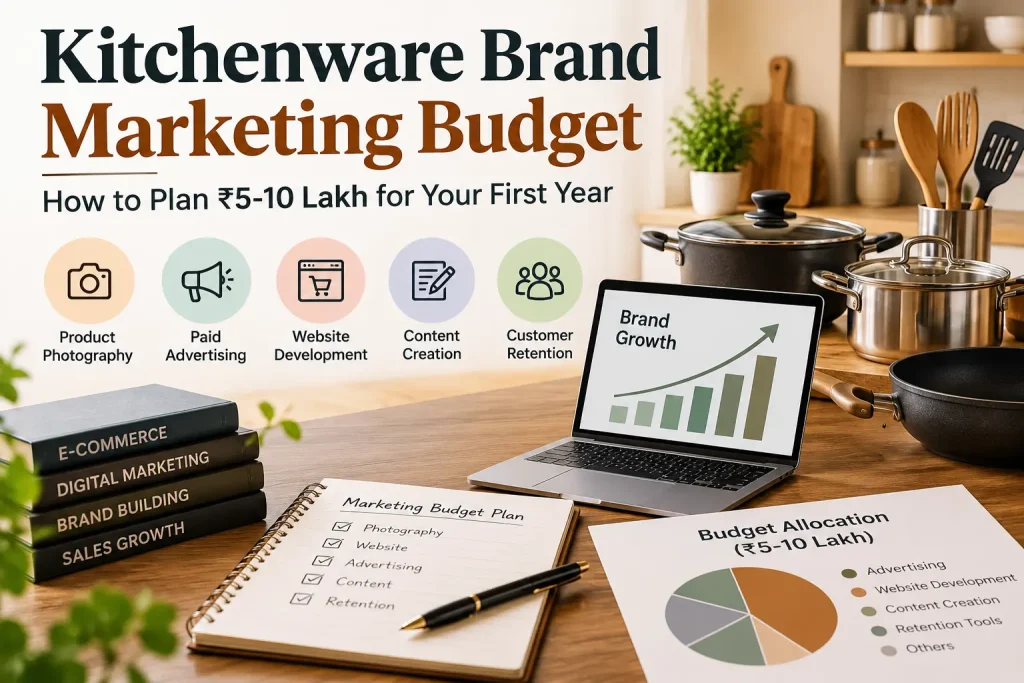
Kitchenware Brand Marketing Budget: How to Plan Your First 12 Months
Planning a realistic Kitchenware Brand Marketing Budget is essential for building a successful online kitchenware business in India. A dedicated budget of ₹5–10 lakh for the first 12 months can help cover product photography, marketplace listings, website development, paid advertising, content creation, and customer retention tools, separate from manufacturing and inventory costs. By allocating funds strategically, preparing for seasonal sales such as Diwali and wedding season, and reviewing performance every quarter, kitchenware brands can manage expenses, build customer trust, and create a sustainable foundation for long-term online growth.
If you were opening a physical utensil shop, you wouldn’t expect to break even in month two. You’d budget for rent, interiors, staff, and a slow build-up of local trust. Launching a kitchenware brand online deserves the same seriousness — yet many founders budget carefully for manufacturing and inventory, then treat marketing as an afterthought with whatever’s left over. This mindset shift is often the real difference between brands that make it past year one and those that quietly fade out.
1. The Physical Shop Comparison
Nobody questions setting aside a year’s rent, interiors, and staff salary budget before opening a retail utensil shop. Online, the equivalent costs — photography, listings, advertising, content, and retention tools — are just as essential, but far easier to skip since there’s no landlord expecting payment on the first of the month.
2. What ₹5-10 Lakh Actually Covers
This range covers the first 12 months of marketing and operations — separate from your manufacturing and inventory costs, which should be budgeted independently.
- Professional lifestyle photography and A+ content: ₹50,000-₹1,00,000
- Basic Shopify/D2C website build: ₹60,000-₹1,50,000
- Marketplace and social advertising (12 months): ₹2,50,000-₹4,50,000
- Content creation, including seasonal campaigns: ₹80,000-₹1,50,000
- Retention tools (CRM, WhatsApp API, email platform): ₹50,000-₹1,00,000
Quick Tip
Treat this as a 12-month runway, not a launch-week splurge. Spreading it deliberately prevents the common trap of a strong first month followed by silence once the initial budget runs out.
3. Why 12 Months, Not 3
Kitchenware has a uniquely seasonal revenue pattern — Diwali and wedding season alone can represent well over half of annual sales. A brand launched in, say, March won’t experience its first full festive season until October at the earliest, and won’t have a complete picture of annual performance until it’s been through both Diwali and wedding season at least once.
Did You Know?
Many kitchenware brands see their most significant single revenue jump not in their launch month, but during their first full Diwali cycle — often 6-10 months after launch, once reviews, listings, and retention systems are already in place.
4. How to Phase the Budget
- Quarter 1: Heaviest spend — photography, website, listing optimization, launch ads
- Quarter 2: Steady ad spend, first bundle/gift set introduced, review base building
- Quarter 3: Seasonal campaign preparation begins for Diwali and wedding season 60-90 days ahead
- Quarter 4: Peak seasonal execution, reinvestment of early revenue into retention and next year’s planning
Case Study Example
A cookware manufacturer we’ve observed initially allocated almost their entire capital to a large first production run, leaving minimal budget for marketing. Sales from friends, family, and local network contacts dried up within two months, and the brand nearly stalled before revisiting their plan — cutting the next production batch size to free up capital specifically for photography, listings, and their first Diwali campaign the following season, which is when meaningful growth actually began.
5. Working With a Smaller Budget
Not every founder has ₹5-10 lakh available upfront, and that’s a manageable reality — the principle matters more than the exact figure. With a smaller budget, focus deeply on one marketplace and skip the D2C website until marketplace sales validate demand.
Expert Advice
A well-executed single-channel launch, fully funded, consistently beats a weak multi-channel launch spread across five platforms with no single one properly resourced.
6. Common Planning Mistakes
Common Mistake
Spending the entire available capital on a large first production batch, leaving nothing to actually market and sell it. Inventory without a marketing budget simply sits in a warehouse.
- ☐Budgeting only for manufacturing and treating marketing as optional
- ☐Expecting profitability within the first 2-3 months
- ☐Skipping seasonal budget planning until the season is already close
- ☐Cutting photography and content budget first when funds get tight
7. Funding the Budget Beyond Personal Savings
Not every founder has ₹5-10 lakh sitting in personal savings, and there are several practical ways to bridge this gap without compromising the plan entirely.
- Reinvesting a portion of early manufacturing margin instead of taking it as profit in year one
- MSME loan schemes designed for food and home-goods manufacturing units
- A phased product launch with a smaller SKU range, freeing capital from inventory toward marketing
- A small angel or family investment earmarked specifically for marketing, keeping manufacturing self-funded
8. A Quarterly Checkpoint Worth Running
Rather than committing rigidly to a 12-month plan and hoping it holds, review your actual spend against revenue every quarter. If by month 6 your revenue isn’t covering at least a modest share of your marketing spend, it’s worth revisiting your channel mix or pricing rather than continuing the same approach for another six months on faith alone.
Key Takeaways
- Treat marketing and operations as a dedicated budget, just like rent for a physical shop
- ₹5-10 lakh is a realistic 12-month range, separate from manufacturing and inventory
- Kitchenware’s seasonal nature means meaningful results often take a full year to appear
- Phase spending across quarters rather than front-loading or under-planning for seasons
- A smaller budget still works if focused deeply on one channel rather than spread thin
What This Looks Like for a Solo Founder vs a Small Team
A solo founder managing manufacturing and marketing alone will naturally need more of the ₹5-10 lakh allocated toward outside help — a freelance photographer, a part-time content creator, or an agency for listings and ads — since there simply isn’t enough personal bandwidth to execute everything directly. A small team with a dedicated marketing hire can shift more of that budget toward paid media and content production instead of outsourced execution. Neither approach is wrong, but the budget split should reflect which one actually describes your situation.
Conclusion
Building a kitchenware brand online is a genuine business, not a quick side project — and it deserves the same 12-month, properly funded commitment you’d give a physical shop. Founders who plan for both the time and the budget give their brand a real chance to still be growing well past the first year.
Planning Your Kitchenware Brand’s First Year?
Get a free growth audit with a realistic 12-month budget and roadmap for your brand.
Frequently Asked Questions
Is ₹5-10 lakh enough to launch a kitchenware brand online?
For a small-to-mid scale launch covering the first 12 months of marketing, listings, photography, and ads, ₹5-10 lakh is a realistic working range, separate from inventory costs.
Why does a kitchenware brand need 12 months to become profitable?
Because reviews, seasonal cycles, SEO, and repeat customers all take time to build. Most brands only capture their first full Diwali and wedding season cycle around months 10-12.
What does the marketing and operations budget actually cover?
Photography, listing optimization, marketplace and social ads, content creation, a basic D2C website, and customer retention tools.
Can I launch a kitchenware brand with a smaller budget?
Yes, but growth will likely be slower. A smaller budget means focusing deeply on one channel rather than spreading across several.
What happens if I only budget for manufacturing and inventory?
Most brands see an initial sales spike from personal networks, followed by a plateau once that limited reach is exhausted.
How should the 12-month budget be phased?
Heavier spend in the first quarter for setup, steady spend through the middle two quarters, and reinvestment of early revenue in the final quarter.