
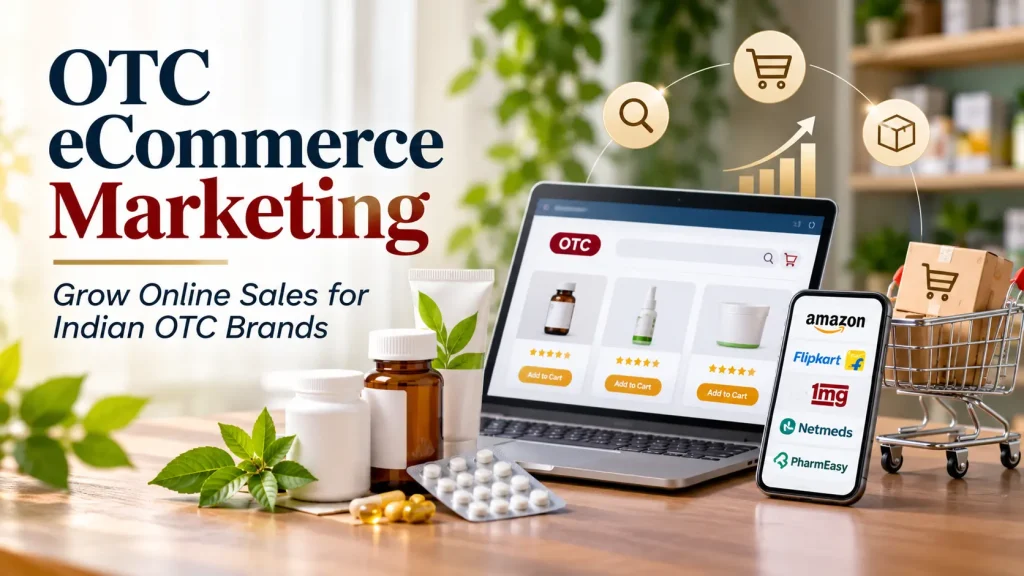
OTC eCommerce Marketing: Strategies to Grow Online Sales for Indian Brands
Budgets for OTC eCommerce marketing scale with how many channels a brand runs at once. A brand starting with marketplace listing optimization and basic SEO typically works with a smaller monthly service budget, focused on a handful of priority listings and 3–5 pieces of supporting content per month. Brands running SEO, paid ads across Google and Meta, and active marketplace ad campaigns together need a meaningfully larger monthly service budget, with ad spend billed separately and scaled to category competitiveness — pain relief and vitamin categories tend to be more competitive, and therefore costlier per click, than niche wound-care or specialty OTC segments.
OTC eCommerce marketing is the fastest-growing channel for Indian over-the-counter brands — pain relief, cold and cough, digestive health, wound care, vitamins, and personal care products that used to sell almost entirely through pharmacy counters. Selling OTC products online today means competing on Amazon, Flipkart, and health-specific marketplaces like 1mg, Netmeds, and PharmEasy, each with its own rules for what OTC brands can and can’t say. This guide covers how to actually grow sales through OTC eCommerce marketing in India, channel by channel.
Why OTC Brands Are Moving Online
The shift toward OTC eCommerce marketing isn’t just about convenience — it reflects a real change in how Indian consumers discover and buy health and wellness products. Buyers researching a symptom now start on Google or a health app before ever walking into a pharmacy, and many complete the purchase without leaving their phone.
For OTC brands, this creates an opportunity that pure pharmacy distribution never offered: the ability to reach a buyer at the exact moment they’re searching for a solution, with content and product pages built specifically to answer that search — something a crowded pharmacy shelf simply can’t do.
It also raises the stakes for brands that stay offline-only. A competitor with a well-optimized Amazon listing and a ranking blog post on “best pain relief spray for back pain” captures that buyer before your product is ever considered — regardless of how strong your offline distribution is.
What Makes OTC eCommerce Marketing Different
Marketing an OTC product online isn’t the same as marketing a regular FMCG or D2C product — the advertising and content rules are tighter, and buyer trust matters more because it’s a health-adjacent purchase.
- Claims discipline: OTC advertising must stay within approved indications and avoid disease-cure language not backed by the product’s actual label and approvals.
- Platform-specific ad policies: Google, Meta, and Amazon all apply extra review to health and medicine-adjacent ads — expect more ad rejections and longer approval times than a typical consumer product.
- Higher trust threshold: Buyers want to see certifications, ingredient transparency, and real reviews before purchasing something they’ll consume or apply to their body — more so than with a typical lifestyle product.
- Repeat-purchase economics: Many OTC categories (pain relief, digestive health, vitamins) are used repeatedly, making subscription and reorder flows far more valuable than one-time acquisition.
If your portfolio also includes prescription or regulated pharma lines, the compliance bar rises further. That is where specialist digital marketing services for pharma companies help keep every claim, creative and landing page within the rules.
Where to Sell OTC Products Online in India
Amazon & Flipkart
Highest overall reach; strong for brand discovery and price-comparison shoppers.
1mg, Netmeds & PharmEasy
Health-specific marketplaces where buyers already have purchase intent for medicines and wellness products.
Your Own D2C Website
Full control over content, subscription flows, and margin — best for building direct customer relationships.
Quick Commerce (Blinkit, Zepto, Instamart)
Fast-growing channel for immediate-need OTC purchases — covered in depth in our quick commerce guide.
Most successful OTC brands don’t pick one — they run a coordinated presence across two or three of these, using the health marketplaces for purchase-intent buyers, Amazon/Flipkart for reach, and their own D2C site for margin and customer data.
Getting each channel right
On Amazon and Flipkart, winning comes down to keyword-optimized titles, strong imagery, and a steady flow of genuine reviews — these platforms reward listings that convert well with better organic placement. On 1mg, Netmeds, and PharmEasy, buyers are further along in their decision journey, so accurate categorization, clear dosage or usage information, and fast fulfillment matter more than discovery-stage content. On your own D2C site, the priority shifts to building a reason to buy direct rather than through a marketplace — usually subscription pricing, bundles, or content that a marketplace listing can’t accommodate.
SEO for OTC eCommerce
Keyword types that convert
- Symptom-led searches: “back pain relief spray,” “cold and cough syrup for adults” — buyers who haven’t picked a brand yet
- Comparison searches: “best digestive tablets in India,” “pain relief gel vs spray” — buyers narrowing down options
- Brand + product searches: once awareness builds, direct brand searches become a growing share of traffic
Content that ranks and builds trust
OTC brands that win organic search usually publish genuinely useful content around the symptom or need their product addresses — not just a product page. A blog post on “how to choose a pain relief product for different types of pain,” internally linked to the actual product listing, consistently outperforms a product page competing alone for a broad symptom keyword.
Paid Ads for OTC Products
Google Ads, Meta Ads, and marketplace ads (Amazon Ads, Flipkart Ads) all work for OTC eCommerce marketing, but each needs a different creative approach to stay compliant and convert.
| Channel | Best for | Compliance note |
|---|---|---|
| Google Search Ads | Capturing symptom and comparison search intent | Ad copy must match approved product claims exactly |
| Meta Ads | Awareness and retargeting past website visitors | Before/after and medical claim restrictions are stricter here |
| Amazon/Flipkart Ads | Winning the buy box moment when buyers are already comparing products | Follows marketplace-specific health category ad policies |
A common mistake is writing one ad script and reusing it across all three — each platform’s review process reads claims differently, and creative that clears Google Ads review can still get rejected on Meta.
Brands running regulated or prescription-adjacent portfolios can read more about how we approach digital marketing services for pharma companies, including compliant paid media and content workflows.
Marketplace Listing Optimization
For Amazon, Flipkart, and health marketplaces alike, the product listing itself is doing as much marketing work as any ad campaign.
- Title and bullet points should lead with the primary use case and format (spray, tablet, syrup, gel) since that’s how buyers filter search results
- A+ content / enhanced brand content should visually explain how and when to use the product — this reduces returns as much as it drives conversion
- Certifications and approvals (FSSAI, AYUSH, manufacturing license where applicable) belong prominently in images, not just fine print
- Review management matters more for OTC than almost any other category — a handful of detailed, credible reviews outperforms a large volume of generic ones
Content & Trust-Building for OTC Buyers
Because OTC purchases are health-adjacent, buyers do more research than they would for a typical consumer product — even for something as routine as a pain relief balm. Brands that invest in genuinely helpful content (usage guides, ingredient explainers, symptom comparisons) consistently see lower return rates and higher repeat purchase, because buyers arrive already understanding how to use the product correctly.
This content also does double duty: a well-written usage guide reduces pre-purchase questions and post-purchase support queries at the same time, since buyers arrive already understanding correct dosage, application, and expected results.
Subscription & Repeat-Purchase Programs for OTC Brands
Many OTC categories — pain relief, digestive health, vitamins, wound care essentials — follow a natural repeat-purchase pattern. A customer who buys once for a specific need often needs the same product again within weeks or months. Brands that build a deliberate reorder system around this capture far more lifetime value than those relying purely on repeat organic or ad-driven visits.
What works for OTC repeat purchase
- Subscribe-and-save options on your own D2C site and where marketplaces support it, with a modest discount incentive
- WhatsApp or SMS reorder reminders timed to typical usage cycles (a 30-day supplement pack reminder around day 25, for instance)
- Post-purchase email flows that check in on usage and satisfaction before prompting a reorder, rather than a generic discount blast
- Bundle offers across complementary OTC products (a cold and cough combo, a digestive health starter kit) that increase basket size on the reorder
The economics matter here: acquiring a new OTC customer through paid ads is usually far more expensive than retaining an existing one, so a well-built reorder flow often delivers a better return than incremental ad spend.
What OTC eCommerce Marketing Costs
Budgets for OTC eCommerce marketing scale with how many channels a brand runs at once. A brand starting with marketplace listing optimization and basic SEO typically works with a smaller monthly service budget, focused on a handful of priority listings and 3–5 pieces of supporting content per month. Brands running SEO, paid ads across Google and Meta, and active marketplace ad campaigns together need a meaningfully larger monthly service budget, with ad spend billed separately and scaled to category competitiveness — pain relief and vitamin categories tend to be more competitive, and therefore costlier per click, than niche wound-care or specialty OTC segments.
A useful way to think about budget allocation: roughly a third toward marketplace optimization and listing content, a third toward paid ads, and a third toward SEO content and reorder-flow setup — adjusted based on which channel is already converting best for your specific product category.
OTC eCommerce vs Traditional Pharmacy Distribution
| Factor | Traditional Pharmacy Distribution | OTC eCommerce Marketing |
|---|---|---|
| Discovery | Depends on shelf placement and chemist recommendation | Depends on search visibility and marketplace ranking |
| Reach | Limited to physical distribution footprint | Pan-India from day one, regardless of physical presence |
| Customer data | Almost none — the pharmacy owns the relationship | Full visibility into buyer behaviour and repeat purchase |
| Margin | Shared across distributor and retailer tiers | Higher on D2C; marketplace commissions apply elsewhere |
| Speed to market | Slower — requires distributor onboarding per territory | Can list and start selling within days on most platforms |
This isn’t an either/or decision for most brands — pharmacy distribution still matters for categories where in-person trust drives the purchase, while eCommerce captures the growing share of buyers who research and buy without ever visiting a counter.
Common Mistakes OTC Brands Make Online
- Treating the marketplace listing as an afterthought instead of the primary conversion asset it actually is
- Using ad claims that don’t match the approved product label, risking ad account and platform-level penalties
- Ignoring reorder and subscription flows for categories that are naturally repeat-purchase
- Running the same creative across Google, Meta, and marketplace ads without adjusting for each platform’s review standards
- Under-investing in reviews and Q&A management, which matters disproportionately for health-adjacent products
A Launch Roadmap for OTC eCommerce Marketing
- 1Weeks 1–2: Platform audit. Review your current listings on Amazon, Flipkart, and any health marketplaces you’re already on — fix titles, images, and certifications first.
- 2Weeks 2–4: Build content foundations. Publish 3–5 symptom and comparison-led blog posts that link directly to your product listings.
- 3Weeks 3–6: Launch paid ads. Start with Google Search Ads on symptom keywords, adjusting creative separately for Meta once compliance is confirmed.
- 4Weeks 5–8: Optimize marketplace listings further. A+ content, review generation campaigns, and Q&A management.
- 5Weeks 8–12: Add reorder flows. Set up subscription options or WhatsApp/email reorder reminders for repeat-purchase categories.
- 6Ongoing: Track by channel and category. OTC categories perform differently across platforms — pain relief may convert best on Amazon while digestive health performs better through health marketplaces.
OTC brands that win online treat the product listing as their most important piece of marketing — not an afterthought to the ad campaign.
Frequently Asked Questions
Can OTC products be advertised online in India?
Yes, OTC products can be advertised online as long as the claims made in ads match the product’s approved label and indications. The restriction is around unverified or disease-cure claims, not the channel itself.
Which platform is best to sell OTC products online in India?
Most OTC brands benefit from a combination — Amazon and Flipkart for reach, health-specific marketplaces like 1mg, Netmeds, and PharmEasy for purchase-intent buyers, and a D2C website for subscription and repeat orders.
How long does OTC eCommerce SEO take to show results?
Most OTC brands see meaningful organic traffic growth within 3–4 months of consistent content and listing optimization, with compounding gains over 6–12 months.
Do OTC ads need special approval on Google and Meta?
Health and medicine-adjacent ads typically go through stricter review on both platforms. Expect longer approval times and be prepared to revise ad copy if claims aren’t clearly substantiated by the product label.
Is it worth building a subscription model for OTC products?
For naturally repeat-purchase categories like pain relief, digestive health, and vitamins, yes — retaining an existing customer through a reorder flow is almost always cheaper than acquiring a new one through paid ads.
Should OTC brands drop pharmacy distribution in favour of eCommerce?
No — the two are complementary. Pharmacy distribution still captures buyers who prefer chemist recommendations and in-person trust, while eCommerce captures the growing share who research and buy digitally.
📚 Related Reads
India Quick Commerce and E-Commerce Statistics
E-Commerce Growth Roadmap for Kitchenware Brands
SEO vs Paid Ads for SMEs: Which Delivers Better ROI?
How to Sell Kitchenware Online in India