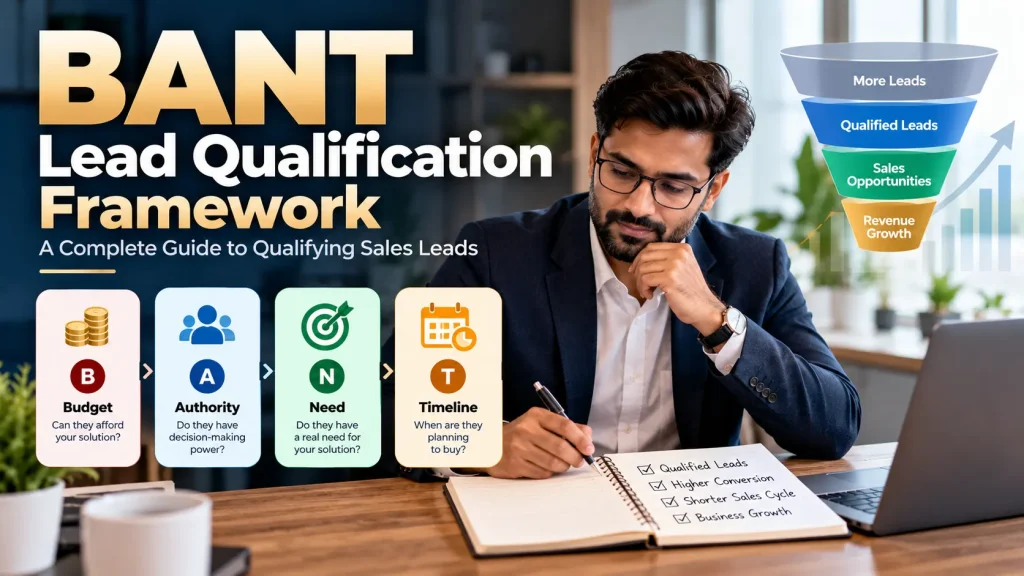
BANT Lead Qualification Framework: How to Qualify Sales Leads
Lead qualification is the process of evaluating potential customers to determine how likely they are to become paying customers.
Not all leads are created equal. Your sales team spends 67% of their time on leads that will never buy. The difference between a thriving sales team and a struggling one isn’t the volume of leads — it’s the quality.
This guide teaches you the BANT framework — a proven system to qualify leads and focus your energy on prospects who are ready to buy.
🎯 What is Lead Qualification?
Lead qualification is the process of evaluating potential customers to determine how likely they are to become paying customers.
Without qualification, your sales team chases every lead equally — wasting hours on prospects who:
- Don’t have budget
- Can’t make decisions
- Don’t actually need your solution
- Aren’t ready to buy anytime soon
79%
of marketing leads never convert to sales due to poor qualification
Benefits of proper lead qualification:
- Sales team focuses on winnable deals
- Shorter sales cycles (no time wasted on dead ends)
- Higher close rates
- Better customer fit (fewer refunds, better retention)
- Accurate revenue forecasting
💰 The BANT Framework Explained
BANT was developed by IBM in the 1960s and remains one of the most widely used lead qualification frameworks. It evaluates leads on four criteria:
B
Budget
Can they afford your solution?
Does the prospect have the financial resources to purchase your product or service? Understanding budget early prevents wasted demos and proposals for prospects who can’t afford you.
What to assess: Available budget, budget approval process, typical spend on similar solutions, fiscal year timing.
Discovery Questions
- 💬“What budget have you allocated for solving this problem?”
- 💬“What are you currently spending on [related solution]?”
- 💬“Is there approved budget for this initiative?”
- 💬“What would you need to see to justify this investment?”
- 💬“Who approves purchases of this size?”
A
Authority
Are they a decision-maker?
Is the person you’re talking to able to make or significantly influence the buying decision? In B2B, decisions often involve multiple stakeholders — you need access to the right ones.
What to assess: Decision-making role, other stakeholders involved, approval hierarchy, champion vs. decision-maker.
Discovery Questions
- 💬“Who else is involved in evaluating solutions like ours?”
- 💬“What’s your role in the decision-making process?”
- 💬“Who has final sign-off on purchases like this?”
- 💬“Have you bought similar solutions before? How did that process work?”
- 💬“Would it be helpful to include [other stakeholders] in our next conversation?”
N
Need
Do they have a genuine problem?
Does the prospect have a real problem that your solution solves? “Nice to have” isn’t enough — you want prospects with pressing pain points that demand a solution.
What to assess: Specific pain points, impact of the problem, urgency of solving it, current workarounds.
Discovery Questions
- 💬“What challenges prompted you to look for a solution now?”
- 💬“What happens if you don’t solve this problem?”
- 💬“How is this issue affecting your team/revenue/efficiency?”
- 💬“What have you tried so far to address this?”
- 💬“What would success look like for you?”
T
Timeline
When do they plan to buy?
When does the prospect need to implement a solution? A lead with a 2-year timeline requires different handling than one buying next month. Timeline affects priority and follow-up cadence.
What to assess: Decision deadline, implementation timeline, triggering events, competing priorities.
Discovery Questions
- 💬“When are you looking to have a solution in place?”
- 💬“What’s driving that timeline?”
- 💬“Are there any events or deadlines we should be aware of?”
- 💬“What needs to happen before you can move forward?”
- 💬“How does this project rank among your other priorities?”
📊 Lead Scoring with BANT
Assign scores to each BANT criterion to prioritize leads objectively:
| Criterion |
High Score (3) |
Medium Score (2) |
Low Score (1) |
| Budget |
Budget approved & matches pricing |
Budget available but not approved |
No budget or significantly under |
| Authority |
Direct decision-maker |
Strong influencer, access to DM |
No influence or DM access |
| Need |
Critical pain, must solve |
Real need, moderate urgency |
Nice to have, no urgency |
| Timeline |
Buying within 30 days |
Buying within 90 days |
6+ months or undefined |
Scoring Guide: Total score 10-12 = Hot lead (priority follow-up). Score 7-9 = Warm lead (nurture actively). Score 4-6 = Cold lead (add to drip campaign). Score below 4 = Disqualify.
📈 MQL vs SQL: Understanding Lead Stages
MQL
Marketing Qualified Lead
Has shown interest but isn’t ready for sales yet.
- •Downloaded content or attended webinar
- •Visited pricing page multiple times
- •Matches target persona demographics
- •Engaged with email campaigns
- •Needs more nurturing before sales call
Vetted and ready for sales engagement.
- •Meets BANT criteria
- •Requested demo or consultation
- •Has defined buying timeline
- •Has budget approval or path to budget
- •Ready for proposal or negotiation
🔄 Alternative Qualification Frameworks
BANT isn’t the only option. Here are other popular frameworks:
MEDDIC
Metrics, Economic Buyer, Decision Criteria, Decision Process, Identify Pain, Champion
Best for complex enterprise sales with multiple stakeholders.
CHAMP
Challenges, Authority, Money, Prioritization
Leads with challenges first; buyer-centric approach.
ANUM
Authority, Need, Urgency, Money
Prioritizes authority; budget discussed last.
💡 Which framework should you use? BANT works well for most B2B sales. Use MEDDIC for enterprise deals over ₹50L. CHAMP is great when your product solves specific challenges. Pick one framework and train your team consistently.
✅ Lead Qualification Checklist
Use this checklist on every discovery call:
☐Confirmed available or approved budget
☐Identified decision-maker(s)
☐Understood specific pain points
☐Quantified impact of the problem
☐Established buying timeline
☐Identified competing priorities
☐Understood evaluation criteria
☐Learned about competitors being evaluated
☐Confirmed next steps and follow-up
☐Got commitment for next meeting
Common Qualification Mistakes to Avoid
- Assuming budget without asking: Always confirm, even if they seem like a big company.
- Selling to non-decision-makers: Ensure you have access to the person who signs checks.
- Accepting vague timelines: “Sometime next year” isn’t a timeline. Push for specifics.
- Skipping qualification to be “helpful”: A 2-hour demo for an unqualified lead helps no one.
- Over-qualifying: Don’t interrogate prospects. Discovery should feel like a conversation, not an interview.
Need Help Generating Qualified Leads?
Brand Chanakya delivers pre-qualified B2B leads that meet your BANT criteria. Stop chasing unqualified prospects.
❓ Frequently Asked Questions
What is the BANT framework?
BANT is a lead qualification framework that evaluates leads based on four criteria: Budget (can they afford it?), Authority (are they a decision-maker?), Need (do they have a genuine problem to solve?), and Timeline (when do they plan to buy?). It was developed by IBM and is widely used in B2B sales to prioritize leads and focus sales efforts on the most promising prospects.
What is lead qualification?
Lead qualification is the process of evaluating potential customers to determine if they are likely to become paying customers. It involves assessing factors like budget, decision-making authority, genuine need for your solution, and purchase timeline. Proper qualification helps sales teams prioritize their time on the most promising leads rather than chasing every inquiry equally.
What is the difference between MQL and SQL?
MQL (Marketing Qualified Lead) is a lead that has shown interest through marketing activities (downloads, webinar attendance) but isn’t sales-ready yet. SQL (Sales Qualified Lead) has been vetted against qualification criteria (like BANT) and is ready for active sales engagement. MQLs are nurtured by marketing; SQLs are actively worked by sales reps.
Is BANT still relevant in 2026?
Yes, BANT remains relevant and widely used. However, modern sales often adapts it — for example, leading with Need (pain points) before discussing Budget. Some teams use hybrid frameworks like CHAMP or MEDDIC for complex sales. The core principle — qualifying leads systematically before investing sales resources — is timeless.
How do I qualify leads without being pushy?
Frame qualifying questions as discovery, not interrogation. Use phrases like “To make sure I’m recommending the right solution…” or “Help me understand…” Focus on their challenges first (Need) before discussing budget or timeline. Good qualification feels like a helpful conversation, not a sales pitch. Listen more than you talk.
What if a lead only meets some BANT criteria?
Not every qualified lead will score perfectly on all four criteria. Prioritize based on your business: for high-ticket sales, Budget and Authority are critical; for shorter sales cycles, Need and Timeline may matter more. Leads missing one criterion can still close — just understand what’s missing and plan accordingly.
Brand Chanakya
Lead Generation & Sales Enablement Agency | ₹1 Cr+ Ad Spend Managed | Udaipur, India