
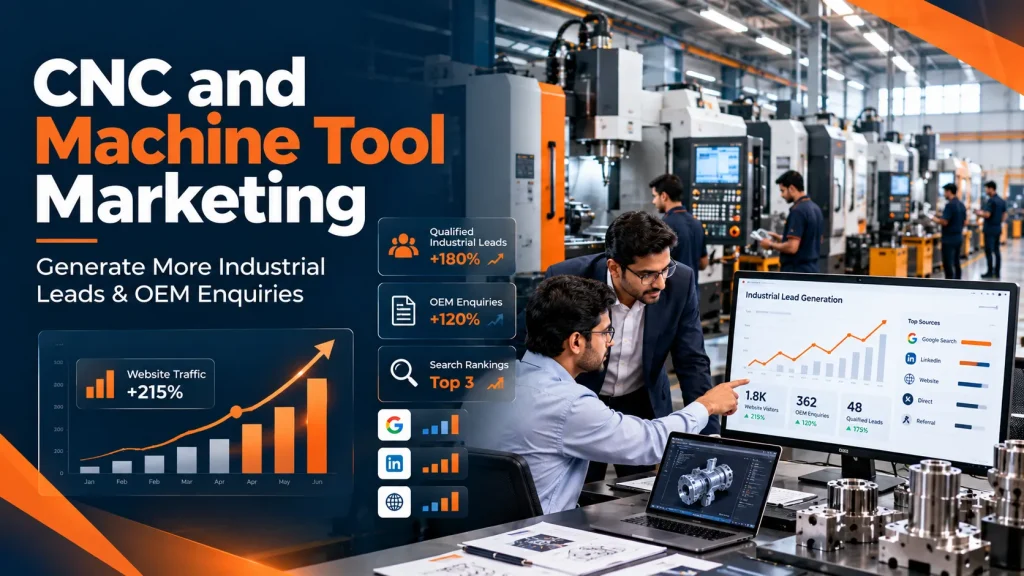
CNC and machine tool marketing works best when built around precision credibility — SEO and content that demonstrate tolerance specs, uptime data, and application-specific case studies, paired with LinkedIn outreach to production managers and IMTEX-integrated trade show campaigns. Buyers in this category are highly technical and skeptical of generic marketing language, so specificity in every claim matters more than in almost any other equipment category.
Who Buys CNC and Machine Tools
| Buyer Type | What They Care About | Best Channel |
|---|---|---|
| Job Shops & Contract Manufacturers | Cost per part, changeover speed, versatility | SEO + Google Ads |
| OEMs & Tier Suppliers | Precision, repeatability, integration with existing lines | LinkedIn outreach + case studies |
| Educational & Training Institutes | Reliability, support, training resources | Direct sales + referral content |
| Export Buyers | Certifications, global service network | Export SEO + trade portals |
How CNC Buyers Actually Search
Machine tool buyers rarely search generically — they search by machine type, axis configuration, and often by application:
By Machine Type
“CNC turning center,” “vertical machining center,” “5-axis mill” — each needs a dedicated page.
By Application
“CNC machine for aerospace parts,” “high-precision automotive components” — application-first searches.
By Comparison
“[competitor] alternative,” “best CNC brands India” — active vendor comparison.
By Spec
“CNC machine 500mm travel,” specific tolerance or capacity searches from engineers who’ve already scoped requirements.
Channel Map for Machine Tool Marketing
SEO
- Machine-type specific pages
- Application & industry pages
- Spec comparison content
- Production manager outreach
- Job shop owner targeting
- Company page showcasing installations
Trade Shows
- IMTEX pre-show campaigns
- Booth appointment booking
- Post-show nurture sequences
Content
- Precision & tolerance case studies
- Uptime & reliability data
- Video demos of machine operation
Content That Builds Precision-Buyer Trust
Publish real tolerance and precision data
Vague claims like “high precision” mean little to an engineer comparing spec sheets side by side.
Show uptime and reliability track record
Downtime cost is often the single biggest concern for job shops running tight production schedules.
Create application-specific case studies
An aerospace-parts case study speaks to a completely different buyer than an automotive-components one.
Feature service and support network details
Buyers investing in capital equipment want to know how fast a technician can reach them if something breaks.
IMTEX and Trade Show Integration
| Phase | Digital Activity | Goal |
|---|---|---|
| Pre-show | LinkedIn awareness ads to likely attendees | Build recognition before the floor opens |
| During show | Booth appointment booking landing page | Convert interest into scheduled meetings |
| Post-show | Structured follow-up sequence by lead score | Nurture booth conversations into RFQs |
Mistakes vs. What Works
Marketing every machine type with identical messaging
A job shop evaluating cost-per-part and an OEM evaluating repeatability need different proof points entirely.
Vague precision claims with no supporting data
Engineers comparing spec sheets dismiss “high precision” language that isn’t backed by actual tolerance figures.
Treating trade shows as a standalone activity
Booth conversations without structured digital follow-up lose most of their value within weeks.
Machine-type and application-specific pages
Speaks precisely to what each buyer segment is actually evaluating.
Real tolerance, uptime and reliability data published
Builds credibility with technically skeptical buyers faster than generic marketing language.
Pre- and post-show digital campaigns around every exhibition
Converts a much larger share of booth conversations into tracked, nurtured pipeline.
Build a Pipeline of Job Shops, OEMs and Export Buyers
We’ll map your CNC and machine tool marketing strategy across SEO, LinkedIn and trade show integration.
Frequently Asked Questions
How is marketing for CNC manufacturers different from general industrial equipment marketing?+
CNC and machine tool buyers are unusually technical and specification-driven, so content needs precise tolerance data, uptime figures, and application-specific proof points rather than general marketing language — vague claims are quickly dismissed by engineers comparing spec sheets.
Is trade show marketing still worth it for CNC manufacturers given digital options?+
Yes — exhibitions like IMTEX remain important discovery moments for this category, but digital pre-show and post-show campaigns significantly improve the ROI of the exhibition spend by converting more booth conversations into tracked, nurtured leads.
Should CNC manufacturers target job shops or OEMs first?+
This depends on your machine range and pricing, but job shops often have shorter sales cycles and are reachable through SEO and Google Ads, while OEMs typically require longer LinkedIn-driven relationship building with production and engineering leadership.
How important is export marketing for CNC manufacturers?+
Often significant — many Indian machine tool manufacturers find meaningful demand through export channels, making certifications, global service network visibility, and export-focused SEO worthwhile additions to a primarily domestic strategy.
📚 You Might Also Like
Pricing Guide
Marketing Cost for Industrial Equipment Manufacturers
See where CNC-specific content and IMTEX campaigns fit into your overall B2B marketing budget.
Competitive Strategy
How Indian Exporters Can Compete With Chinese Suppliers
CNC exporters are among the manufacturers fighting Chinese pricing hardest — here’s how precision credibility wins deals.
Export Marketing
Export SEO Guide: Getting Found by International Buyers
Machine tool export buyers search differently — here’s how to rank for the certifications and specs they look for.
Lead Generation
B2B Lead Generation: The Complete Guide
Turning job-shop and OEM enquiries into qualified pipeline — the same discipline behind every high-ticket B2B sale.