
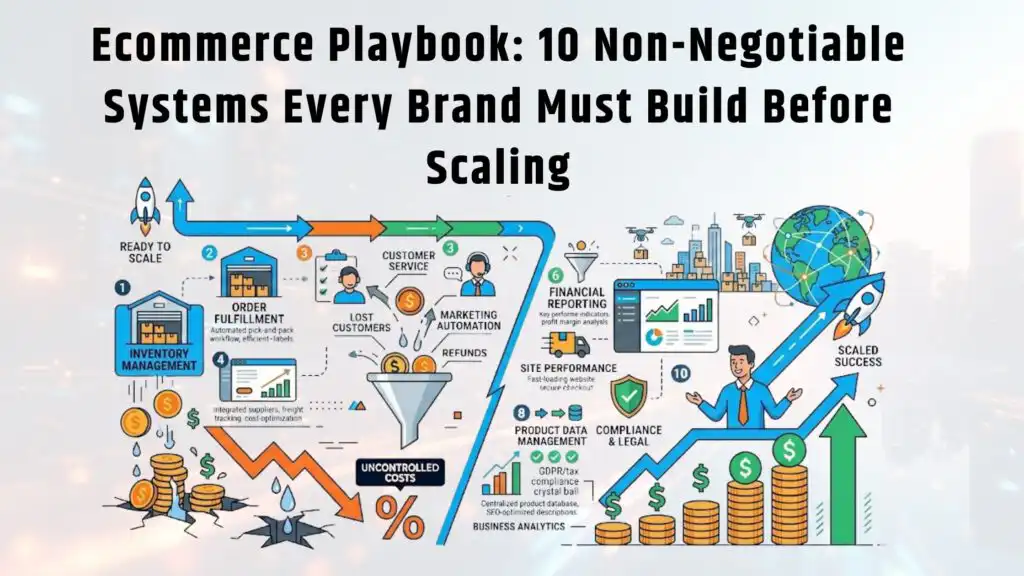
The future of ecommerce won’t be ruled by the fastest or the biggest — it’ll be ruled by the most systemized.
In the early stages, growth can come from hustle — running ads, launching products, pushing inventory. But once your brand starts approaching ₹30–50 lakh/month, chaos begins to show:
- Orders increase, but operations break
- Ad spend rises, but profitability drops
- Teams grow, but accountability disappears
This is where most brands hit a plateau.
Scaling beyond ₹50 lakh/month is not about “doing more.”
It’s about building systems that allow you to grow without breaking.
Here’s your complete 2026 Ecommerce Playbook — the 10 non-negotiable systems every serious ecommerce brand in India must build before scaling.
1. System #1 — Product-Market Fit Tracker
Most brands scale products based on assumptions:
- “This SKU is selling well”
- “Customers seem to like this category”
But without structured tracking, you’re guessing — not validating.
A Product-Market Fit Tracker helps you:
- Analyze performance by region (Delhi vs Tier 2 cities)
- Compare marketplaces vs D2C performance
- Understand customer segments (age, gender, buying behavior)
What to track:
- Conversion rate per SKU
- Repeat purchase rate
- Region-wise demand
- Return reasons
💡 Insight: A product that works on Amazon may fail on your website — and vice versa.
Scaling without this system = scaling risk.
2. System #2 — Unified Analytics Dashboard
Most ecommerce brands suffer from data fragmentation:
- Ads data in Meta/Google
- Sales data in Shopify/Amazon
- Customer data in CRM
No single source of truth.
A unified dashboard combines everything into one place.
Key metrics to track daily:
- CAC (Customer Acquisition Cost)
- LTV (Lifetime Value)
- Contribution margin
- ROAS (Return on Ad Spend)
- Profit per order
💡 If you can’t see your numbers daily, you can’t control your business.
3. System #3 — Review & Feedback Loop
Customer feedback is the fastest way to improve your product and brand.
But most brands:
- Collect reviews
- Never analyze them
- Never act on them
A proper system should:
- Automatically request reviews post-delivery
- Categorize feedback (quality, packaging, delivery, etc.)
- Identify patterns
Example:
If 20% of customers complain about packaging damage —
that’s not feedback, that’s a business problem.
💡 Feedback is not for validation — it’s for improvement.
4. System #4 — Retention & Loyalty Funnel
Most brands focus only on acquiring new customers.
But in reality:
👉 Repeat customers drive the majority of profits
Without a retention system, you are constantly paying for growth.
Build a retention engine using:
- WhatsApp automation (order updates, reorders)
- Email remarketing
- Loyalty programs (points, rewards)
- Subscription models
What to track:
- Repeat purchase rate
- Time between orders
- Customer lifetime value
💡 A 10% increase in retention can significantly boost profitability.
5. System #5 — Ad Optimization Framework
Running ads without a framework is one of the biggest reasons brands lose money.
Instead of random campaigns, follow a structured system:
Step 1: Idea Testing (multiple creatives)
Step 2: 7-Day Testing Window
Step 3: Scale top 2–3 winners
Step 4: Retarget engaged users
Step 5: Expand with lookalike audiences
Golden Rule:
Never run ads on autopilot.
What to avoid:
- “Always-on” campaigns without review
- Scaling without profitability
- Ignoring creative fatigue
💡 Ads don’t fail — bad systems do.
6. System #6 — Inventory Health Tracker
Inventory is where most ecommerce cash gets stuck.
Without tracking:
- You overstock slow products
- You run out of bestsellers
- You block working capital
An Inventory Health Tracker helps you monitor:
- Stock aging
- Sell-through rate
- Reorder levels
- Dead stock
Key metric:
👉 Inventory turnover ratio
💡 It’s not low sales that hurt — it’s unsold inventory.
7. System #7 — Omni-Channel Integration
In 2026, relying on a single channel is risky.
Customers are everywhere:
- Marketplaces (Amazon, Flipkart)
- Your D2C website
- Quick commerce (Blinkit, Zepto, Instamart)
A strong brand meets customers where they are.
Omni-channel system includes:
- Centralized inventory
- Unified pricing strategy
- Consistent branding
- Channel-wise performance tracking
💡 Don’t depend on one platform — diversify your revenue streams.
8. System #8 — Profit & Expense Monitoring
Revenue is vanity. Profit is reality.
Many brands scale revenue but:
- Margins shrink
- Costs increase
- Cash flow becomes unstable
A profit monitoring system ensures:
- You track expenses in real-time
- You calculate contribution margin per order
- You identify loss-making SKUs
Rule:
👉 If profit per order is below 20%, fix it before scaling.
Scaling a broken model only multiplies losses.
9. System #9 — SOP & Team Accountability Matrix
As your team grows, chaos increases — unless you have systems.
Every ecommerce business needs:
- Written SOPs (Standard Operating Procedures)
- Defined roles and responsibilities
- Clear KPIs for each team
Example:
Operations Team:
- Dispatch time
- RTO rate
Marketing Team:
- ROAS
- CAC
Customer Support:
- Response time
- Resolution rate
💡 What gets measured gets managed.
10. System #10 — Brand Story Engine
In 2026, products alone won’t sell — stories will.
Customers don’t just buy products; they buy:
- Identity
- Trust
- Emotion
A Brand Story Engine ensures consistency across:
- Website
- Packaging
- Social media
- Ads
- Emails
Ask yourself:
- What does your brand stand for?
- Why should customers trust you?
- What makes you different?
💡 People remember stories — not SKUs.
Final Thought
Most ecommerce brands try to scale first and fix later.
That’s the biggest mistake.
Because without systems:
- Growth creates chaos
- Revenue hides inefficiencies
- Profit disappears
By 2026:
- Brands without systems will struggle
- Brands with systems will dominate
Scaling is not about speed —
it’s about structure.
If you’re serious about scaling beyond ₹50 lakh/month,
you don’t need more ads — you need better systems.
👉 Get the Full Ecommerce Systems Audit with Brand Chanakya — Build a Brand Ready for 2026 Growth
Follow us on Instagram: @brand_chanakya