
Most businesses don’t fail at SEO because they lack effort.
They fail because they lack a system.
They publish blogs, build backlinks, fix technical issues — yet results remain inconsistent. Traffic may grow for a while, then stagnate. Leads fluctuate. Revenue impact is unclear.
That’s because SEO is often treated as a set of tasks, not a structured growth engine.
In reality, SEO is not:
- Just content
- Just backlinks
- Just technical fixes
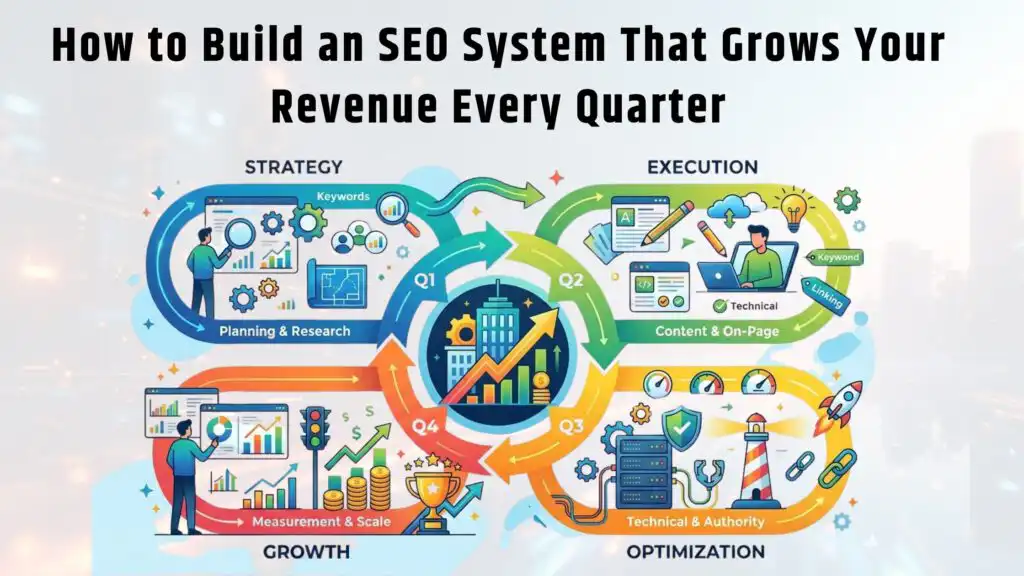
It is the integration of all these elements into a repeatable, measurable, and compounding system that drives predictable growth.
The most successful businesses treat SEO like engineering — with:
- Processes
- Frameworks
- Measurement systems
- Continuous optimization
When done right, SEO becomes a quarter-on-quarter revenue driver, not a guessing game.
Why Most SEO Strategies Fail
Before building a system, it’s important to understand what’s broken.
❌ Random Execution Without Structure
Many businesses:
- Publish blogs without keyword strategy
- Build backlinks without relevance
- Optimize pages without tracking outcomes
There is activity — but no direction.
❌ No Connection to Revenue
SEO is often measured in:
- Traffic
- Rankings
But not:
- Leads
- Sales
- Revenue
Without revenue linkage, SEO becomes a vanity metric.
❌ One-Time Effort Mindset
Businesses treat SEO like a project:
- “Let’s do SEO for 3 months”
But SEO is not a campaign — it’s a continuous system.
The Foundation: What an SEO System Actually Means
An SEO system is a structured process that:
- Identifies opportunities
- Executes consistently
- Measures impact
- Improves continuously
It ensures that every action contributes to long-term SEO growth in India, not short-term spikes.
Think of it as a growth assembly line where:
👉 Input = Data + Strategy
👉 Process = Execution
👉 Output = Traffic + Leads + Revenue
A Revenue-Driven SEO System Has 4 Core Components
A high-performance SEO system works in cycles — not one-time actions.
1. Diagnosis (Data-Driven Analysis)
Every quarter begins with diagnosis.
This is where most businesses skip steps — and pay the price later.
What to analyze:
- Intent Gaps
- What are users searching for that you’re not targeting?
- Are you missing high-intent keywords?
- Content Gaps
- What content do competitors rank for that you don’t?
- Which pages are underperforming?
- Technical Issues
- Site speed
- Crawl errors
- Indexing problems
- Mobile usability
- Competitor Shifts
- New pages created
- Ranking changes
- Content strategies
- Emerging Micro-Intents
- New search trends
- Long-tail keyword opportunities
Why Diagnosis Matters
Without diagnosis:
- You guess instead of strategize
- You waste effort on low-impact tasks
💡 A strong SEO system always starts with clarity, not content creation.
2. Design (Strategy & Architecture)
Once you understand the data, the next step is designing the system.
This is where you build your SEO strategy for India-focused growth.
Key elements of design:
- Keyword Clusters
Group keywords based on intent:
- Informational
- Commercial
- Transactional
- Content Architecture
Plan:
- Landing pages
- Blog clusters
- Supporting content
- Page-Level Strategy
Define:
- Target keyword
- Search intent
- Content structure
- CTA placement
- Technical Roadmap
Identify:
- Speed improvements
- Schema implementation
- URL structure fixes
- CRO (Conversion Rate Optimization)
Ensure traffic converts:
- Better CTAs
- Lead forms
- UX improvements
Outcome of Design Phase
You now have a clear roadmap:
- What to build
- In what order
- For what purpose
3. Deployment (Execution in Sprints)
This is where strategy turns into action.
Instead of random execution, a strong SEO system uses weekly or bi-weekly sprints.
What happens in deployment:
- Content Creation
- Blogs
- Landing pages
- Industry pages
- Technical Fixes
- Speed optimization
- Error resolution
- Schema updates
- On-Page SEO
- Title optimization
- Internal linking
- Content formatting
- Off-Page SEO
- High-quality backlinks
- Authority building
- UX & CRO Improvements
- Page layout optimization
- CTA testing
- Local & SGE Optimization
- Google Business optimization
- AI-driven search visibility (SGE readiness)
Why Sprints Work
- Faster execution
- Clear accountability
- Continuous progress
💡 SEO success comes from consistent execution, not occasional effort.
4. Development (Continuous Improvement)
SEO is never “done.”
The final stage is ongoing development, where you:
- Monitor performance
- Analyze results
- Improve continuously
What to track:
- Keyword rankings
- Organic traffic
- Conversion rates
- Bounce rates
- Revenue from SEO
What to improve:
- Underperforming pages
- Content updates
- UX enhancements
- Internal linking
💡 In SEO, what worked last quarter may not work next quarter.
That’s why systems must evolve.
When SEO Becomes a System, Revenue Becomes Predictable
Once all four components work together, something powerful happens:
SEO stops being uncertain.
Instead, every quarter delivers:
📈 More visibility
🤝 More trust
📩 More inquiries
💰 More conversions
🔁 More stable growth
The Real Benefit: Predictability
Most marketing channels are volatile:
- Ads fluctuate
- Costs increase
- Results vary
But a strong SEO system creates:
👉 Compounding growth
Each quarter builds on the previous one.
How to Build Your SEO System in India (Practical Steps)
If you want to implement this, start here:
- Audit your current SEO performance
- Identify top 20 revenue-driving keywords
- Build content clusters around them
- Fix technical issues immediately
- Create a quarterly SEO roadmap
- Execute in weekly sprints
- Track revenue — not just traffic
Common Mistakes to Avoid
- Treating SEO as content writing only
- Ignoring technical SEO
- Not tracking conversions
- Stopping SEO after initial results
- Chasing trends instead of systems
Final Thought
SEO is not a campaign.
It is not a service.
It is not a checklist.
It is a revenue engine.
Businesses that:
- Build systems
- Measure performance
- Improve continuously
…don’t just grow — they scale predictably and sustainably.
And in a competitive market like India, predictability is your biggest advantage.
If you want an SEO system that grows your revenue every quarter,
you need more than execution — you need engineering.
👉 Get a Complete SEO System Audit — Build a Scalable, Revenue-Driven Growth Engine with Brand Chanakya
Follow us on Instagram: @brand_chanakya