
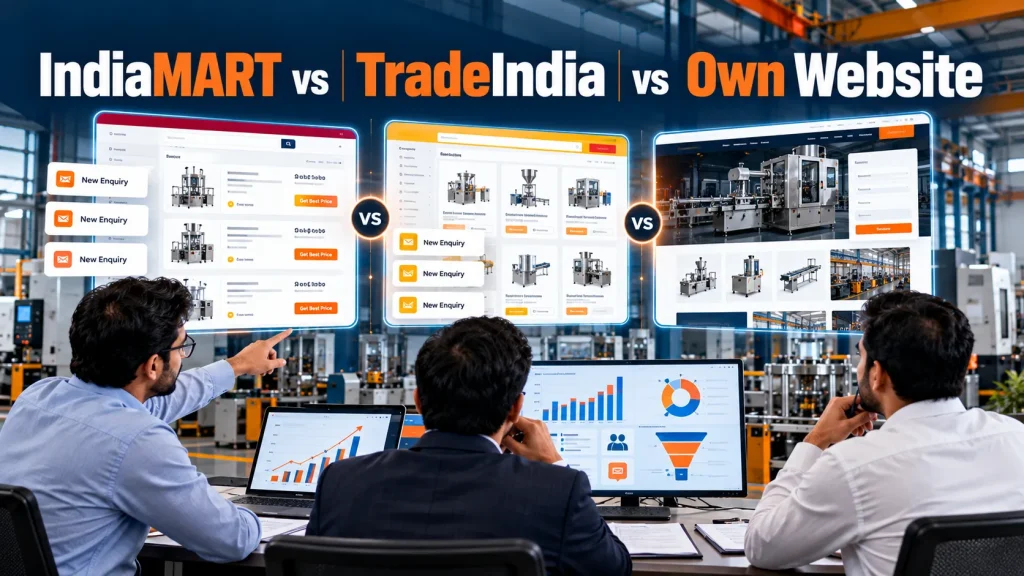
IndiaMART vs TradeIndia vs Own Website: Which Platform Delivers Better B2B Leads?
IndiaMART delivers the highest lead volume and works well for smaller-ticket, faster-decision equipment enquiries, TradeIndia offers a lower-cost supplementary channel with less competition, and your own website is the only asset that compounds in value over time and doesn’t disappear the moment you stop paying. Most established equipment manufacturers eventually shift budget weighting toward their own SEO-driven website while keeping a presence on IndiaMART for volume — treating TradeIndia as an inexpensive add-on rather than a primary channel.
The Three Options at a Glance
IndiaMART
India’s largest B2B marketplace. Highest lead volume, but also highest competition and lead-sharing with rivals.
TradeIndia
A lower-cost alternative portal with smaller but sometimes higher-focus buyer traffic.
Your Own Website
The only channel you fully control — compounds in value through SEO and never expires with a subscription.
Full Feature & Cost Comparison
| Factor | IndiaMART | TradeIndia | Own Website |
|---|---|---|---|
| Typical monthly cost | ₹15,000–₹60,000+ | ₹8,000–₹30,000 | ₹25,000–₹80,000 (SEO/hosting) |
| Lead volume | High | Moderate | Grows over time |
| Lead exclusivity | Shared with competitors on same listing | Shared with competitors | Fully exclusive to you |
| Value if you stop paying | Drops to near zero immediately | Drops to near zero immediately | Retains most of its ranking value |
| Best for | Fast lead volume, smaller-ticket enquiries | Low-cost supplementary reach | Long-term brand & qualified pipeline |
Lead Quality: Portals vs. Your Own Site
Reported Lead-to-Order Conversion (Illustrative)
IndiaMART
TradeIndia
Own Website (SEO)
Buyers who find you organically through your own website — having already researched specs, applications, and credibility content — typically arrive further along in their decision process than a buyer scrolling through a marketplace category page comparing five suppliers at once.
Why Platform Leads Don’t Compound
The core difference between a marketplace listing and your own website isn’t features — it’s ownership. A listing you rent disappears the day the subscription lapses. A page that ranks on Google keeps generating enquiries for years without additional monthly spend.
A portal listing is rented visibility
Stop paying, and your ranking, reviews, and enquiry history are effectively gone overnight.
An SEO-ranked website page is owned visibility
Once a product or application page ranks, it keeps generating traffic and enquiries with far lower ongoing cost per lead.
Portals share your buyer with every competitor on the same category page
Your own website presents your equipment without three rival listings sitting right next to it.
Website leads carry more context by the time they enquire
Visitors who’ve read your specs and case studies arrive more informed and further along than a cold portal browse.
The Right Way to Combine All Three
IndiaMART
- Primary volume channel
- Fast enquiry capture
- Lead-quality filtering process
TradeIndia
- Low-cost supplementary reach
- Secondary listing, minimal extra effort
- Cross-link to main website
Own Website
- Long-term SEO investment
- Product & application-specific pages
- Central hub for case studies & specs
LinkedIn & Ads
- Direct decision-maker outreach
- Remarketing to website visitors
- Trade show & dealer campaigns
Not Sure How to Split Budget Across Channels?
We’ll assess your current portal performance and build a plan that shifts weight toward long-term, owned visibility.
Frequently Asked Questions
Should I drop IndiaMART and focus only on my website?
Not necessarily — IndiaMART often delivers useful lead volume, especially for smaller-ticket equipment. The better approach is usually to keep it as a volume channel while gradually building your own website’s SEO so it becomes a growing, more qualified source over time.
Is TradeIndia worth using alongside IndiaMART?
For most manufacturers, yes, as a low-cost supplement — the incremental cost is small, and it captures buyers who specifically search that portal. It rarely makes sense as a primary channel on its own.
Why do website-sourced leads convert better than portal leads?
Buyers who arrive at your website organically have often already reviewed your specs, applications and credibility content, meaning they’re further along in their evaluation than someone scanning a marketplace category page with multiple competing listings.
How long before an equipment manufacturer’s own website starts generating meaningful leads?
This depends on competition and current site maturity, but most manufacturers see initial ranking movement within 2-3 months and a meaningful volume of qualified organic enquiries developing over 4-6 months.
📚 You Might Also Like
Pricing Guide
Marketing Cost for Industrial Equipment Manufacturers
See how trade portal management and website SEO budgets actually compare across a full B2B marketing plan.
Lead Generation
B2B Lead Generation: The Complete Guide
Whichever channel you pick — portal or website — here’s the qualification discipline that turns enquiries into orders.
Website Cost
Website Development Cost in Udaipur
If you’re finally ready to build the owned asset that outperforms portal leads, here’s what it actually costs.
Common Mistakes
Why Cheap Websites Fail in India
Don’t repeat the portal mistake with your website too — why an underbuilt site rarely delivers the owned-visibility payoff.