
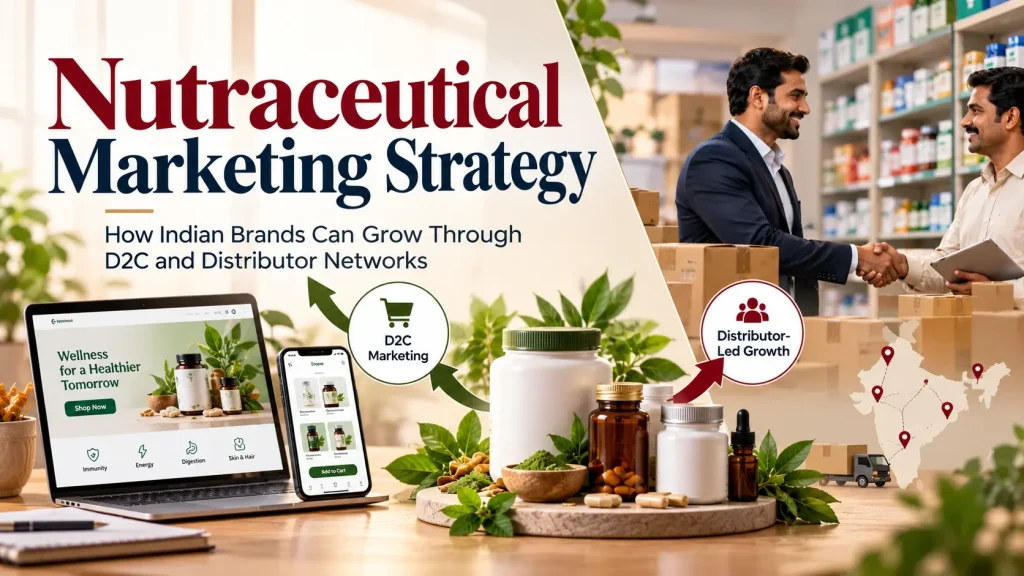
Nutraceutical Marketing Strategy: D2C vs Distributor-Led Growth for Indian Brands
A nutraceutical marketing strategy is a structured approach to promoting health supplements, functional foods, and wellness products through digital marketing, e-commerce platforms, and distributor networks. In India, nutraceutical and Ayurvedic brands can combine D2C marketing with distributor-led strategies to attract customers, generate business enquiries, expand market reach, and achieve sustainable growth.
Every Indian nutraceutical or Ayurvedic brand hits the same fork in the road: build a direct-to-consumer engine on Instagram, Meta Ads and your own website, or invest in a distributor and retail network that gets you onto pharmacy and general trade shelves across the country. Picking the wrong one first is the most expensive mistake we see domestic wellness brands make.
01
Why This Decision Comes Before Any Marketing Spend
D2C and distributor-led growth aren’t just sales channels — they’re entirely different marketing systems. A D2C brand markets to individual consumers who complete a purchase online in one sitting. A distributor-led brand markets to two audiences at once: the distributors and retailers who need to be convinced to stock you, and the end consumers who need to be convinced to ask for you by name at the counter.
Building creative, SEO, and ad campaigns before deciding which of these you’re actually running is how brands end up with a website that reads like a consumer brand but a sales team that’s chasing wholesale orders — or the reverse.
02
The Two Models, Side by Side
Model A
Direct-to-Consumer (D2C)
You sell directly through your own website and marketplaces like Amazon and Flipkart. Marketing is consumer-facing from day one: performance ads, influencer content, subscription funnels, and SEO built around symptoms and benefits people search for.
Model B
Distributor-Led Growth
You sell through stockists, pharmacy chains, and general trade, with distributors and retailers as your immediate customer. Marketing splits between B2B trade marketing (distributor onboarding, margin communication, trade schemes) and consumer pull-marketing that drives footfall to the shelf.
| Factor | D2C favours you if… | Distributor favours you if… |
|---|---|---|
| Product type | Explained clearly online — supplements, functional foods, personal wellness | Needs trust from a known retail counter — classical Ayurvedic formulations, chronic-care products |
| Buyer behaviour | Comfortable researching and buying online | Prefers asking a chemist or store owner before buying |
| Margin structure | Can absorb ad spend and platform commissions | Built to share margin with distributor and retailer tiers |
| Geography | Concentrated in metro / Tier-1 digitally active audiences | Needs Tier-2/3 town and semi-urban reach fast |
| Team strength | Strong content, ads, and D2C ops capability | Strong field sales and distributor relationship capability |
03
Marketing D2C Nutraceutical & Ayurvedic Brands
For D2C, the marketing job is to compress the trust-building a chemist or store owner would normally do into your own content and ad creative.
What actually moves the needle
- Symptom- and benefit-led SEO — ranking for how people actually search: “immunity booster for adults,” “ashwagandha for stress,” not just your brand or product name.
- Meta and Google Ads with real before/after proof — testimonials, ingredient transparency, and lab or certification callouts, since wellness ad categories face tighter platform scrutiny.
- Subscription and repeat-purchase flows — most nutraceutical categories are consumed monthly; a strong WhatsApp or email reorder flow often beats new-customer acquisition on ROI.
- Marketplace presence on Amazon and Flipkart — many D2C wellness buyers still research on your website but purchase on a marketplace for trust and faster delivery.
04
Marketing Distributor-Led Nutraceutical & Ayurvedic Brands
Distributor-led growth needs two campaigns running in parallel — one to recruit and retain distributors, one to pull consumers toward the shelf.
Reaching distributors and retailers
- SEO for stockist and distributorship searches — “Ayurvedic products distributorship in India,” “nutraceutical stockist opportunity,” mirrors how pharma PCD franchise searches work.
- B2B marketplace listings on IndiaMART and TradeIndia to catch domestic wholesale and retail-chain buyers actively sourcing.
- LinkedIn outreach to regional pharmacy chains and wellness retail groups.
Pulling consumers toward the shelf
- Local and regional-language content that builds category awareness without needing a purchase click — since the sale happens offline.
- Google Business Profile and local SEO for any retail or clinic touchpoints your brand controls directly.
- Point-of-sale and packaging-led brand recall, supported by social proof content retailers can point customers to.
05
Why Most Domestic Brands End Up Running Both
In practice, few Indian nutraceutical or Ayurvedic brands stay purely D2C or purely distributor-led past their first 1–2 years. A hybrid model is common: distributor relationships fund national retail reach and cash flow, while a smaller D2C arm on your own site and marketplaces builds direct customer data, tests new products, and protects margin on your best-selling lines.
A simple sequencing rule
If you’re starting from zero, build D2C first for products that are easy to explain and trust online, and layer in distributor partnerships once you have proof points — reviews, repeat orders, and category traction — to show potential stockists.
06
A Compliance Note Before You Start
Nutraceutical and Ayurvedic advertising in India sits under FSSAI and AYUSH advertising guidelines, alongside the Drugs and Magic Remedies Act for any disease-cure claims. Domestic marketing that stays within structure/function language — “supports immunity,” “aids digestion” — rather than disease-treatment claims keeps both your ad accounts and your regulatory standing safe. This applies equally to D2C ad creative and any consumer-facing distributor material.
The brands that scale fastest in this category aren’t the ones with the biggest ad budget — they’re the ones who picked the right model for their product before spending on either.
Not Sure Which Model Fits Your Brand?
Brand Chanakya works with pharma, nutraceutical, and Ayurvedic manufacturers across India on both D2C and distributor-led digital marketing. Get a free audit of where your marketing budget is best spent.
📚 Related Reads
How to Sell Kitchenware Online in India
SEO vs Paid Ads for SMEs: Which Delivers Better ROI?
IndiaMART vs TradeIndia vs Website: Which Is Best for Manufacturers?
Inbound vs Outbound Lead Generation: Which Works Better?