
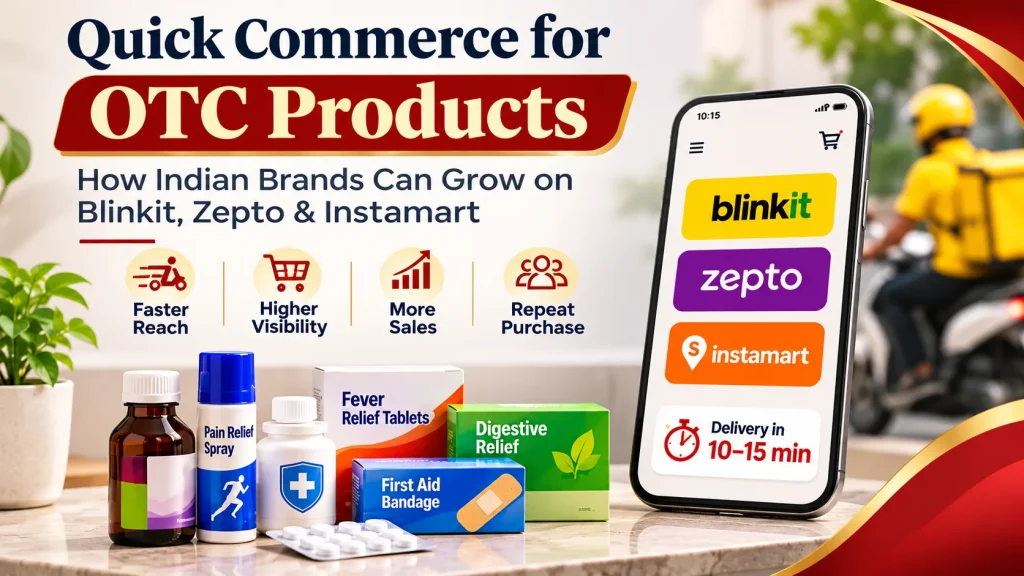
Quick Commerce for OTC Products: How Indian Brands Can Grow on Blinkit, Zepto & Instamart
Discover how Quick Commerce for OTC Products can help Indian healthcare brands increase product visibility, reach customers faster, and grow online sales through platforms like Blinkit, Zepto, and Swiggy Instamart. Learn how to get your OTC products listed, improve in-app rankings, run sponsored advertisements, optimise pricing and promotions, and manage dark-store inventory effectively. Explore practical strategies to build a strong quick commerce presence and expand your OTC brand across India.
Quick commerce OTC products are having a moment in India — a headache, a cut that needs a bandage, or a sudden fever doesn’t wait for a next-day delivery slot, and that’s exactly the gap Blinkit, Zepto, and Instamart fill. For OTC brands, quick commerce has become less of an experiment and more of a core distribution channel, with its own rules for listing, ranking, and winning repeat purchases. This guide walks through how to actually grow on it. If you’re also building your wider online presence, start with our guide to OTC eCommerce marketing in India.
Why Quick Commerce Matters for OTC Brands
OTC purchases are frequently need-driven and time-sensitive — pain relief, fever medication, digestive aids, wound care, and basic first-aid supplies are rarely planned purchases. That makes quick commerce a near-perfect fit: a buyer with a headache right now isn’t going to wait two days for a marketplace delivery, but will happily open Blinkit, Zepto, or Instamart and have the product in fifteen minutes.
This is a fundamentally different buying moment than a marketplace or D2C purchase, and brands that treat quick commerce as “just another Amazon” tend to underperform against brands that build a strategy specifically around immediate-need buying.
How Quick Commerce Buying Behaviour Differs
- Search is shorter and more literal — buyers type “pain relief spray” or “fever tablet,” not a considered comparison search
- Decisions happen in seconds — there’s rarely time for a buyer to read a detailed product description before choosing
- Visual recognition matters more than copywriting — pack imagery and instantly recognisable branding often outperform long descriptions
- Availability beats brand preference — if your product is out of stock in the buyer’s local dark store, a competitor gets the sale in the same fifteen minutes
Every part of an OTC brand’s quick commerce strategy needs to account for this: fast decisions, local stock availability, and instant visual clarity.
Getting Listed on Blinkit, Zepto & Instamart
Blinkit
Strong in metro and Tier-1 cities; onboarding typically routes through their seller/brand partnership program.
Zepto
Growing fast across dense urban clusters; places heavy weight on fulfillment reliability for ranking.
Instamart
Backed by Swiggy’s existing delivery network, useful for brands already active in Swiggy’s ecosystem.
Each platform requires its own catalog submission — accurate product images, category tagging, batch and expiry details for OTC items, and compliance documentation (FSSAI, manufacturing license, or drug license where applicable). Getting this right the first time matters: a rejected or incomplete listing can delay your go-live by weeks on some platforms.
Because these platforms operate through city-specific dark stores rather than a single national warehouse, going live nationally isn’t a single onboarding event — it’s a rolling process of adding city and dark-store coverage as your supply chain can support it.
Documentation that speeds up approval
OTC and health-adjacent products face extra scrutiny during onboarding compared to a typical FMCG item. Having these ready before you start the application meaningfully shortens approval time:
- Valid FSSAI license and, where applicable, drug license or manufacturing license copies
- Batch numbering and expiry date formats that match what the platform’s catalog system expects
- High-resolution front, back, and side pack images showing all mandatory label information legibly
- A GST-registered business entity and active bank account for settlement, as required by each platform’s seller terms
Brands that submit incomplete documentation on the first attempt often lose two to three weeks to back-and-forth clarification — worth avoiding by preparing this upfront rather than during the application itself. Brands with regulated or prescription-adjacent lines can also explore specialist digital marketing services for pharma companies to keep listings and claims compliant.
Winning Visibility Inside the App
Ranking on quick commerce apps works differently from marketplace SEO — there’s no long-tail keyword game, since search terms are short and category-driven. What actually drives visibility:
- In-stock reliability — frequent stockouts at the dark-store level quietly demote your ranking over time
- Conversion rate — listings that convert well when shown tend to get shown more often
- Category and sub-category tagging accuracy — being correctly filed under “pain relief” or “first aid” rather than a generic catch-all category
- Review and rating scores — even a small number of strong reviews meaningfully affects placement
Sponsored Listings & Quick Commerce Ads
All three platforms now offer sponsored placement options — similar in concept to Amazon Ads, but built around hyperlocal inventory. A sponsored slot only shows your product where it’s actually in stock nearby, which makes wasted ad spend on out-of-stock impressions a real risk to manage.
For OTC brands, sponsored listings work best on high-intent, symptom-specific searches — bidding on “pain relief” or “cold tablet” category placements tends to outperform broad brand-awareness style ad buys, since quick commerce buyers are rarely browsing casually.
Making sponsored spend efficient
Because quick commerce ad inventory is hyperlocal, the same campaign can perform very differently across cities depending on your actual stock coverage there. A practical approach is to run city-level sponsored campaigns rather than one national campaign, pausing spend in any city where stock coverage drops below a reliable threshold, and reallocating that budget to cities where fulfillment is consistently strong.
Pricing & Promotions Strategy
Quick commerce buyers are less price-sensitive than marketplace shoppers in the moment of an urgent need, but promotions still matter for winning first-time trial and repeat purchase over time.
- Combo packs (a fever + pain relief bundle, for instance) increase basket size without discounting the core product
- Platform-specific promotional slots (banner placements, “trending in health” carousels) can be worth testing for new product launches
- Consistent pricing across platforms avoids buyers feeling like they got a worse deal on one app versus another — which quietly erodes trust over repeat purchases
Inventory & Dark Store Considerations
Quick commerce success depends heavily on supply chain readiness, more so than marketplace or D2C selling. Because each dark store holds limited local stock, an OTC brand needs to plan inventory allocation by city and even by dark-store cluster, not just a single national number.
Brands entering quick commerce for the first time typically start with a handful of high-density metro dark stores rather than attempting full national coverage immediately — this keeps stockouts manageable while the brand learns real local demand patterns before scaling further.
This also changes how you plan production and dispatch cycles. Instead of shipping large periodic batches to a handful of regional warehouses, quick commerce demands smaller, more frequent replenishment cycles into individual dark stores — which usually means working closely with the platform’s supply chain or fulfillment partner team rather than treating it as a set-and-forget listing.
Packaging & Visual Recognition
Because quick commerce decisions happen fast and mostly through browsing a category rather than reading detailed listings, pack design does more marketing work here than almost any other channel. A pack that’s instantly recognisable at thumbnail size — clear product type, bold category colour-coding, minimal clutter — consistently outperforms a pack designed primarily for a pharmacy shelf, where a buyer has more time to read and compare.
Platform-by-Platform Comparison
| Factor | Blinkit | Zepto | Instamart |
|---|---|---|---|
| Strongest markets | Metro & Tier-1 cities | Dense urban clusters | Cities with existing Swiggy density |
| Ranking emphasis | Conversion + stock reliability | Fulfillment speed metrics | Category tagging accuracy |
| Ad format | Sponsored category slots | Sponsored + banner placements | Sponsored listings via Swiggy Ads |
| Good fit for | Brands prioritising metro reach first | Brands optimising for fast repeat orders | Brands already active on Swiggy’s ecosystem |
None of these platforms is universally “better” for an OTC brand — the right starting point depends on where your existing demand and distribution strength already sit. A brand strong in Delhi and Mumbai pharmacy channels, for instance, often finds Blinkit’s metro density an easier first platform to prove the model on before expanding to the others.
Analytics & Performance Tracking on Quick Commerce
Each platform provides its own seller or brand dashboard with visibility into impressions, conversion rate, stockout frequency, and sponsored ad performance — but because these are siloed by platform, OTC brands running across all three need a consolidated view to actually compare performance city-by-city and platform-by-platform.
- Track stockout rate as closely as sales — a high stockout percentage in a city usually explains a ranking drop before any other metric does
- Compare cost-per-order across platforms, not just cost-per-click, since sponsored spend efficiency varies meaningfully between Blinkit, Zepto, and Instamart
- Monitor repeat purchase rate by city — this tells you where your product-market fit is strongest and where local marketing effort is better spent
What Quick Commerce Costs an OTC Brand
Costs on quick commerce break into three parts: platform listing and commission fees (which vary by platform and category), sponsored placement ad spend (scaled to how competitive your OTC category is in that city), and the operational cost of maintaining dark-store-level inventory accuracy. Brands new to the channel typically start with a modest sponsored ad budget concentrated in two or three metro cities, expanding city coverage as conversion data comes in, rather than spreading a small budget thin across every city all three platforms operate in.
Common Mistakes to Avoid
- Treating quick commerce like a smaller Amazon, reusing marketplace-style long descriptions instead of optimizing for fast, visual decisions
- Ignoring stockouts at the dark-store level, not realising they quietly hurt ranking as much as they hurt that day’s sales
- Launching nationally on day one instead of proving the model in a few dense metro clusters first
- Inconsistent pricing across Blinkit, Zepto, and Instamart, which erodes buyer trust over repeat purchases
- Under-investing in pack-level visual clarity, assuming the same design that works on a pharmacy shelf will work in a fifteen-second app scroll
- Running one national sponsored campaign instead of city-level campaigns, which wastes spend in cities where stock coverage can’t support the resulting demand
- Treating each platform’s dashboard in isolation instead of building a consolidated view of stockouts, conversion, and cost-per-order across Blinkit, Zepto, and Instamart together
A Launch Roadmap for Quick Commerce OTC Products
- 1Weeks 1–3: Onboard on one platform first. Get your catalog, compliance documentation, and imagery right on Blinkit, Zepto, or Instamart before expanding to the others.
- 2Weeks 2–4: Concentrate on 2–3 metro dark-store clusters. Prove conversion and manage inventory tightly before scaling city coverage.
- 3Weeks 4–6: Add the remaining platforms. Apply the same category tagging and imagery standards consistently across all three.
- 4Weeks 5–8: Launch sponsored listings. Start with your highest-intent, symptom-specific category placements.
- 5Weeks 8–12: Review stockout and ranking data. Adjust inventory allocation and expand city coverage based on where demand is strongest.
On quick commerce, the brand that’s in stock and instantly recognisable at a glance wins the sale — not necessarily the brand with the better product story.
Frequently Asked Questions
How do I get my OTC product listed on Blinkit, Zepto, or Instamart?
Each platform has its own brand or seller onboarding process requiring accurate product catalog details, imagery, and compliance documentation such as FSSAI or drug license certification where applicable.
What makes quick commerce different from selling OTC products on Amazon or Flipkart?
Quick commerce buying happens in a much shorter decision window, is driven by immediate need rather than research, and ranking depends heavily on local dark-store stock availability rather than long-tail keyword SEO.
Should a new OTC brand launch on all three quick commerce apps at once?
It’s usually better to onboard one platform first, prove conversion in a few metro dark-store clusters, and expand to the others once inventory and ranking patterns are understood.
Do sponsored listings work well for OTC products on quick commerce?
Yes, particularly on high-intent, symptom-specific searches — but only where the product is reliably in stock, since sponsored spend on out-of-stock inventory is wasted.
Which quick commerce platform should an OTC brand start with?
It depends on where your existing distribution and brand awareness are strongest — a brand with strong metro pharmacy presence often finds Blinkit’s metro density the easiest first platform to prove the model before expanding to Zepto and Instamart.
📚 Related Reads
India Quick Commerce and E-Commerce Statistics
SEO vs Paid Ads for SMEs: Which Delivers Better ROI?
Cost Per Lead in India: What You Should Really Be Paying
How to Sell Kitchenware Online in India