
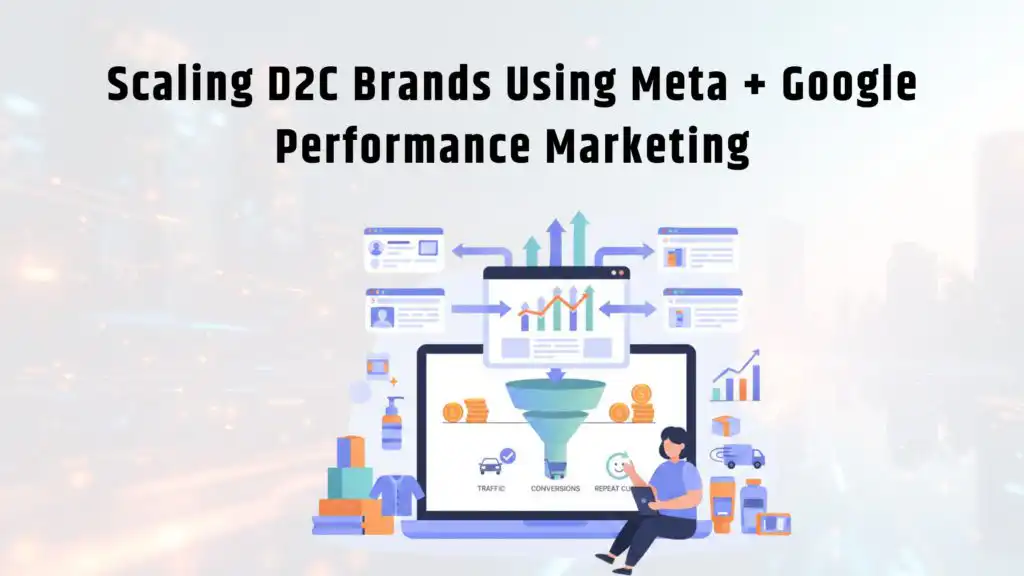
Most D2C brands don’t fail because ads don’t work. They fail because ads are run in isolation. Some brands rely only on Meta platforms, while others depend entirely on Google Ads. Both approaches create growth ceilings. True, scalable D2C growth happens when Meta and Google performance marketing work together as a single system.
Meta platforms are excellent at creating demand. Google is unmatched at capturing demand. When these two channels are aligned strategically, D2C brands unlock predictable revenue, better customer quality, and stronger profitability. When they are not aligned, brands experience unstable ROAS, rising acquisition costs, and inconsistent growth.
Scaling D2C brands using Meta and Google performance marketing is not about spending more. It’s about designing a system where each platform plays a clear role in the customer journey.
Why Relying on a Single Channel Limits D2C Growth
Many D2C brands start with one platform and stick to it because it “works.” Over time, this becomes a risk.
Brands that rely only on Meta face:
- Volatile performance due to algorithm changes
- Creative fatigue
- Audience saturation
Brands that rely only on Google face:
- Limited scale due to finite search demand
- High competition on keywords
- Rising costs in crowded categories
Using both platforms together reduces dependency risk and creates a more stable growth engine.
Understanding the Different Strengths of Meta and Google
Meta and Google serve very different purposes in ecommerce performance marketing.
Meta platforms (Facebook and Instagram) are strongest at:
- Demand creation
- Product discovery
- Visual storytelling
- Influencing buying decisions early
Google platforms are strongest at:
- Capturing high-intent demand
- Converting ready-to-buy users
- Defending brand searches
- Delivering stable, bottom-funnel revenue
Scaling D2C brands requires respecting these differences rather than forcing both platforms to do the same job.
The Full-Funnel Role of Meta + Google Together
When combined correctly, Meta and Google cover the entire funnel.
At the top of the funnel, Meta introduces products to new audiences who are not actively searching. This builds awareness and interest.
In the middle of the funnel, Meta retargeting and Google non-brand search reinforce consideration and comparison.
At the bottom of the funnel, Google branded search, Shopping ads, and remarketing capture high-intent buyers ready to convert.
This full-funnel alignment is what turns ecommerce performance marketing into a predictable system rather than a gamble.
How Meta Feeds Google in a High-Performing System
One of the most overlooked advantages of Meta advertising is how it indirectly improves Google performance.
As Meta campaigns scale:
- Brand searches increase on Google
- Click-through rates on Google ads improve
- Conversion rates rise due to prior exposure
Customers who first discover a brand on Instagram often convert later through Google Search or Shopping. Without Meta, Google performance marketing loses this demand-generation layer.
Structuring Campaigns Across Meta and Google
Successful D2C brands do not treat Meta and Google as separate silos. Instead, they structure campaigns with clear intent roles.
Common structure includes:
- Meta prospecting for demand creation
- Meta retargeting for reinforcement
- Google non-brand campaigns for intent capture
- Google brand campaigns for protection and efficiency
This structure prevents overlap, reduces wasted spend, and improves attribution clarity.
Budget Allocation: How to Balance Meta and Google Spend
Budget allocation is one of the most critical decisions in ecommerce performance marketing.
Brands that overinvest in Meta without Google often struggle to convert demand efficiently.
Brands that overinvest in Google without Meta struggle to scale volume.
A balanced approach ensures:
- Meta drives scalable reach
- Google captures high-intent revenue
- Cash flow remains stable
The exact split depends on category, margins, and growth stage, but balance is always key.
Attribution Challenges in Multi-Channel Performance Marketing
Attribution becomes more complex when Meta and Google work together. Customers may see multiple ads across platforms before converting.
Common attribution mistakes include:
- Overcrediting last-click channels
- Undervaluing awareness campaigns
- Making budget decisions based on incomplete data
Strong D2C brands look at blended metrics like overall CAC, total revenue growth, and contribution margin instead of relying on platform-level ROAS alone.
Scaling Without Breaking the System
Scaling Meta and Google together requires discipline. Increasing budgets without improving inputs leads to diminishing returns.
Successful D2C brands scale by:
- Expanding creative volume before increasing spend
- Improving landing pages alongside traffic growth
- Monitoring blended acquisition costs
- Scaling incrementally rather than aggressively
This approach keeps ecommerce performance marketing stable even as budgets grow.
Common Mistakes When Combining Meta and Google
Many brands struggle not because the platforms don’t work, but because of poor coordination.
Common mistakes include:
- Running Meta and Google with conflicting messaging
- Competing against own brand keywords unintentionally
- Scaling one platform while ignoring the other
- Judging performance using isolated metrics
These mistakes reduce efficiency and create internal competition between channels.
How Meta and Google Performance Marketing Evolves with Growth
As D2C brands grow, the role of each platform changes.
Early-stage brands use Meta to validate demand and Google to capture early intent.
Growth-stage brands use both platforms aggressively to scale while controlling costs.
Mature brands focus on efficiency, retention, and defending market share across both platforms.
Understanding this evolution helps brands apply the right strategy at the right time.
Long-Term Impact of a Unified Performance Marketing System
When Meta and Google performance marketing are aligned, brands benefit beyond short-term revenue.
Long-term benefits include:
- Stronger brand recall
- Higher-quality customer data
- Improved repeat purchase behavior
- More predictable growth planning
This compounding effect is what separates scalable D2C brands from short-lived successes.
Final Takeaway
Scaling D2C brands using Meta and Google performance marketing is not about choosing platforms — it’s about designing a system where each platform supports the other.
Meta creates demand. Google captures it. Together, they form the backbone of sustainable ecommerce performance marketing.
Brands that align strategy, messaging, and measurement across both platforms build growth engines that last beyond algorithms and trends.
Meta and Google work best when aligned as one system.
Isolated campaigns often limit scale and stability.
A connected approach improves long-term performance.
Book Service with Brand Chanakya
Follow us on Instagram: @brand_chanakya