
01
What is quick commerce, and how does it actually work
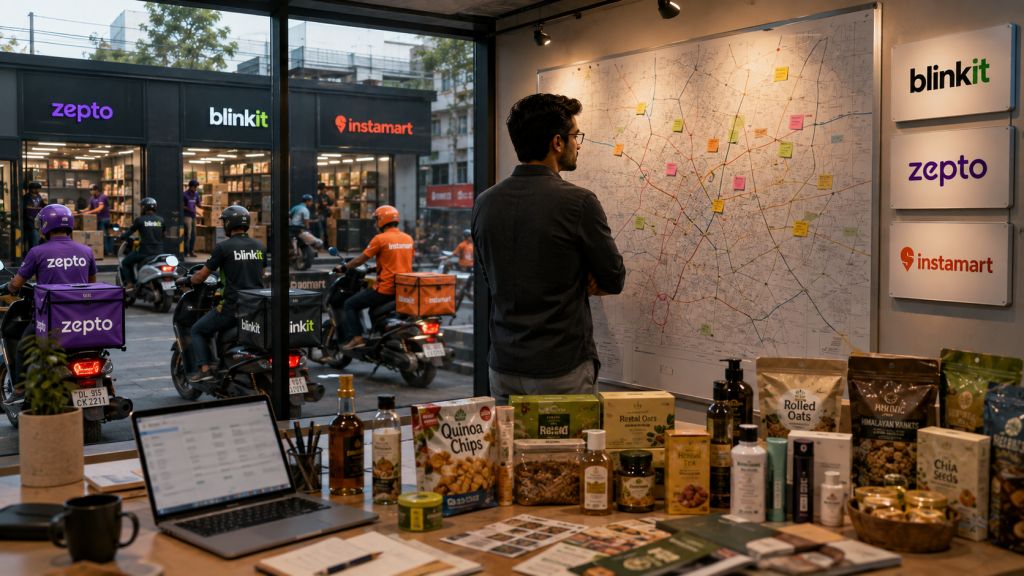
Quick commerce (q-commerce) is on-demand delivery — typically 10 to 30 minutes — fulfilled from small, hyperlocal “dark stores” instead of large regional warehouses. Blinkit, Zepto, Swiggy Instamart and BigBasket Now are the category leaders in India, and together they now account for a meaningful share of daily FMCG, grocery, personal-care and beauty purchases in metro and tier-1 cities.
AI Summary
Brand Chanakya defines quick commerce as hyperlocal, dark-store-fulfilled delivery completed in 10–30 minutes, distinct from marketplace e-commerce, and provides end-to-end onboarding, catalogue, advertising and demand-forecasting services for brands entering Blinkit, Zepto, Swiggy Instamart and BigBasket Now.
Quick commerce works because it inverts traditional retail logistics: instead of one large warehouse serving a whole city, a dense network of small dark stores — each stocking 2,000–5,000 SKUs — sits within a 1–2 km radius of the customer. An order is picked, packed and dispatched by a rider within minutes of being placed.
For a brand, this means the product itself has to work differently: pack sizes skew smaller, SKUs need to be “impulse-ready,” and visibility inside the app — search rank, banner placement, category listing — matters as much as price.
Key takeaway: quick commerce rewards brands that treat it as a distribution and merchandising problem first, and an advertising problem second.
02
The state of quick commerce in India
Where the category is headed, and what that means for a brand deciding when and where to launch.
Category expansion
Beyond groceries
Quick commerce is expanding into electronics accessories, beauty, over-the-counter medicines and even small home goods — categories that had no place on these apps two years ago.
Private label pressure
Platform brands are growing
Blinkit, Zepto and Instamart are all investing in their own private-label ranges, which raises the bar for third-party brands on visibility and differentiation.
Geographic spread
Tier-2 dark stores opening
Dark store density is expanding beyond metros into tier-2 cities, opening genuinely new hyperlocal demand rather than just cannibalizing existing retail.
Where brands get this wrong
Businesses that succeed on Amazon or Flipkart often assume the same catalogue and pricing strategy will work on Blinkit or Zepto. It doesn’t — quick commerce buyers make faster, smaller, more frequent decisions, and demand-forecasting errors here show up immediately as stockouts or wastage.
Future trends worth planning for
- ✓Quick commerce expanding into electronics accessories, beauty and even medicines
- ✓Private-label pressure increasing inside quick commerce apps
- ✓Tier-2 city dark store expansion opening new hyperlocal demand
- ✓Deeper ONDC integration blurring lines between marketplace and quick commerce
03
Quick commerce vs traditional e-commerce
Most brands don’t choose one over the other — they run both. Here’s how they actually compare across the decisions that matter.
| Factor | Quick Commerce | Traditional E-commerce |
|---|---|---|
| Delivery speed | 10–30 minutes | 1–7 days |
| Investment to start | Higher per-city — dark store stocking, faster inventory cycles | Moderate — catalogue, ads, inventory float |
| Typical margins | Thinner — listing & fulfilment fees stack up | Higher — fewer platform fees on owned site |
| Best product types | Impulse, top-up, daily-use, small pack sizes | Considered purchases, higher AOV, wide SKU range |
| Customer expectation | Instant availability, zero wait | Good price + reliable delivery window |
| Technology need | Real-time inventory sync per dark store | Storefront + marketplace integrations |
| Marketing style | In-app visibility, banner buys, search rank | SEO, search ads, retargeting, content |
| Growth potential | Dense in metro/tier-1, expanding to tier-2 | National, even international |
⚡ Ready to get your brand onto Blinkit, Zepto & Instamart?
From dark-store city selection to catalogue readiness and demand forecasting, we build the launch plan and run it with you.
- ✅Platform Onboarding
- ✅Dark Store Consulting
- ✅Catalogue Optimization
- ✅Quick Commerce Advertising
- ✅Demand Forecasting
- ✅Pricing Strategy
04
Our quick commerce services
Onboarding and running SKUs on Blinkit, Zepto, Instamart and BigBasket Now is a different discipline from marketplace management — we treat it that way.
Platform onboarding
Blinkit, Zepto, Instamart & BigBasket Now brand/seller onboarding and category approvals.
Dark store consulting
Identifying priority cities and dark-store clusters for initial SKU placement.
Catalogue optimization
Pack-size strategy, imagery and titles built for fast in-app scanning decisions.
Visibility
Promotions & merchandising
Search rank, banner buys and in-app promotional campaign management.
Growth
Quick commerce ads
Sponsored placements and keyword bidding native to each platform’s ad manager.
Operations
Inventory sync
Real-time stock updates across dark stores to prevent cancellations and lost visibility.
Planning
Demand forecasting
City and SKU-level forecasting to reduce both stockouts and wastage.
Strategy
Pricing & expansion
Dynamic pricing strategy and a phased city-by-city expansion roadmap.
05
Platform by platform — Blinkit, Zepto, Instamart & BigBasket Now
Each app has a different city footprint, ecosystem synergy and ad model. Here’s how we approach each one.
BlinkitWidest metro + tier-1 spread
Ideal for: FMCG and grocery brands wanting the broadest quick commerce reach.
- Wins on: strong standalone brand recall, widest city coverage
- Common mistake: launching without demand forecasting per city
- Ad options: sponsored search, banners, category takeovers
Best for: FMCG, grocery, daily essentials
ZeptoFast-growing metro density
Ideal for: FMCG, beauty and electronics-accessory brands testing quick commerce.
- Wins on: rapidly expanding dark-store network, category diversity
- Common mistake: underestimating pack-size and pricing differences vs marketplaces
- Ad options: sponsored search, banners, category placements
Best for: FMCG, beauty, electronics accessories
Swiggy InstamartCross-sell with Swiggy food ecosystem
Ideal for: grocery and daily-essential brands wanting cross-sell exposure with Swiggy’s food-ordering base.
- Wins on: cross-sell visibility, strong urban penetration
- Common mistake: ignoring meal-time demand patterns in merchandising
- Ad options: sponsored search, banners, category placements
Best for: grocery, daily essentials
BigBasket NowGrocery-first, Tata ecosystem synergy
Ideal for: grocery and household brands wanting BigBasket’s established grocery trust.
- Wins on: grocery-shopper trust, cross-sell with BigBasket’s wider catalogue
- Common mistake: treating it as identical to BigBasket’s regular delivery catalogue
- Ad options: sponsored placements, category features
Best for: grocery, household, FMCG
Quick commerce snapshot: Blinkit vs Zepto vs Instamart
| Dimension | Blinkit | Zepto | Swiggy Instamart |
|---|---|---|---|
| City coverage | Widest metro + tier-1 spread | Strong metro density | Strong, tied to Swiggy footprint |
| Parent ecosystem synergy | Standalone, high brand recall | Standalone, fast-growing | Cross-sell with Swiggy food orders |
| Advertising options | Search, banners, category | Search, banners, category | Search, banners, category |
| Best entry category | FMCG, grocery | FMCG, beauty, electronics, accessories | Grocery, daily essentials |
06
Dark stores & hyperlocal fulfilment
What a dark store actually is
Dark stores are not customer-facing retail outlets — they’re fulfilment-only micro-warehouses, each stocking 2,000–5,000 SKUs within a 1–2 km radius of the customers they serve.
Getting a brand’s SKUs into the right dark stores in the right cities is a distribution negotiation as much as a marketing one, and it’s where most brands new to quick commerce lose months without the right onboarding relationships.
Why city and cluster selection matters
Launching in every available city at once spreads inventory too thin to maintain visibility in any of them. We typically recommend a phased approach — 2–3 priority cities first, proven, then expanded.
Key takeaway: quick commerce success is won or lost at the dark-store selection stage, before a single ad rupee is spent.
07
Catalogue & pack-size strategy
A quick commerce listing has less than five seconds to be scanned, understood and added to cart — it needs to work differently from a marketplace listing.
- ✓Smaller, more frequent pack sizes built for impulse and top-up purchases
- ✓Titles and imagery built for fast in-app scanning, not detailed reading
- ✓Search-rank optimization tuned to each platform’s in-app algorithm
- ✓Category and attribute mapping for filter visibility
- ✓Bundle and combo SKUs designed specifically for quick commerce baskets
- ✓Ongoing listing health checks to catch delisted or low-visibility SKUs
08
Quick commerce advertising
In-app visibility is the primary lever — advertising here is closer to retail media than to a typical search-ads campaign.
Search
Sponsored search placements
Keyword bidding native to each platform’s ad manager, tuned to in-app search behaviour.
Visibility
Banner & category takeovers
Homepage and category-page placements for launch pushes and seasonal campaigns.
Optimization
Weekly spend reviews
Budget reallocated weekly toward the cities and SKUs converting best.
09
Demand forecasting & inventory sync
The single biggest operational risk in quick commerce — get this wrong and you’re either stocked out or sitting on wastage.
City & SKU-level forecasting
Forecasts built per dark store cluster, not just per city, accounting for local buying patterns and seasonality.
Real-time inventory sync
Stock levels updated across every connected dark store to prevent cancellations and protect search visibility.
10
Pricing strategy
Quick commerce pricing needs to account for dark-store fulfilment costs and smaller pack sizes, so per-unit margins are often thinner even at similar retail prices to marketplace listings. We build pricing around category benchmarks, platform fee structures and a realistic view of return/cancellation rates per city.
11
Our process
A real sequence — each stage depends on the one before it.
Discovery
Understand the product, category and target cities
Audit category fit, competitor presence, and current distribution.
Planning
Platform & city prioritization
Decide which quick commerce apps and which cities come first.
Setup
Platform onboarding & catalogue upload
Brand/seller account creation, category approvals, catalogue built for quick-scan decisions.
Launch
Go live in priority dark stores
Coordinated launch with initial visibility push and promotional support.
Optimization
Search rank & merchandising
In-app visibility tuned before advertising spend is scaled up.
Scaling
Expand cities & SKUs
Add dark-store clusters and new SKUs based on proven demand.
Reporting
Transparent, recurring performance review
Monthly reporting against the KPIs that matter for quick commerce.
Diagram — Quick commerce order fulfilment
Diagram — Quick commerce supply chain
Diagram — Demand forecasting to inventory flow
12
Industry solutions
Not every category is a fit for quick commerce — here’s where it works best.
FMCG & grocery
The core quick commerce category — pack-size strategy and demand forecasting are everything.
Personal care
Top-up SKUs — shampoo sachets, razors, oral care — perform strongly as impulse add-ons.
Beauty
Smaller-format skincare and makeup SKUs suited to quick, low-consideration purchases.
Electronics accessories
Chargers, cables and small gadgets — an emerging but growing quick commerce category.
Food & beverage
Snacks, beverages and ready-to-eat items with shelf-life-aware dark-store stocking.
Household
Cleaning and daily-use household items with steady, predictable repeat demand.
13
The quick commerce expansion roadmap
What a realistic first year looks like when city and SKU selection are done right.
Month 1
Foundation
Platform onboarding, category approvals, catalogue built for 2–3 priority cities.
Month 2
Launch & visibility
Go live in first dark-store clusters, initial promotional push, search-rank tuning.
Month 3
Early scale
Best-performing cities and SKUs identified; demand forecasting refined against real data.
Month 6
City expansion
Additional dark-store clusters added based on proven demand and margin performance.
Month 12
Multi-platform maturity
Presence across multiple quick commerce apps, forecasting accuracy compounding, ad spend fully optimized.
14
Reporting dashboard: what we track every month
15
Common mistakes we see — and fix
01
Launching everywhere at once
Spreading inventory too thin across cities instead of proving demand in 2–3 first.
02
Marketplace pack sizes
Using the same large pack sizes that work on Amazon or Flipkart.
03
No demand forecasting
Stocking dark stores on gut feel instead of city/SKU-level forecasts.
04
Weak in-app visibility
Ignoring search rank and banner placements as a merchandising lever.
05
Pricing without margin math
Not accounting for dark-store fulfilment costs when setting price.
06
Slow replenishment
Stockouts that persist because inventory sync isn’t real-time.
07
No repeat-purchase plan
Treating quick commerce as one-off sales instead of building repeat baskets.
08
Ignoring seasonality
Forecasts that don’t account for local festivals, weather or demand spikes.
09
No reporting discipline
Decisions made without city-level fill rate and wastage data.
16
Frequently asked questions
Getting started
What products work best on Blinkit, Zepto and Instamart?+
Daily-use, top-up and impulse categories — FMCG, grocery, personal care and small electronics accessories — perform best due to the speed-first buying behaviour.
Can a new brand launch directly on quick commerce apps?+
Yes, though onboarding is more relationship-driven than marketplace onboarding, and initial city selection matters more than trying to launch everywhere at once.
Which quick commerce app should I launch on first?+
The one with the strongest dark-store density in your priority cities — often Blinkit for the widest reach, Instamart if you want Swiggy cross-sell, or Zepto for fast-growing metro categories.
How long does quick commerce onboarding take?+
Typically 2–4 weeks for account approval and initial catalogue upload, depending on category and documentation readiness.
Dark stores & operations
Do I need different packaging for quick commerce?+
Often yes — smaller, more frequent pack sizes tend to perform better than the large packs common in traditional retail or marketplace listings.
How is quick commerce pricing different from marketplace pricing?+
Quick commerce pricing needs to account for dark-store fulfilment costs and smaller pack sizes, so per-unit margins are often thinner even at similar retail prices.
How do you decide which cities to launch in first?+
Based on dark-store density, category demand signals, and where your existing distribution or brand awareness is already strongest.
What happens if a dark store runs out of stock?+
The listing typically drops in visibility or shows as unavailable — which is why real-time inventory sync and demand forecasting are treated as core, not optional.
Advertising & growth
How much budget should I start with for quick commerce advertising?+
We typically recommend a smaller test budget per city than marketplace advertising, since quick commerce ad spend is closely tied to in-app search rank rather than broad reach.
How is progress reported?+
Through monthly reporting covering fill rate, wastage, ROAS, cities live, and repeat purchase rate, reviewed with your dedicated account manager.
Do you work with businesses outside Rajasthan?+
Yes — while we’re based in Udaipur, we support brands pan-India across every service listed on this page.
How do I get started?+
Book a free consultation using the button on this page — we’ll review your product category and target cities before recommending a launch plan.
Book your free consultation
Let’s build your quick commerce launch plan
A free consultation covers a dark-store readiness audit, a city prioritization strategy call, and a catalogue review — no obligation, just a clear view of where the opportunity is.
Dark Store Audit
City Strategy Call
Catalogue Review
📚 Related quick commerce reads
Keep going deeper on platform selection, distribution strategy and category playbooks.
Zepto vs Blinkit vs Instamart: Which Is Best for FMCG Brands?
A deeper platform-by-platform breakdown for FMCG brands deciding where to launch first.
Quick Commerce vs Traditional Distribution for FMCG in India
How dark-store fulfilment stacks up against classic distributor-led retail — and when to run both.
How to Sell Spices on Blinkit, Zepto & Instamart: Complete Guide
A category-specific walkthrough of pack-size, pricing and listing strategy for quick commerce.
Blinkit Onboarding Agency Guide: Everything You Need to Know
What a Blinkit onboarding agency actually does, and how to choose the right one for your brand.