
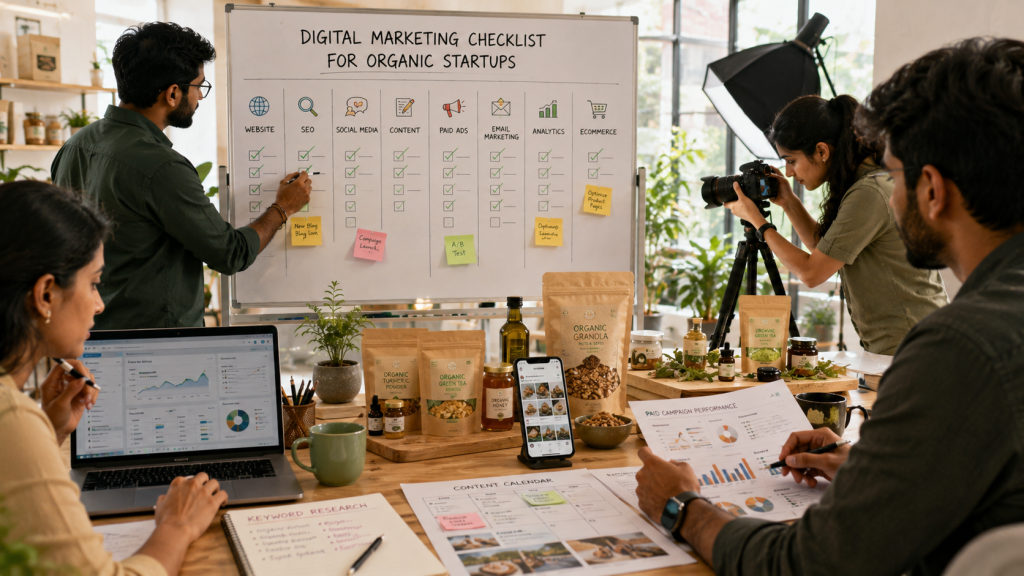
Launching an organic food startup means juggling manufacturing, compliance, packaging, and marketing all at once — and marketing is usually the piece that gets rushed. This checklist gives you the exact sequence to follow so nothing critical gets missed before your first sale.
Phase 1: Foundation (Before You List Anything)
- ✓FSSAI license and GST registration completed
- ✓Organic certification (NPOP/PGS-India) obtained or in process with proof documents ready
- ✓Brand name, logo, and packaging finalized and print-ready
- ✓Domain name registered for your future website
Phase 2: Digital Presence Basics
- ✓Instagram and Facebook business pages set up with certification and farm story in bio
- ✓WhatsApp Business profile configured with catalog and quick replies
- ✓Google Business Profile created if you have a physical office or farm location
- ✓Basic Shopify or WordPress website live, even if simple, with certification badges on the homepage
Expert Tip
Your Google Business Profile matters even for an online-only brand — it builds trust when customers search your brand name to verify legitimacy before buying.
Phase 3: Marketplace Listing Readiness
| Item | Why It Matters |
|---|---|
| Professional product photography | First impression drives click-through and conversion |
| Certification badge in first 3 images | Builds instant trust before the buyer reads anything |
| Keyword-optimized title and bullets | Determines whether you show up in search at all |
| A+ content / enhanced brand content | Tells your farm story where the buyer is deciding |
Common Setup Mistakes at This Stage
Common Mistake
Uploading phone-camera product photos to save cost. Buyers judge organic food quality visually first — poor images cost far more in lost conversions than professional photography costs upfront.
Phase 4: First Marketing Campaigns
- Launch with a limited-time introductory offer to generate your first 20-30 reviews
- Run small-budget Sponsored Products ads on Amazon once the listing looks complete
- Start a simple content calendar — 3 posts a week covering farm story, recipes, and health benefits
- Collect customer WhatsApp numbers and emails at every single order for retention later
Phase 5: Retention Setup
- ✓WhatsApp broadcast list or CRM tool set up for reorder reminders
- ✓Email welcome sequence prepared for D2C customers
- ✓Subscription option enabled on at least your top-selling SKU
- ✓Review request automation set up post-delivery
Phase 6: Tracking and Measurement
Set up basic tracking before you spend on ads, not after. At minimum, install Meta Pixel and Google Analytics on your website, and track marketplace metrics weekly rather than monthly in the early months.
| Metric | Check Frequency |
|---|---|
| Listing conversion rate | Weekly |
| Ad spend vs revenue (ACoS/ROAS) | Weekly |
| Review count and rating | Weekly |
| Repeat purchase rate | Monthly |
Phase 7: Team and Tools You’ll Actually Need
Startups often overbuy tools before they have the team to use them, or underinvest in the one or two tools that would save real time. Here’s a lean, practical setup for a small organic food team.
- Design: Canva for quick social content, a freelance photographer for hero product shots
- Customer communication: WhatsApp Business API or a simple CRM for order updates and reorder nudges
- Analytics: Google Analytics and marketplace’s native dashboards — no need for expensive BI tools at this stage
- Content: One person (founder or hire) responsible for a simple weekly content calendar
Expert Tip
Don’t hire a large marketing team on day one. A lean setup — one content person and an agency or freelancer for ads and SEO — is usually more effective than an in-house team still learning the category.
Phase 8: Red Flags That Mean You’re Not Ready to Launch
- Certification documents are still pending approval
- Packaging doesn’t clearly show FSSAI number and net weight
- No one on the team is responsible for responding to customer queries within 24 hours
- There is no plan for what happens if the first batch runs out faster than expected
Phase 9: A Realistic First-Month Timeline
Startups often try to complete every checklist item simultaneously and end up rushing all of them. A phased first month works better:
- Week 1: Certifications confirmed, social profiles created, photography scheduled
- Week 2: Website live, listings drafted with certification-forward images
- Week 3: Listings published, introductory offer launched, first content posts go out
- Week 4: Review collection begins, WhatsApp retention list started, first ad tests run
Common Mistake
Trying to launch on five platforms simultaneously in week one. This spreads limited startup bandwidth so thin that none of the listings get the attention needed to actually convert.
Key Takeaways
- Complete legal and certification basics before any listing goes live
- Digital presence (Instagram, WhatsApp, basic website) should exist before your first sale
- Invest in professional photography — it directly impacts conversion for organic products
- Don’t run paid ads until your listing has enough reviews to convert traffic
- Set up retention channels from day one, not after you’ve lost early customers
- Phase your first month rather than launching everywhere at once
Revisiting the Checklist as You Grow
This checklist isn’t a one-time exercise. Revisit it every quarter as your startup grows — certifications may need renewal, photography may need refreshing for new SKUs, and retention tools that worked for 50 customers may need upgrading once you’re managing 500. Treat it as a living document rather than a launch-day formality you complete once and forget.
- Quarter 1: Focus on launch fundamentals from this checklist
- Quarter 2: Revisit photography and content as new SKUs are added
- Quarter 3: Upgrade retention tools if customer volume has outgrown manual WhatsApp management
- Quarter 4: Reassess certification renewals and platform expansion opportunities
Conclusion
A structured checklist prevents the most common startup mistake — spending on marketing before the foundation is ready to convert that traffic into sales. Follow this sequence, and your launch month will build genuine momentum instead of wasted spend.
Want This Checklist Applied to Your Brand?
Get a free growth audit and a launch-ready action plan for your organic food startup.
Frequently Asked Questions
What should an organic food startup do first — website or marketplace listing?
Most startups should launch a marketplace listing first since it needs less setup time, then build the D2C website in parallel once initial sales validate demand.
How much should a new organic food startup budget for digital marketing?
A realistic starting range is ₹30,000 to ₹75,000 per month for the first six months.
Do I need a social media presence before launching sales?
Yes, at minimum an Instagram and WhatsApp Business profile should be live with your farm story and certifications before your first sale.
What certifications should be visible on my website and listings?
India Organic (NPOP), FSSAI, and any lab testing certifications should be visible in your first three product images and homepage.
Should I run paid ads immediately at launch?
Only after your listing has at least 10-15 genuine reviews. Running ads to an unproven listing wastes budget.
How do I know if my checklist is complete?
You are ready to launch when certifications are visible, listing images are professional, fulfilment works, and a retention channel is in place.
Related Reading
Organic Food Brand Budget: Complete Guide
Phase 4’s ₹30k-75k monthly figure explained in full — where that budget actually goes.
How to Sell Organic Food Online in India
A complete walkthrough that pairs with this checklist — the full launch strategy behind each phase.
Why Organic Food Brands Fail Online
Skip a phase in this checklist, and this is usually what happens 12-18 months later.