
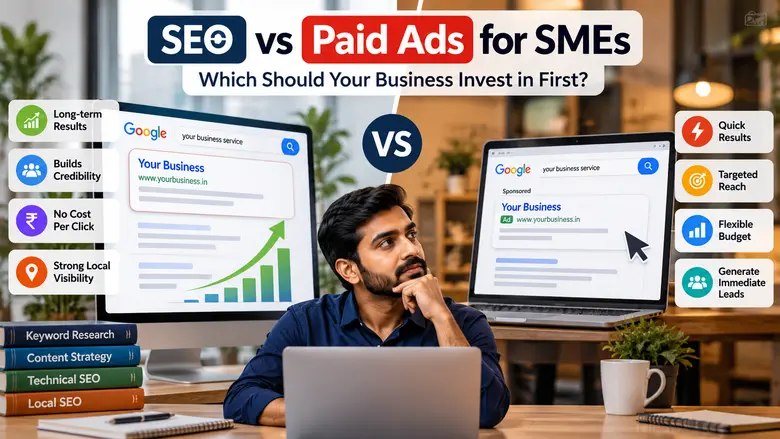
SEO vs Paid Ads for SMEs: Which Should Your Business Invest in First?
SEO vs paid ads for SMEs: if you need inquiries soon and people already search for what you sell, paid search ads are usually the faster place to start. If you can wait, have content to publish and want to reduce long-term dependence on ad spend, SEO deserves early investment. Many small businesses end up doing a little of both, but the order and the split should follow your urgency, search demand, website readiness and budget, not a general rule.
This guide compares the two honestly, gives you a decision framework, and shows how they can support each other.
Key takeaways
- Paid ads can start showing as soon as campaigns are approved, but visibility stops when spending stops.
- Organic listings cost nothing per click, but Google notes that some SEO changes can take several months to have an effect.
- Advertising with Google does not change your organic rankings, in either direction.
- If few people search for your product, neither SEO nor search ads will create demand on their own.
- A weak website undermines both channels, so fix the basics first.
01How SEO and Paid Ads Work for SMEs
SEO (search engine optimisation)
SEO means improving your website so search engines understand it and consider it a useful result for relevant searches. That includes technical fixes, clear page structure, helpful content and a well-maintained Google Business Profile for local businesses.
Google states that it never accepts payment to rank sites organically and that appearing in organic results costs nothing. You pay for the work, not for the clicks.
Paid search ads (SEM / PPC)
Paid search places ads above or below organic results for keywords you choose. You typically pay when someone clicks, and you set budgets and target locations.
Ads can run as soon as they are approved, and you can turn them off at any time. The flip side: when the budget stops, the visibility stops.
One point surprises many business owners. Google says that advertising with Google won’t have any effect on a site’s presence in organic results. Buying ads does not improve your SEO, and not buying them does not hurt it.
02SEO vs Paid Ads for SMEs: Side-by-Side Comparison
This is a qualitative comparison of how the channels behave. It is not a performance comparison; results vary widely by industry, competition, geography and execution.
| Factor | SEO | Paid search ads |
|---|---|---|
| Speed to visibility | Gradual; Google notes some changes take hours and others several months | Fast once campaigns are approved and funded |
| Cost model | Time, content and expertise; no charge per click | Management effort plus spend on clicks |
| When spending stops | Existing rankings can persist for a time, though they can decline if competitors improve | Ads stop appearing |
| Control | Limited; rankings are decided by the search engine | High over keywords, locations, times and budget |
| Testing and learning | Slow feedback loop | Quick feedback on which searches and messages bring inquiries |
| Best at | Answering detailed questions, many product or service pages, long-term visibility | Capturing existing demand quickly, seasonal offers, testing new markets |
| Main risks | Low-quality or spammy tactics; waiting without measuring progress | Wasted spend on broad keywords; weak landing pages; rising click costs |
03Decision framework: goals, urgency and resources
Work through these questions in order. Your answers point to where the first rupee should go.
- Question 1
Do people already search for what you sell?YesGo to question 2.RarelySearch channels will be slow for you. Consider social media, marketplaces, referrals or trade channels first, and build SEO content that explains the problem you solve. - Question 2
Is your website ready to convert visitors?YesGo to question 3.NoFix speed, mobile layout, clear offers and contact options first. Both channels depend on it. - Question 3
Do you need inquiries in the next few weeks?YesStart with a focused paid search campaign, and begin SEO basics alongside.NoGo to question 4. - Question 4
Can you create useful content regularly?YesPrioritise SEO, using a small ad budget to learn which searches convert.NoPaid ads with a lean SEO foundation, or get help producing content.
Text summary: check search demand, then website readiness, then urgency, then your capacity for content. Urgency and limited content favour ads first; patience and content capacity favour SEO first.
04How the answer changes by business type
The examples below are illustrative starting points, not prescriptions.
| Business type | Typical first move | Reasoning |
|---|---|---|
| Local service (clinic, salon, repair, coaching) | Google Business Profile and local SEO, plus small location-targeted search ads | Many searches are local; Google says you cannot pay for better local ranking, so the profile must earn it |
| Manufacturer with many products or grades | SEO on product and application pages; search ads on high-intent product terms | Buyers search specific specifications; detailed pages compound over time |
| New product nobody searches for yet | Awareness channels first; SEO content on the problem it solves | Search channels capture demand; they rarely create it |
| Seasonal or event-driven offer | Paid ads timed to the season | SEO may not build visibility in time for a short window |
| Highly competitive category | Narrow niches in both channels | Broad terms are costly in ads and slow in SEO; specific terms are more achievable |
05Using both without wasting money
SEO and paid search are not rivals. Used together, each makes the other cheaper to run well:
- Ads inform SEO. Search term reports show which exact phrases led to inquiries. Those phrases are strong candidates for new or improved pages.
- SEO reduces ad dependence. Where you rank well organically for a term, you can test whether reducing ad spend on it changes total inquiries.
- Shared landing pages. A clear, fast product or service page helps both ad performance and organic visibility.
- Different stages of the buying journey. Informational content can attract early researchers organically, while ads capture people ready to call.
To judge either channel fairly, set up conversion tracking for calls and form submissions, and record which inquiries became customers.
06A phased approach to investment
If you are unsure, a phased plan limits risk while you learn:
- Foundation. Fix website basics, set up analytics and conversion tracking, and complete your Google Business Profile if you serve local customers.
- Learn with paid search. Run a tightly targeted campaign on high-intent terms with a budget you can afford to learn from. Record which searches produce real inquiries.
- Build organic assets. Create or improve pages for the terms and questions that proved valuable. Google advises waiting a few weeks before judging whether SEO changes have had an effect, and bigger changes can take months.
- Rebalance. Review both channels on cost per qualified inquiry and sales, then shift budget toward what works for you.
For businesses that want one team handling both channels, Brand Chanakya’s SEO and SEM services cover this combined approach, and our SME and MSME marketing page explains how we plan channel mixes for smaller budgets.
07How to measure each channel fairly
SEO and ads move at different speeds, so judging them with the same yardstick in the same month is unfair to SEO and flattering to ads. Use measures that suit each channel, then compare them on business outcomes over a sensible period.
Signals for SEO
- Pages indexed and free of errors in Search Console
- Impressions and clicks for the queries you care about
- Which pages attract organic visitors who then call or enquire
- Inquiries and sales from organic search, recorded at source
Signals for paid ads
- Search terms that triggered your ads, and which to exclude
- Tracked conversions: calls, forms, WhatsApp clicks
- Cost per qualified inquiry from your own records
- Sales traced back to campaigns, where you can
Two practical habits help. First, record the source of every inquiry in one place, whether a CRM or a simple sheet, so organic and paid are counted the same way. Second, agree review dates in advance: a short one for ads, because feedback comes quickly, and a longer one for SEO, because Google itself suggests waiting weeks before judging changes.
Illustrative example
A hypothetical tile and sanitaryware dealer in a Tier 2 city needs showroom visits before the wedding season, so it starts with location-targeted search ads for specific product terms. Search term reports show that people often search for particular finishes and sizes. The dealer then builds organic pages for those finishes, with real photos and price guidance. Over the following months it reviews both channels by showroom visits and orders recorded against each source, and adjusts ad spend on terms where its organic pages start appearing. The scenario is invented to show the sequence, not to predict results.
08Common mistakes and how to avoid them
SEO and paid ads can both support business growth, but choosing the wrong approach or expecting immediate results can waste your marketing budget. Avoid broad ad keywords, stopping SEO too early, or assuming that paid ads improve organic rankings. Instead, set realistic timelines, target relevant search terms, maintain a website that converts visitors into leads, and track inquiries and sales from each channel to make informed investment decisions.
Expecting SEO to replace ads within weeks
SEO is a longer-term investment. Measure progress with leading indicators such as pages indexed and impressions in Search Console, not only inquiries in the first month.
Bidding on broad keywords
Single words like a product category attract researchers, students and job seekers. Start with specific, high-intent phrases and add negative keywords.
Believing ads help rankings
They do not. Treat the two as separate investments with separate measures.
Stopping SEO too soon
Pausing after a couple of months often wastes the groundwork. Agree realistic review points before you start.
09Bottom Line: SEO vs Paid Ads for SMEs
For most SMEs, the question is not SEO or paid ads forever, but which comes first. Choose ads first when you need inquiries quickly and demand already exists. Choose SEO first when you can be patient, have content to create, and want lasting visibility. In both cases, a ready website and proper tracking come before any spend.
10Frequently asked questions
Is SEO free?
Organic listings do not charge per click, but SEO still costs time, content creation, and often professional help. It is better described as “no media cost” than free.
How long does SEO take to show results?
There is no fixed timeline. Google’s own guidance says some changes may take effect in hours and others in several months. Competition, site history, and content quality all affect the pace.
Can I run Google Ads without a website?
Some formats, such as call-focused ads or campaigns linked to a Business Profile, can work without a full site, but options are limited. A simple, fast landing page usually improves results and trust.
Should a small business do SEO itself?
Google notes that small local businesses can probably do much basic SEO themselves, starting with its SEO Starter Guide. Outside help makes sense when you lack time, need technical fixes, or face strong competition.
What about Meta or social media ads?
Social ads reach people based on interests and demographics rather than searches. They are useful when demand needs creating, or for retargeting site visitors, and can complement either search channel.
Not sure which channel to start with?
Share your website, your main products or services, and how soon you need inquiries. Ask for a recommendation that explains the order and the reasoning.
📚 You Might Also Like
How Much Does Digital Marketing Cost for Small Businesses in India?
Digital Marketing Checklist for MSMEs: 7 Things to Set Up Before Running Ads
How to Choose a Digital Marketing Agency for Your SME or MSME
SEO & SEM Services