
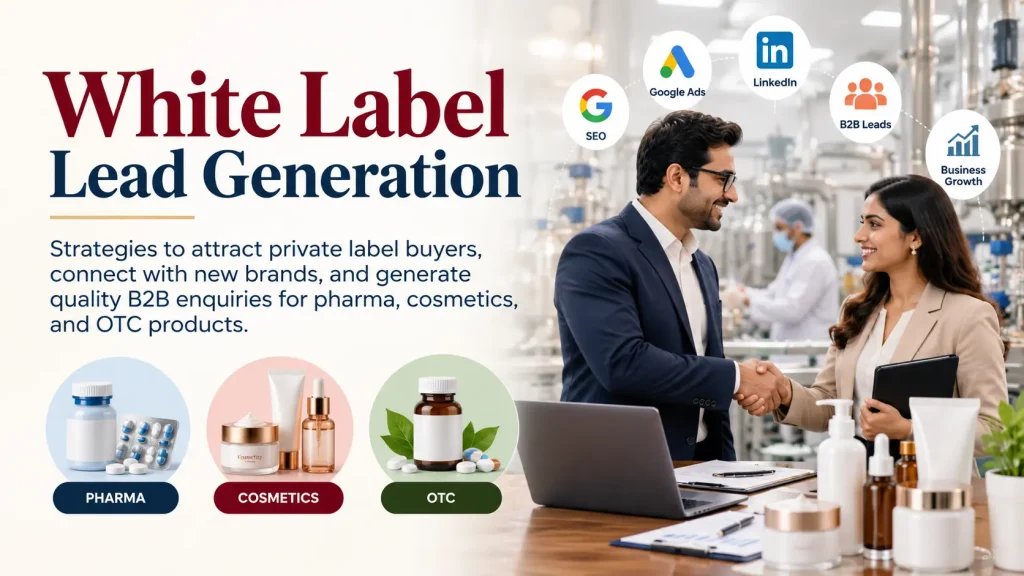
White Label Lead Generation: Strategies to Attract Quality Buyers
Learn how manufacturers can generate quality white label and private label leads, connect with potential buyers, and build strong business partnerships across the pharma, cosmetics, and OTC industries. Explore how SEO, Google Ads, IndiaMART, TradeIndia, Instagram, and LinkedIn can help manufacturers reach D2C founders, retail brands, wellness startups, and businesses looking for reliable manufacturing partners. Understand how category-specific landing pages, visible MOQ and certification details, structured enquiry forms, and effective lead qualification can turn online searches into genuine business opportunities and support consistent B2B growth.
Every pharma, cosmetic, and OTC manufacturer eventually asks the same question: how to get white label customers without relying entirely on referrals and trade show chance encounters. The good news is that private label buyers — D2C founders, retail brands, and wellness startups — are actively searching online for manufacturing partners right now. This guide covers exactly how to build a digital system that turns those searches into qualified enquiries.
01
What White Label and Private Label Actually Mean
The terms get used interchangeably, but there’s a useful distinction. White label typically refers to a manufacturer’s existing, ready-made formulation that a brand puts its own name and packaging on. Private label usually means a formulation developed specifically for that brand, sometimes exclusively, based on their brief.
In practice, most manufacturers offer both — a catalog of ready formulations for brands who want to launch fast, and custom development for brands with a specific product vision. Being clear about which one you’re marketing (and to whom) matters, because these are two different buyer journeys with two different sales cycles.
02
Why Manufacturers Struggle to Get White Label Customers
- Invisible online — most manufacturers still rely on word of mouth and trade directories, while their buyers are searching Google and Instagram for “private label skincare manufacturer” or “white label supplement company”
- No clear enquiry path — a website with a single generic “contact us” form, rather than a structured brief-intake process, loses serious buyers who want to move fast
- MOQ and certification details buried or missing — the two facts a private label buyer checks first before ever reaching out
- Treating all enquiries the same — a first-time D2C founder with a small budget and an established retail brand scaling up need completely different sales conversations, but often get the same generic response
03
Who Buys White Label: The Buyer Personas
D2C & Instagram-First Founders
Launching a skincare, supplement, or wellness brand with no manufacturing of their own — need low MOQs and fast turnaround.
Established Retail & Pharmacy Brands
Adding a private label range alongside existing branded products — need consistency and scale.
Salons & Clinics
Cosmetic and skincare private label for in-house branded product lines.
E-commerce Sellers
Sourcing OTC, supplement, or cosmetic products to sell under their own marketplace brand.
Wellness & Nutraceutical Startups
Need formulation expertise alongside manufacturing, often earlier in their brand journey.
Pharma Companies Seeking Overflow Capacity
Established pharma brands outsourcing specific product lines to a third-party manufacturer.
Each of these searches with different language and different urgency — a first-time founder searches “how to start a skincare brand,” while an established brand searches “cosmetic private label manufacturer bulk order” — and your content needs to speak to both.
04
SEO for White Label & Private Label Manufacturers
Keyword categories that drive real enquiries
- Direct intent: “white label supplement manufacturer,” “private label cosmetics manufacturer India,” “OTC private label company”
- Category + product: “private label skincare manufacturing,” “white label protein powder manufacturer”
- Educational/early-funnel: “how to start a private label skincare brand,” “how to get white label customers for my formula” (relevant if you also sell formulation consulting)
- Location-based: “third party manufacturing pharma [city/state]” for buyers who prefer a nearby facility for site visits
Content structure that ranks
A dedicated landing page per category — pharma contract manufacturing, cosmetic private label, OTC/supplement private label — each with its own MOQ, certification, and process information, consistently outperforms one combined “manufacturing services” page trying to rank for all three at once.
05
Google Ads & B2B Marketplace Leads
Google Ads works well for white label lead generation because search intent here is almost entirely commercial — someone typing “private label cosmetics manufacturer” is actively evaluating partners, not casually browsing.
| Channel | Best for | Note |
|---|---|---|
| Google Search Ads | Fast enquiry flow for high-intent manufacturer searches | Match landing pages to category — don’t send cosmetic enquiries to a generic manufacturing page |
| IndiaMART / TradeIndia | Bulk and wholesale buyer discovery | Requires a complete, regularly refreshed catalog listing |
| Instagram/Meta Ads | Reaching first-time D2C founders early in their brand journey | Works well paired with educational content, not just a direct pitch |
06
LinkedIn Outreach for Contract Manufacturing
LinkedIn is particularly effective for reaching established retail brands and pharma companies looking for overflow manufacturing capacity — buyers who are less likely to be found through consumer-style Instagram content, but who actively research vendors professionally.
A working approach combines a company page showcasing facility certifications and case studies with targeted outreach to founders, category managers, and procurement leads at brands that fit your ideal client profile — rather than broad, unfiltered connection requests.
07
Building a Website That Converts White Label Enquiries
The website is where most white label deals are won or lost before a call ever happens. The essentials:
- MOQ clearly stated per category — hiding this behind a “contact us for details” form filters out serious buyers before they even enquire
- Certifications displayed prominently — GMP, ISO, FSSAI, or CDSCO approvals as relevant, not buried in a downloadable PDF
- A structured enquiry form that captures product category, expected quantity, and timeline upfront, so your sales team isn’t starting from zero on every lead
- Sample formulation catalog where possible — buyers move faster when they can see what’s already available versus needing full custom development
- Real turnaround timelines — vague promises lose buyers who are comparing you against a competitor who’s specific
08
Qualifying White Label Leads Before the Sales Call
Not every enquiry that lands in a manufacturer’s inbox is worth the same sales effort. A structured intake process — built into the website form itself — helps separate a serious, funded brand ready to place an order from an early-stage founder still exploring feasibility, without either group feeling dismissed.
Fields worth capturing upfront
- Product category and specific formulation interest — routes the enquiry to the right internal team immediately
- Expected order quantity or launch volume — even an approximate range helps prioritise follow-up speed
- Timeline to launch — a brand needing product in 4 weeks needs a very different conversation than one still six months from launch
- Whether they need formulation development or are choosing from an existing catalog — this alone often determines the entire sales cycle length
Manufacturers who skip this and route every enquiry through a single generic sales conversation tend to lose their fastest-moving, highest-value leads to slower response times, while spending disproportionate effort on very early-stage enquiries that may take months to convert, if they convert at all.
09
Category-Specific Considerations
| Category | What buyers check first | Marketing emphasis |
|---|---|---|
| Pharma contract manufacturing | Drug license, WHO-GMP certification, batch capacity | Compliance credibility and manufacturing scale |
| Cosmetic private label | Formulation range, packaging options, MOQ | Speed to market and design flexibility |
| OTC & supplement private label | FSSAI approval, ingredient sourcing transparency, lab testing | Trust and third-party quality validation |
A single marketing message across all three categories tends to under-serve each one — a pharma buyer wants to see compliance credentials front and centre, while a cosmetic brand founder is often more focused on packaging flexibility and speed.
Pharma contract manufacturing marketing
Buyers here are often existing pharma brands or franchise companies looking for overflow capacity, so the marketing emphasis should lead with facility certifications, batch size flexibility, and regulatory track record — content that reads as credible to someone who already understands the compliance landscape, rather than educational content aimed at first-time founders.
Cosmetic private label marketing
This buyer segment skews younger and more D2C-native, often launching a brand from scratch. Marketing here benefits from visible formulation catalogs, clear low-MOQ options for first orders, and content that walks through the brand-launch process end to end, since many buyers are navigating manufacturing for the first time.
OTC and supplement private label marketing
Buyers in this category sit somewhere between the two — often more experienced than a first-time cosmetic founder, but still needing clear reassurance on ingredient sourcing, lab testing, and FSSAI compliance before committing to an order.
10
Content & Case Studies That Build Trust
Because white label and private label decisions involve real financial and reputational risk for the buyer, content that reduces perceived risk consistently outperforms purely promotional pages.
- Process walkthroughs — a clear explanation of what happens from enquiry to first shipment, which removes uncertainty for first-time founders
- Facility and certification showcases — short, visual content proving manufacturing standards, not just claiming them
- Client success stories — even anonymised examples of brands that launched successfully through your manufacturing partnership build more trust than generic testimonials
- Comparison and education content — “white label vs private label” or “how to choose a private label manufacturer” style guides capture buyers earlier in their research
11
What Lead Generation Costs for White Label Manufacturers
Costs scale with how many product categories and channels a manufacturer runs at once. A manufacturer focused on one category with a foundational website and SEO setup typically works with a modest monthly service budget. Manufacturers running SEO, Google Ads, and LinkedIn together across multiple categories (pharma, cosmetic, OTC) need a larger monthly budget, with ad spend billed separately and scaled to how competitive each category’s keywords are — cosmetic private label terms, for instance, tend to be more competitive than niche pharma contract manufacturing terms in some markets.
12
Common Mistakes Manufacturers Make
- One combined “manufacturing services” page trying to serve pharma, cosmetic, and OTC buyers at once, instead of dedicated category pages
- Hiding MOQ and pricing structure behind a generic contact form, which filters out serious buyers rather than qualifying them
- No structured enquiry intake, forcing the sales team to manually chase basic details on every lead
- Under-investing in certification visibility, especially for pharma and OTC categories where compliance is the first thing a buyer checks
- Relying solely on trade shows and referrals, missing the growing share of buyers who research and shortlist manufacturers entirely online before ever attending an event
13
A 90-Day Roadmap to Get Started
Manufacturers that win white label business online aren’t the ones with the biggest facility — they’re the ones who made MOQ, certifications, and process completely visible before a buyer ever had to ask.
14
Frequently Asked Questions
How do I get white label customers for my manufacturing business?
Build category-specific landing pages with clear MOQ and certification details, run SEO and Google Ads targeting direct-intent searches like “private label manufacturer,” and use LinkedIn to reach established brands looking for contract manufacturing partners.
What’s the difference between white label and private label?
White label typically refers to an existing, ready-made formulation a brand rebrands as its own, while private label usually means a formulation developed specifically for that brand’s requirements.
Do pharma, cosmetic, and OTC private label buyers need different marketing?
Yes. Pharma buyers prioritise compliance credentials like drug licenses and GMP certification, cosmetic buyers focus more on formulation range and packaging flexibility, and OTC/supplement buyers weigh FSSAI approval and ingredient transparency most heavily.
How long does it take to start getting white label leads online?
Google Ads can generate enquiries within 2–3 weeks of launch. SEO-driven leads typically build over 3–4 months, with stronger, more consistent lead flow after 6 months of sustained content and optimization.
Should MOQ and pricing be listed publicly on a manufacturer’s website?
Listing at least a starting MOQ range publicly helps filter serious buyers from casual enquiries, saving sales time even if final pricing is still discussed on a call.
How do I qualify white label leads before spending sales time on them?
Capture product category, expected order volume, launch timeline, and whether they need custom formulation development directly in your enquiry form — this alone filters serious, near-term buyers from early-stage exploratory enquiries.
Is LinkedIn or Google Ads better for finding white label customers?
Google Ads tends to capture buyers already actively searching with strong purchase intent, while LinkedIn works better for reaching established brands and pharma companies you can proactively identify and approach for contract manufacturing partnerships.
Ready to Build a Lead Generation System for Your Manufacturing Business?
Brand Chanakya helps pharma, cosmetic, and OTC manufacturers build SEO, Google Ads, and LinkedIn programs that turn white label and private label searches into qualified enquiries.
📚 Related Reads
Lead Generation for Manufacturers in India: Proven B2B Strategies to Get Quality Leads
Qualified B2B Lead Generation: How to Attract Buyers Who Actually Convert
IndiaMART vs TradeIndia vs Website: Which Is Best for Manufacturers?
Manufacturing Lead Nurturing: How to Convert B2B Leads into Sales