
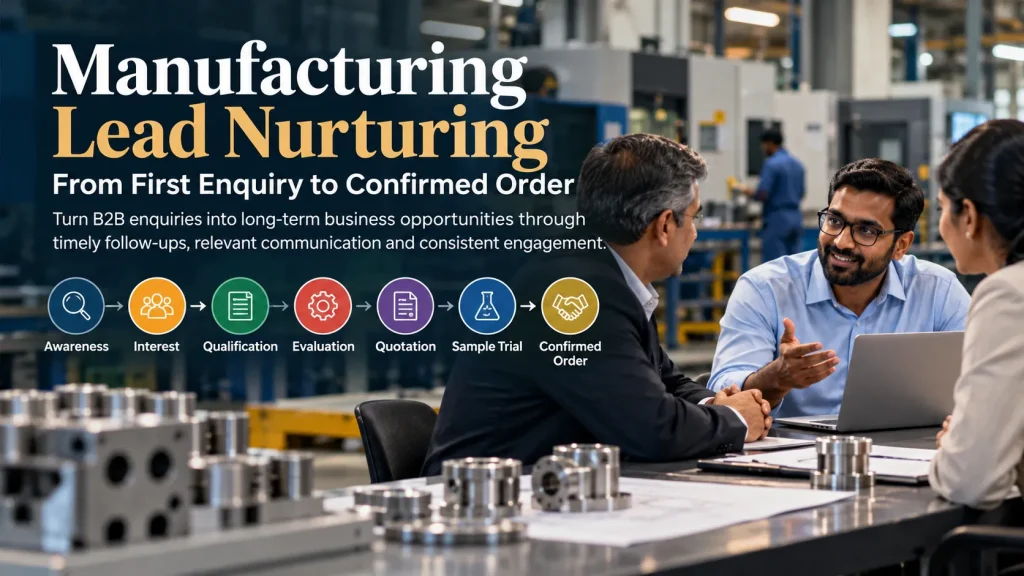
Manufacturing Lead Nurturing: From First Enquiry to Confirmed Order
Manufacturing lead nurturing helps turn B2B enquiries into long-term business opportunities through timely follow-ups, relevant communication, lead qualification, and consistent engagement at every stage of the sales cycle. Learn how to build buyer trust, keep prospects engaged, and move qualified leads closer to a confirmed order.
A manufacturer’s marketing usually gets plenty of attention at one single moment: generating the initial enquiry. What happens for the following weeks or months — while an RFQ sits with a procurement team, while samples get evaluated, while budget approval works through committee — is often left entirely to a sales team’s memory and goodwill. Given that manufacturing sales cycles routinely run 3 to 12 months, that gap is where a large share of otherwise-promising leads quietly go cold. This guide maps the full funnel, stage by stage, and what should actually be happening at each one.
The instinct to focus marketing effort almost entirely on lead generation is understandable — it’s the most visible, most easily measured part of the process. But in a business where the average deal takes the better part of a year to close, the mid-funnel stages aren’t a footnote to the strategy. They often account for more lost revenue than weak top-of-funnel targeting ever does, simply because so few manufacturers treat them as anything worth actively managing.
None of what follows requires an enterprise marketing automation platform or a large dedicated team — most of it is achievable with disciplined process and a handful of the right tools, applied consistently across every lead rather than reserved for the handful a sales rep happens to remember.
🔄 The Manufacturing B2B Funnel Stages
Manufacturing buyers move through a fairly predictable sequence, even if the exact terminology varies by company. Understanding each stage in detail — not just its name — is what makes it possible to design nurturing that actually fits where a buyer currently stands.
It’s worth noting that buyers don’t always move through these stages in a strict straight line. A procurement committee might loop back from quotation to qualification if a new stakeholder joins the evaluation, or a sample trial might restart after a specification change. Treating this as a rigid, one-directional pipeline is less useful than treating it as a set of concerns a buyer is working through — concerns that can resurface, which is exactly why consistent, stage-appropriate nurturing matters more than a single perfectly timed follow-up.
| Stage | What’s Happening | Buyer’s Primary Concern |
|---|---|---|
| Awareness | Buyer becomes aware your company exists as a potential supplier | “Who does this kind of work?” |
| Research | Buyer investigates your website, capabilities, certifications | “Are they actually capable of this?” |
| Enquiry | Buyer submits an RFQ or initial contact | “Will they respond seriously and quickly?” |
| Qualification | Vendor assessment — checking references, compliance, capacity | “Can we trust them with our supply chain?” |
| Quotation | Technical and commercial proposal submitted | “Is this priced and specified correctly?” |
| Sample/Trial | Quality approval against real specifications | “Do they actually deliver what they promised?” |
| Order | Production order placed, vendor onboarding completed | “Let’s formalize this relationship.” |
🌱 Nurturing Tactics by Stage
Each stage calls for a different kind of touchpoint — treating every stage with the same generic follow-up email is where most nurturing efforts fall flat.
Awareness → Research
Build Findability and Credibility
SEO, LinkedIn presence, and trade portal listings do the work here — the goal is simply being visible and credible enough to make the initial shortlist.
Enquiry → Qualification
Respond Fast, Respond Technically
A same-day, technically specific response — not a generic “thanks for reaching out” — is one of the strongest differentiators at this stage, since it signals genuine capability rather than a sales script.
Quotation
Follow Up With Value, Not Just Pressure
Instead of a bare “checking in,” share a relevant case study, a capability detail, or clarification that genuinely helps the buyer’s internal evaluation move forward.
Sample/Trial
Stay Visible Without Being Pushy
This stage often has the longest silence — a light-touch check-in cadence (not daily, not silent for months) keeps you top-of-mind without appearing anxious about the outcome.
Order & Beyond
Formalize and Expand
Once an order is placed, nurturing shifts toward relationship depth — understanding the buyer’s broader sourcing needs to identify expansion opportunities within the account.
🎯 A Simple Lead Scoring Framework
Given how long the full cycle runs, a basic scoring system helps sales and marketing agree on which leads deserve active follow-up versus which need to stay in a lighter nurturing sequence.
| Signal | Points |
|---|---|
| RFQ submitted with technical drawing/spec attached | +3 |
| Enquiry from a named procurement or engineering title | +2 |
| Mentions certifications, compliance, or audit requirements | +2 |
| References a specific project or forecasted volume | +2 |
| Generic “send quote” with no technical detail | -1 |
This is a starting framework, not a rigid formula — the specific signals and point weights worth tracking will differ by industry vertical and by what your own historical data shows actually predicts a closed order. The value of even a rough version, though, is immediate: it forces an explicit conversation about what “qualified” really means for your business, rather than leaving it as an unspoken assumption that sales and marketing may not even agree on.
A simple threshold — leads scoring 5+ get immediate, high-touch sales attention; lower scores enter an automated or lighter-touch nurturing sequence — prevents a small sales team from spreading itself too thin trying to chase every enquiry with equal intensity.
The exact point values matter less than the discipline of having any shared framework at all. We’ve seen sales and marketing teams disagree for months about which leads are “worth” pursuing, purely because they were using gut feeling rather than a shared, written scoring logic — a five-minute conversation to agree on point values usually resolves friction that otherwise persists indefinitely.
🚧 Common Nurturing Mistakes
🔇
Going silent after the quote
Sending a quotation and waiting passively for a reply, rather than proactively following up with value-add content.
📋
Treating every lead identically
Applying the same follow-up cadence to a high-intent RFQ and a vague price enquiry wastes effort on the wrong leads.
😬
Being too aggressive too early
Daily follow-ups during a multi-month qualification stage read as desperation, not diligence, to a professional buyer.
📉
No tracking beyond initial contact
Without a CRM or tracking system, leads in the middle stages of a long cycle are easily forgotten entirely.
What ties these four together is a mismatch between effort and stage — either too little (silence, forgotten leads) or too much (daily pressure) relative to what a buyer actually needs from you at that point in their internal process. Getting the cadence and tone right at each stage is less about a rigid script and more about staying genuinely useful without becoming a nuisance.
🛠️ Tools & Channels for Each Stage
Awareness
SEO + LinkedIn
Research
Website content
Qualification
Email + calls
Quotation
CRM + email sequences
Sample/Trial
Light-touch check-ins
A CRM — even a simple one — becomes essential once you’re managing more than a handful of leads across multi-month cycles simultaneously. Without it, tracking which of twenty active RFQs is waiting on you versus waiting on the buyer becomes genuinely unmanageable, and leads slip through purely due to lack of visibility, not lack of interest.
The specific tool matters far less than the habit of using one consistently. A basic spreadsheet, disciplined about being updated after every meaningful contact, will outperform an expensive CRM platform that nobody actually keeps current. Start with whatever your team will realistically maintain, and upgrade the tooling once the process itself is proven — not the other way around.
In a 3-to-12-month sales cycle, the marketing that happens after the first enquiry matters more than the marketing that generated it.
That’s a hard thing for many manufacturers to internalize, because lead generation is the visible, budgeted line item — the campaign, the trade show booth, the SEO retainer. Nurturing, by contrast, often has no dedicated budget line at all; it’s assumed to just happen as part of “sales doing their job.” Treating it instead as a designed process, with its own tools, cadence, and ownership, is usually the single highest-leverage change a manufacturer can make to their existing funnel without spending a rupee more on top-of-funnel lead generation.
❓ Frequently Asked Questions
How often should we follow up during the qualification stage?
A cadence of roughly every 2–3 weeks, with genuine value in each touchpoint rather than a bare check-in, tends to strike the right balance between staying visible and not appearing overly aggressive.
Do we need a CRM even as a small manufacturer?
Yes, once you’re tracking more than a handful of active leads at once — even a simple CRM prevents leads from being forgotten during long, multi-stage cycles.
What’s the biggest single reason manufacturing leads go cold?
Inconsistent or absent follow-up during the qualification and quotation stages — buyers interpret silence as disinterest or unreliability, even when it’s simply a tracking gap.
Should marketing or sales own the nurturing process?
Both, with a clear handoff — marketing typically owns awareness and research-stage nurturing through content and email, while sales owns direct qualification and quotation-stage follow-up, ideally coordinated through a shared CRM.
Can Brand Chanakya set up lead nurturing sequences for us?
Yes — email nurturing sequences, retargeting campaigns, and lead scoring frameworks tailored to manufacturing sales cycles are part of our B2B manufacturing marketing services.
How do we know if a lead has actually gone cold or is just slow?
A useful rule of thumb: if a lead hasn’t responded to two consecutive value-add follow-ups spaced a few weeks apart, move it to a lighter, longer-interval nurturing track rather than dropping it entirely — procurement timelines slip often, and a lead going quiet doesn’t always mean it’s dead.

Losing leads somewhere between enquiry and order?
We’ll map your current funnel and show you exactly where leads are going cold — and how to fix it.
📚 Related Reads
BANT Lead Qualification Framework: A Complete Guide to Qualifying Sales Leads
Lead Response Time: How to Respond Faster and Convert More Leads
OEM Lead Generation for Manufacturers: How to Attract Qualified OEM and Tier-1 Buyers
Lead Generation for Manufacturers in India: Proven B2B Strategies to Get Quality Leads