
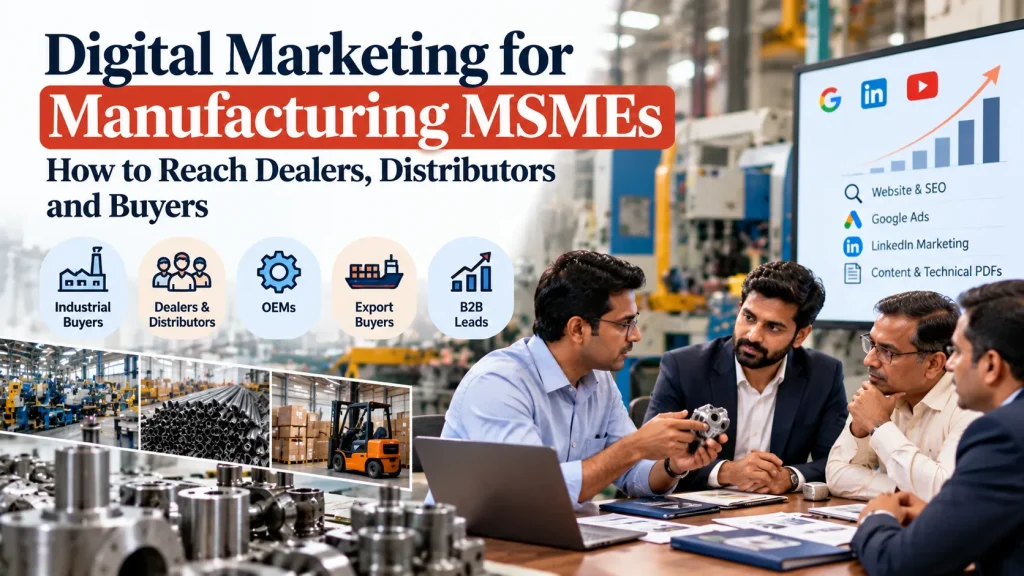
Digital Marketing for Manufacturing MSMEs: How to Reach Dealers, Distributors and Buyers
Industrial buyers rarely buy on impulse. They search for specifications, compare suppliers, ask for samples and quotations, and often involve several people before placing an order. Digital marketing for manufacturing MSMEs works best when the website behaves like a technical sales engineer, each audience (end buyers, dealers, OEMs and exporters) gets a clear path to inquire, and every inquiry is sorted quickly by type and fit.
This guide maps the industrial buyer and distributor journey, lists the technical content your website needs, and gives you an inquiry-qualification table for your sales desk.
Key takeaways
- Dealers, procurement teams, engineers and export buyers ask different questions. Give each a separate page and inquiry path.
- Detailed product pages with specifications, applications and order terms do more for industrial SEO than generic “about us” copy.
- Only publish certifications, test results and capacities you can document.
- Sort every inquiry by type first (dealer, buyer, OEM, export, service, spam), then by fit.
- Industrial sales cycles are long; record outcomes so you can see which channels produce purchase orders, not just inquiries.
01How industrial buying differs
A manufacturer of pumps, packaging material, fasteners or chemicals typically sells to more than one kind of customer, each with its own priorities:
- Direct industrial buyers: purchase managers want reliable supply, consistent quality, price and payment terms.
- Engineers and specifiers: want exact specifications, tolerances, material grades, drawings and application suitability.
- Dealers and distributors: want margins, territory, minimum order quantities, marketing support and after-sales backing.
- OEMs: want customisation capability, development timelines and capacity to scale.
- Export buyers: want documentation, packaging standards, lead times and trade terms.
A single homepage and a generic “contact us” form cannot serve all five. The digital marketing plan should start by deciding which of these groups matter most to your next stage of growth.
02The buyer and distributor journey
Most industrial purchases pass through similar stages. The content and contact options you need change at each one.
- Stage 1Identify needA new project, a failing supplier, or a product line to add.
- Stage 2ResearchSearches by product, grade, application or problem; reads specifications.
- Stage 3ShortlistCompares suppliers on capability, credibility and location.
- Stage 4EvaluateRequests quotations, samples, drawings, factory visits or references.
- Stage 5Order and repeatTrial order, then repeat supply or dealership agreement.
Text summary: identify need, research, shortlist, evaluate, then order and repeat. Dealers follow a similar path but evaluate commercial terms and support rather than technical fit alone.
Digital channels do most of their work in the research and shortlist stages, when you are not yet in the conversation. If your specifications, applications and credibility signals are not visible online at that point, you may never be shortlisted.
03Your website as a technical sales tool
Google’s guidance on creating helpful, people-first content is a good fit for manufacturers: write for the engineer or buyer who needs an answer, not for search engines. In practice, that means the pages below.
Technical website-content checklist
- One page per product family, and ideally per key grade or model, with a clear name buyers actually search for.
- Specification tables in HTML text (not only images), including sizes, materials, capacities and tolerances you can stand behind.
- Applications and industries served, with the conditions where the product is and is not suitable.
- Minimum order quantities, pack sizes, typical lead times and delivery regions, where you are able to share them.
- Downloadable datasheets or catalogues, with the key information also on the page itself. Google can index PDF files, but an HTML page is easier to read on mobile.
- Certifications and test reports only where you hold current, verifiable documents.
- Real photos or short videos of products, processes, quality checks and facilities.
- A request-for-quotation form that asks for product, quantity, application and delivery location.
- A separate dealer or distributor inquiry page.
- Clear contact routes: sales, dealer network, export and service.
Content ideas that serve technical buyers
Beyond product pages, a small library of practical content helps buyers at the research stage and gives your sales team something useful to share:
- Application notes: which product or grade suits which operating conditions, and why.
- Selection guides: how to choose between your own models by size, material or capacity.
- Installation and maintenance guidance: short videos or step-by-step pages that reduce service calls and show expertise.
- Answers to repeated questions: the questions your sales engineers answer every week, written up once.
Ask your production and quality teams to review technical pages before publishing. Their input keeps the content accurate and often surfaces details competitors leave out.
Accuracy is non-negotiable. Do not publish performance figures, capacities, compliance claims or export credentials you cannot document. Industrial buyers verify them, and an overstated claim can cost you the account and create legal risk.
04Reaching each audience online
Manufacturers can use digital marketing to reach industrial buyers, dealers, distributors, OEMs, and export buyers through targeted SEO, Google Ads, LinkedIn marketing, and relevant technical content tailored to each audience’s needs.
Buyers and engineers
Search ads on specific product and grade terms; SEO on product and application pages; technical videos showing the product in use.
Dealers and distributors
Dealer-recruitment pages, location-targeted social ads, B2B marketplace presence and WhatsApp catalogues for existing partners.
OEMs
Capability pages showing processes and customisation, LinkedIn content aimed at engineering and purchase roles, and direct outreach supported by case-neutral technical notes.
Export buyers
English (and, where relevant, other language) product pages, clear documentation information, and search or marketplace presence in target countries, only where you are genuinely export-ready.
Trade fairs remain important in many industrial categories. Digital channels make them more valuable: publish what you will show before the fair, capture visitor details with consent, and follow up afterwards with the relevant product pages.
05Recruiting dealers and distributors
Dealer recruitment is its own campaign, with its own page and questions. A prospective dealer wants to know whether the partnership will be profitable and well supported. Your dealer page should explain, as far as you are willing to share publicly:
- The product range and who buys it in their area
- Territories currently open
- What you expect from a dealer: showroom, storage, staff, investment or order commitments
- What you provide: training, marketing material, warranty support, lead sharing
- The next step after applying
The application form should ask for firm name, city, current product lines, years in trade and storage or showroom capacity. These fields help your team separate serious applicants from casual inquiries before the first call.
Illustrative example
A hypothetical maker of agricultural sprayers wants dealers in two new districts. Instead of running generic “dealership opportunity” ads across the state, it targets farm-equipment retailers in those districts, sends them to a page listing open territories and support, and asks about existing product lines on the form. Applications fall in number but rise in relevance, because retailers outside the target districts or trade no longer apply. This is an invented scenario to show the method.
06Inquiry-qualification table
Give this to whoever handles incoming inquiries. Sorting by type first makes the next step obvious.
| Inquiry type | Typical signals | Questions to ask | Next step if it fits |
|---|---|---|---|
| Direct buyer RFQ | Company name, product, quantity | Application, specification, quantity, delivery location, timeline | Quotation or sample; assign sales owner |
| Dealer or distributor | Trading firm, mentions territory or margins | Location, current lines, capacity, expected volumes | Dealer call; share terms; territory check |
| OEM or custom development | Drawings, custom sizes, annual volumes | Specifications, volumes, development timeline, decision makers | Technical review; feasibility response |
| Export inquiry | Overseas company or port mentioned | Country, product, quantity, required documentation, trade terms | Route to export desk; confirm capability honestly |
| Service or spares | Existing product, fault or part number | Model, purchase source, issue | Route to service team |
| Not a lead | Job seekers, students, vendors selling to you | None needed | Polite reply or redirect; record source to refine targeting |
Record the inquiry type against its source. If one campaign produces mostly “not a lead” inquiries, its keywords or targeting need tightening.
07Measuring what matters
Useful measures for manufacturers go beyond clicks and form fills:
- Inquiries by type and source
- RFQs and samples sent
- Dealer applications and dealers onboarded
- Purchase orders and repeat orders, traced back to source where possible
Because orders close weeks or months after the first inquiry, Google Ads supports offline conversion imports, which link sales that happen offline back to the original ad click or call. Even without this, a simple habit of recording “how did you find us?” and the first source in your CRM or sheet helps.
For MSMEs building this system from scratch, Brand Chanakya’s digital marketing services for SMEs and MSMEs include manufacturing as a focus area, covering B2B inquiry generation and marketplace presence.
08Common mistakes and how to avoid them
Avoid common digital marketing mistakes by keeping product specifications accurate, creating separate inquiry forms for buyers and dealers, and setting realistic expectations for results. Manufacturing MSMEs should track qualified leads, quotations, and purchase orders to identify which marketing channels contribute to business growth.
Specifications only in image catalogues
Text inside images is hard to search and hard to read on phones. Put key specifications in HTML tables as well.
One form for every audience
Dealers, buyers and job seekers all land in the same inbox. Separate forms and pages make routing and qualification faster.
Overstating capability
Claiming certifications, capacities or export experience you do not have damages trust quickly. Publish only what you can prove.
Judging channels within weeks
A dealer found this month may place orders for years. Review channels over periods that match your sales cycle.
09The bottom line
Digital marketing for manufacturing MSMEs is about being findable and credible during the research and shortlist stages, then handling inquiries by type. Build detailed, accurate product pages, give dealers and buyers separate paths, and record which sources lead to orders. That foundation lets you add search ads, marketplaces or dealer campaigns with confidence.
10Frequently asked questions
Do industrial buyers really search online?
Many do research online, especially for specifications, alternative suppliers and new applications, even if the final order is placed by phone or through a purchase department. Your own inquiry records are the best evidence for your category.
Should we list prices on our website?
For custom or volume-dependent products, exact prices are often impractical. Showing minimum order quantities, price-influencing factors, or indicative ranges can still filter inquiries. Decide based on how competitors and your buyers operate.
Are B2B marketplaces enough on their own?
Marketplaces can bring steady inquiries, but you do not control the platform, and buyers can compare you with many suppliers at once. A strong website gives you an independent channel and a place to send marketplace buyers for more detail.
Is LinkedIn useful for manufacturers?
It can be, particularly for reaching engineering, procurement and management roles at OEMs and larger buyers. Consistent, specific content usually works better than occasional promotional posts.
How technical should our content be?
As technical as your buyers need. Engineers want exact specifications; owners of dealer businesses want commercial clarity. Separate pages let you serve both without confusing either.
Building your industrial marketing system?
Tell us what you manufacture, who buys it, and whether you want more direct buyers, dealers, or both. Ask for a plan built around your inquiry types.
📚 You Might Also Like
Digital Marketing Services for SMEs & MSMEs
Qualified B2B Lead Generation for MSMEs: A Practical Guide
How to Choose a Digital Marketing Agency for Your SME or MSME
Digital Marketing Checklist for MSMEs: 7 Things to Set Up Before Running Ads