
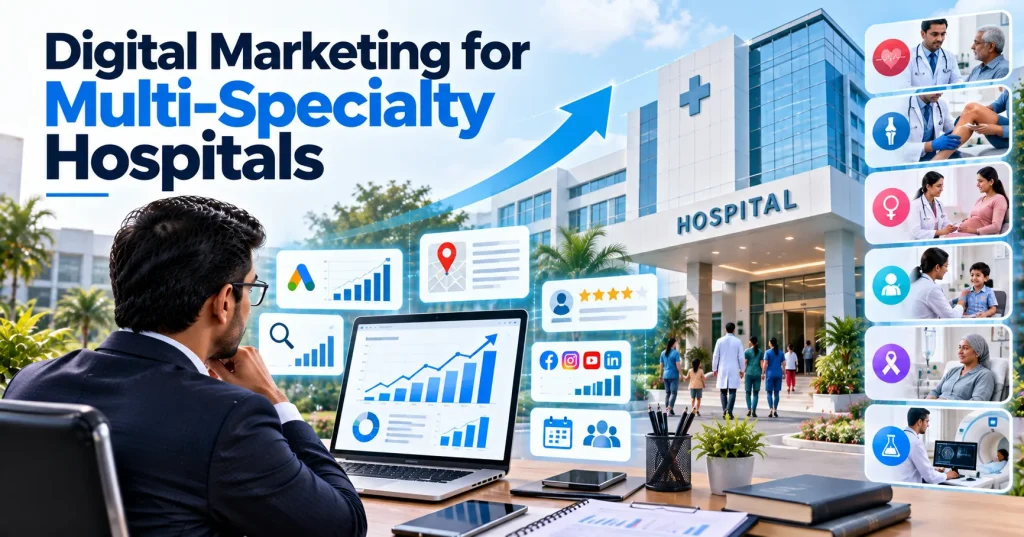
Multi-specialty hospitals face a unique marketing challenge: you’re not selling one service, you’re selling 15–20 different specialties to different patient segments with different needs.
A person searching for “knee replacement surgery” has a very different journey than someone looking for “pregnancy care packages.” Your digital marketing strategy must account for these differences while maintaining a unified hospital brand.
Unique Challenges of Multi-Specialty Hospitals
Before diving into tactics, let’s understand what makes multi-specialty hospital marketing different:
Key Marketing Challenges
💡 The Solution: Treat each specialty as a mini-business with its own marketing strategy, while maintaining umbrella brand campaigns that establish hospital credibility.
Digital Marketing Channels That Work
Hospital SEO
Rank for treatment searches, doctor names, and “best hospital in [city]” queries.
✓ Department-wise landing pages
✓ Doctor profile optimization
✓ Treatment / procedure pages
✓ Health blog content
✓ Local citations & backlinks
Google Ads (Search)
Capture high-intent patients actively searching for treatments.
✓ Department-specific campaigns
✓ Treatment / surgery keywords
✓ Competitor brand bidding
✓ Location targeting (50km radius)
✓ Call-only campaigns for emergency
Google Business Profile
Dominate “near me” searches and Google Maps visibility.
✓ Complete profile with all services
✓ Photo & video updates
✓ Review generation system
✓ Q&A section management
✓ Google Posts for offers
Social Media Marketing
Build brand awareness and trust through engaging content.
✓ Doctor introduction reels
✓ Patient success stories
✓ Health awareness content
✓ Behind-the-scenes tours
✓ Live Q&A with specialists
Content Marketing
Establish expertise and capture informational searches.
✓ Condition / disease guides
✓ Treatment comparison articles
✓ Cost & insurance explainers
✓ Video testimonials
✓ Downloadable health resources
Reputation Management
Build and maintain a 4.5+ star rating across platforms.
✓ Automated review requests
✓ Negative review response SOP
✓ Practo / Justdial optimization
✓ Video testimonial collection
✓ Social proof integration
Marketing Each Specialty Department
Each specialty has different patient psychology, search behaviour, and decision timelines. Here’s a strategic framework:
| Specialty | Primary Channel | Key Keywords | Decision Time |
| Cardiology | Google Ads + SEO | angioplasty, heart surgery, cardiologist near me | 1–4 weeks |
| Orthopedics | Google Ads + GBP | knee replacement, joint pain, ortho specialist | 2–8 weeks |
| Gynecology / IVF | Social Media + SEO | IVF treatment, pregnancy care, gynecologist | 4–12 weeks |
| Oncology | SEO + Content | cancer treatment, chemotherapy, oncologist | 1–4 weeks |
| Neurology | Google Ads + SEO | brain surgery, spine specialist, neurologist | 2–6 weeks |
| Pediatrics | Social Media + GBP | child specialist, pediatrician, vaccination | Same day – 1 week |
| Emergency | GBP + Google Ads | 24 hour hospital, emergency near me, trauma | Immediate |
| Diagnostics | Local SEO + GBP | MRI scan, blood test, health checkup packages | Same day – 3 days |
🎯 High-Margin Focus: Allocate 50–60% of your ad budget to high-margin departments like Cardiac Surgery, Joint Replacement, IVF, and Oncology. These have longer patient lifetime value and justify higher acquisition costs.
Patient Acquisition Funnel
Multi-Specialty Hospital Patient Journey
Budget Planning & Allocation
Starter
₹80K–1.2L /month
✓ SEO (3–4 departments)
✓ Google Ads (₹30–40K spend)
✓ Social Media (12 posts)
✓ GBP Optimization
✓ Monthly Reporting
RECOMMENDED
Growth
₹1.5–2.5L /month
✓ Full SEO (all departments)
✓ Google Ads (₹60–80K spend)
✓ Meta Ads (₹20–30K spend)
✓ Social Media (20 posts + reels)
✓ Content Marketing (8 articles)
✓ Reputation Management
✓ Weekly Reporting
Enterprise
₹3–5L+ /month
✓ Everything in Growth
✓ YouTube Channel Management
✓ Doctor Personal Branding
✓ PR & Media Coverage
✓ Marketing Automation
✓ Dedicated Account Team
Budget Allocation by Channel (Recommended)
| Channel | % of Budget | Purpose |
| Google Ads (Search) | 35–40% | Immediate patient acquisition |
| SEO & Content | 25–30% | Long-term organic growth |
| Social Media & Meta Ads | 15–20% | Brand awareness & retargeting |
| Reputation & GBP | 10–15% | Trust building & local visibility |
| Creative & Video | 5–10% | Content production |
KPIs & Metrics to Track
Cost Per Lead (CPL)
Target: ₹150–400 depending on specialty
Lead-to-Appointment Rate
Target: 20–30% of leads book appointments
Appointment Show Rate
Target: 70–80% of booked appointments
Google Business Profile Views
Target: 10K+ monthly views
Review Rating
Target: 4.5+ stars on Google
Organic Traffic Growth
Target: 15–20% MoM growth
Website Conversion Rate
Target: 3–5% visitors to leads
Revenue Attribution
Target: 5–10X ROI on marketing spend
90-Day Action Plan
Month 1: Foundation
Audit existing digital presence (website, GBP, social media)
Set up tracking (Google Analytics, call tracking, form tracking)
Optimize Google Business Profile completely
Launch Google Ads campaigns for top 3 departments
Start review generation system
Month 2: Scale
Create landing pages for all major departments
Expand Google Ads to more specialties
Launch social media content calendar
Publish 8–10 SEO-optimized blog articles
Set up retargeting campaigns
Month 3: Optimize
Analyze performance data and optimize campaigns
Double down on top-performing channels
Launch doctor personal branding initiatives
Create video testimonials and department tours
Implement marketing automation for lead nurturing
Ready to Fill Your Hospital’s OPD Slots?
Get a customized digital marketing strategy for your multi-specialty hospital.
Frequently Asked Questions
How much should a multi-specialty hospital spend on digital marketing?
Multi-specialty hospitals typically invest ₹1–5 lakhs per month on digital marketing including agency fees and ad spend. Smaller hospitals can start with ₹80,000–1.2L/month, while larger chains may spend ₹3–5L+ for comprehensive campaigns across all departments.
Which digital marketing channels work best for hospitals?
Google Ads (Search) works best for immediate patient acquisition. SEO provides sustainable long-term traffic. Google Business Profile is essential for local visibility. Social media builds brand awareness. For multi-specialty hospitals, a combination of all channels with 40% budget on Google Ads delivers best results.
How long does it take for hospital SEO to show results?
Hospital SEO typically shows initial improvements in 2–3 months with significant traffic growth in 4–6 months. Competitive keywords like “best hospital in [city]” may take 8–12 months. Meanwhile, Google Ads can generate patient enquiries within days of campaign launch.
Should each department have separate marketing campaigns?
Yes, each specialty department benefits from targeted campaigns. Create separate landing pages and ad groups for Cardiology, Ortho, Gynecology, etc. This improves ad relevance, quality scores, and conversion rates. Allocate higher budgets to high-margin departments like IVF, Oncology, and Joint Replacement.
How do you track ROI from hospital digital marketing?
Track these metrics: Cost per lead (target ₹150–400), lead-to-appointment conversion rate (target 20–30%), appointment-to-patient conversion (target 60–70%), and revenue per patient. Use call tracking, form submissions, and CRM integration to attribute patients to specific channels and campaigns.

Brand Chanakya
Brand Chanakya is a performance-driven digital marketing agency specializing in healthcare marketing and patient acquisition. Based in Udaipur, serving hospitals and clinics across India.
📚 You Might Also Like
Web Development
Business Website Development: The Complete 2026 Guide
Why your hospital’s website is infrastructure, not a brochure — and what a conversion-ready site needs.
Free Audit
AI Visibility Audit: Why Every Business Needs One in 2026
Patients are already asking ChatGPT “best hospital near me” — find out if your hospital gets mentioned.
Pricing Guide
How Much Does Digital Marketing for Schools Cost in India?
Another institution-heavy vertical — see how budget tiers compare across sectors like education.
Budget Strategy
Zero-Click Search Is Here: What It Means for Your Marketing Budget
Why “best hospital in [city]” searches increasingly never lead to a click — and how to rebalance spend.